Here is the honest starting point for every Mt Fuji day trip. The mountain is shy. On a clear winter morning it fills half the sky and looks close enough to touch. On a humid summer afternoon, you can stand on the shore of Lake Kawaguchi, in exactly the right spot, and see nothing but grey.
So a good Fuji day is really two decisions. First, which side of the mountain do you visit? Second, is today actually a day when Fuji is likely to show itself? This guide walks through the three main choices, Kawaguchiko and the Chureito Pagoda on the north side, Fujiyoshida town at the mountain's foot, and Hakone on the eastern side, with the real fares and journey times for each.
Do this before you book anything. Dedicated Mt Fuji visibility forecasts score the next few days by viewpoint area, and live cameras around the Fuji Five Lakes show the mountain (or the cloud where it should be) in real time. Check the evening before, then again over breakfast.
A few patterns worth knowing:
Mornings beat afternoons. Cloud tends to build around the summit as the day warms up. An early start is the single best thing you can do for your chances.
Winter is the reliable season. Cold, dry air from December to February gives the clearest views of the year. Late June to September is the worst stretch, when the mountain can hide for days at a time.
Keep a spare day if you can. If your Tokyo stay has any flexibility, hold the Fuji trip for the clearest morning rather than fixing it to one date weeks ahead.
If the forecast is hopeless, swap the day. Tokyo will happily fill it, and Fuji will still be there tomorrow.
Lake Kawaguchi (Kawaguchiko) is the most developed of the Fuji Five Lakes and the easiest to enjoy without a plan. The railway station and bus terminal sit together at Kawaguchiko Station, sightseeing buses loop the lake from there, and the northern shore gives you the postcard composition: water in front, Fuji behind.
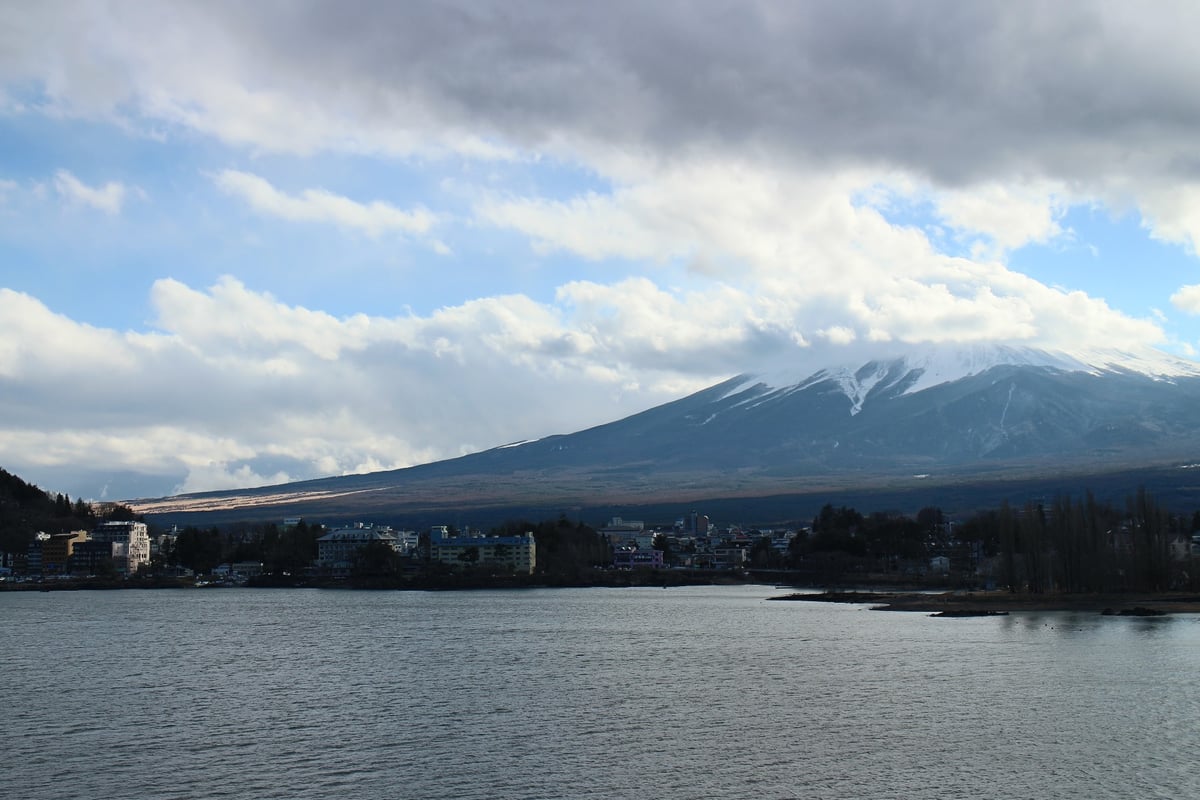
Fuji across Lake Kawaguchi in winter, when the air is clearest. Photo: Suicasmo, CC BY-SA 4.0
The north shore is where most people aim. Oishi Park, at the far end of the lake, has flower beds laid out as a foreground for the mountain, lavender in early summer and red kochia bushes in autumn. The Mt Fuji Panoramic Ropeway climbs Mt Tenjo on the eastern shore for a higher angle, and the sightseeing buses (the Red Line runs the north shore, the Green Line the quieter western lakes) mean you rarely wait long between stops.
Kawaguchiko suits a loose day. Arrive mid morning, walk a stretch of the shore, take the ropeway if the summit is clear, and eat houtou for lunch. Houtou is the local noodle soup, thick flat noodles in a pumpkin and miso broth, served in a heavy iron pot. It tastes even better when you have been standing in cold lakeside wind.
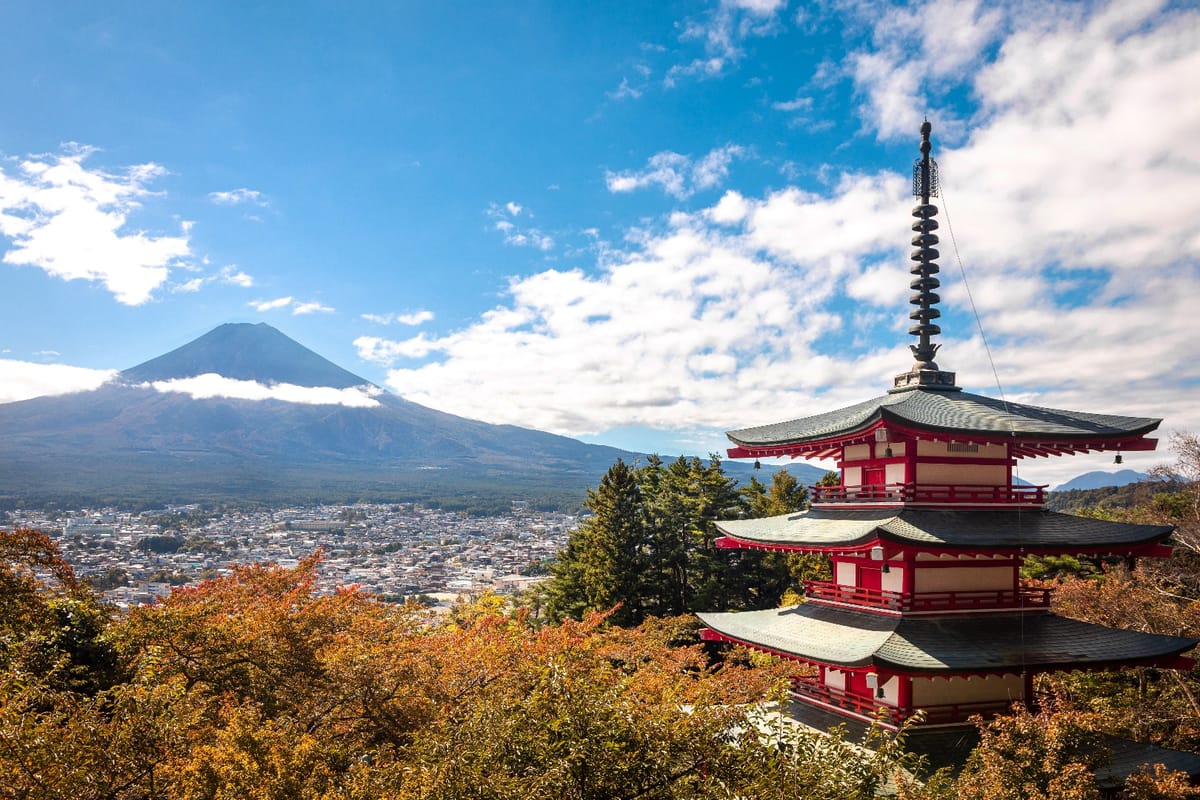
The image on every Japan calendar, a vermilion five-storey pagoda with Fuji lined up behind it, is taken from Arakurayama Sengen Park in Fujiyoshida, the town at the mountain's northern foot. The pagoda is the Chureito, a war memorial built in 1962, and the viewing deck sits above Arakura Fuji Sengen Shrine.
The catch is the climb. From Shimoyoshida Station on the Fujikyu Railway, the city's official walking route takes about 25 minutes to the observation deck, and the last stretch is the Sakuya-hime Staircase, 398 steps. It is a proper climb, not a stroll, but the deck is open around the clock and entry is free. Go early and you may share it with a handful of photographers instead of a crowd. Mid April brings cherry blossom around the pagoda, late October and November bring red maples, and both seasons are busy by 10am.
Fujiyoshida itself deserves an hour. Honcho Street, the shopping street running down from the station area, points straight at the mountain, so Fuji swells at the end of the road between the shop signs and power lines. It is the view locals actually live with, and it photographs beautifully.
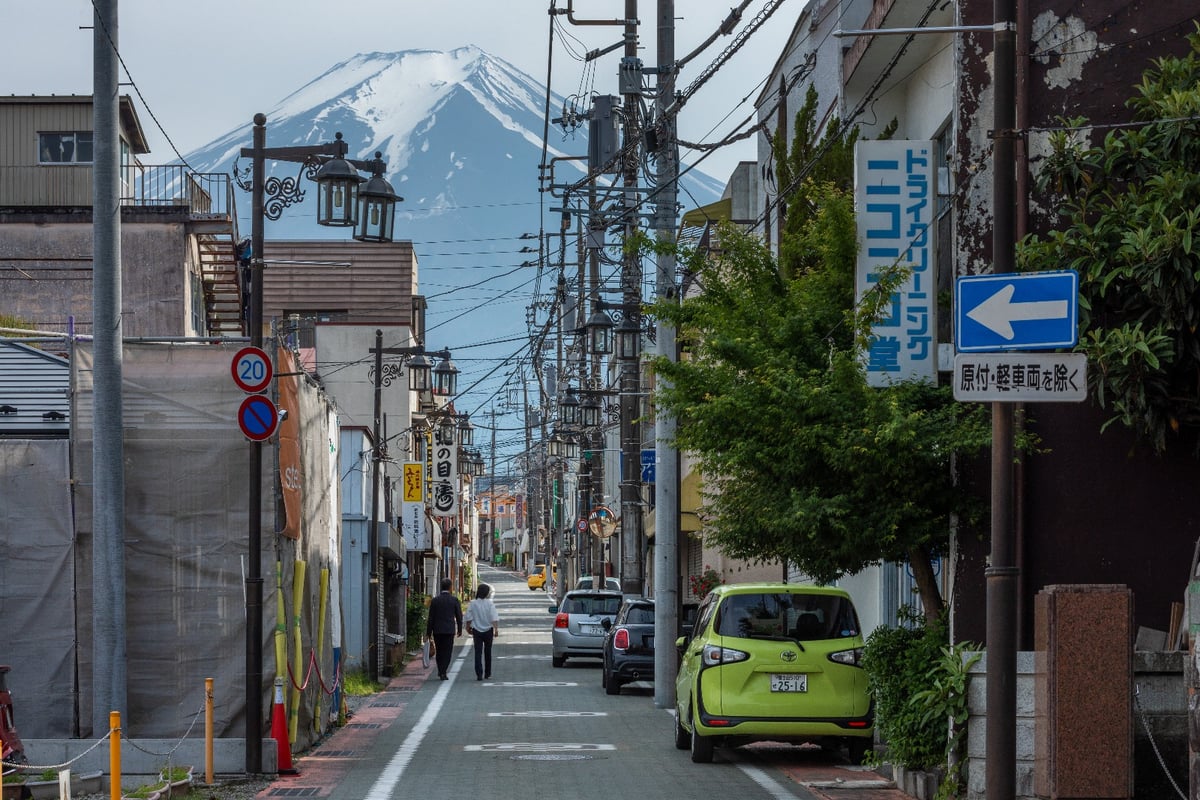
Honcho Street in Fujiyoshida, where the mountain waits at the end of the road. Photo: Ximonic (Simo Räsänen), CC BY-SA 4.0
Practical point: Chureito and Kawaguchiko combine easily in one day. Shimoyoshida is on the same Fujikyu line, a few minutes and a small local fare from Kawaguchiko Station. Do the pagoda first, while your legs and the light are fresh, then drift down to the lake.
Hakone, over on the eastern side, is a different proposition. It is a mountain resort area of hot springs, a switchback railway, a ropeway over a steaming volcanic valley at Owakudani, and a lake, Ashinoko, crossed by sightseeing ships. On a clear day Fuji appears across the lake from Moto-Hakone and the Hakone Shrine lakeside torii, and from the ropeway, and those are genuinely fine views.
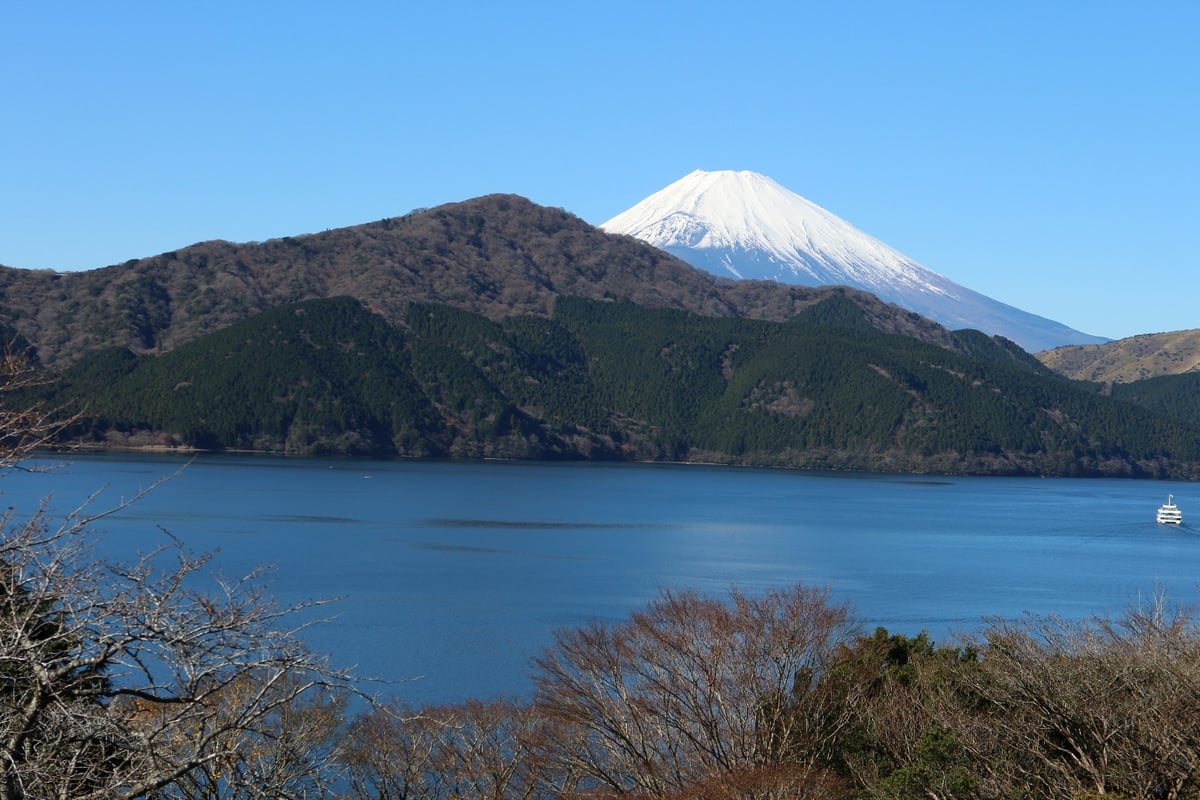
Fuji across Lake Ashi. Hakone sits in the mountains, so clear views are a gift, not a given. Photo: Suicasmo, CC BY-SA 4.0
But be honest with yourself about the odds. Hakone's weather is its own. The area sits high, catches cloud easily, and Fuji is further away and less dominant than from the Five Lakes. If seeing Fuji is the whole point of the day, Hakone is the gamble of the three. If you want a varied day of trains, boats and hot springs and would treat a Fuji sighting as a bonus, Hakone is the richest day of the lot. Our day trips comparison (https://yonihon.com/travel-guide/best-day-trips-from-tokyo/) sets Hakone against Kamakura, Nikko and Yokohama in full.
All prices below are one way for an adult, checked on 23 November 2026.
Direct buses leave Busta Shinjuku, the bus terminal above Shinjuku Station's south side, for Kawaguchiko Station all day. Fujikyu Bus puts the journey at about 1 hour 45 minutes and the fare at ¥2,200, or ¥2,000 if you book and pay online. Buses also run from Tokyo Station. Book a seat, especially the return: on fine weekends the afternoon buses back to Tokyo fill up, and motorway traffic can stretch the trip well past two hours.
This JR and Fujikyu limited express runs straight from Shinjuku to Kawaguchiko, stopping at Shimoyoshida on the way, which makes it the tidy option for the Chureito Pagoda. Fastest journey time is 1 hour 53 minutes, the fare is ¥4,200 (¥2,580 basic fare plus ¥1,620 limited express charge), and every seat is reserved. There are only a handful of round trips a day, so book ahead. Slower but cheaper rail routings change at Otsuki onto the Fujikyu Railway, whose local trains cost ¥1,170 from Otsuki to Kawaguchiko.
This one catches people out. The Japan Rail Pass is a JR product, and the line from Otsuki to Kawaguchiko belongs to the Fujikyu Railway, not JR. So the pass covers you only as far as Otsuki. From Otsuki you pay the Fujikyu fare yourself, ¥1,170 on a local train, plus a limited express supplement if you stay on a through train like the Fuji Excursion. It is a small amount, but have an IC card or cash ready. Our full explainer on passes and IC cards is in Getting Around Japan (https://yonihon.com/travel-guide/getting-around-japan-trains-ic-cards-jr-pass/).
Day tours from Shinjuku and other central meeting points bundle the driving, the pagoda, Oshino Hakkai village and the lake into one long day, usually for less than the return train fare per person. Prices vary by operator and date, so check the listing for your day. Tours suit you if you dislike early starts at unfamiliar stations or want several stops without watching a timetable. The trade-offs are fixed timing at each viewpoint and the same motorway traffic risk as the bus on the way home.
Odakyu's Romancecar limited express runs from Shinjuku to Hakone-Yumoto in about 80 to 85 minutes for ¥2,470 (¥1,270 fare plus ¥1,200 limited express charge, all seats reserved). Ordinary Odakyu trains cost just the ¥1,270 fare and take longer. The Hakone Freepass, ¥7,100 for two days from Shinjuku at the current price, covers the return Odakyu trip and the trains, cable car, ropeway, boats and buses of the Hakone loop, but not the Romancecar supplement, which is charged per ride on top.
Plenty of visitors imagine a day trip means standing on the mountain itself. The Fuji Subaru Line climbs from the Kawaguchiko side to the Yoshida Trail 5th Station, about 2,300 metres up, and buses from Kawaguchiko Station take roughly 50 minutes when they run, at ¥2,000 one way or ¥3,400 return.
In summer, outside the climbing season crowds, it is an interesting add-on. In winter, treat it as a bonus rather than a plan. Snow closes the upper Subaru Line for long stretches (last winter the road reached the 5th Station only until mid January, then not again until April), buses turn back partway or stop altogether, and most of the 5th Station shops and restaurants shut for the season. The climbing trails themselves are closed outside the official season, which runs from early July to mid September. A winter Fuji day is better spent at the lakes and viewpoints below, where the mountain looks its best anyway, wearing its snow.
One last piece of advice. However you go, start earlier than feels reasonable. The first buses and trains out of Tokyo reach the lakes while the air is still cold and clear, and that, more than any viewpoint choice, is what decides whether you see the mountain at all.
8 minutes · November 23, 2026
10 minutes · November 23, 2026
9 minutes · November 23, 2026
