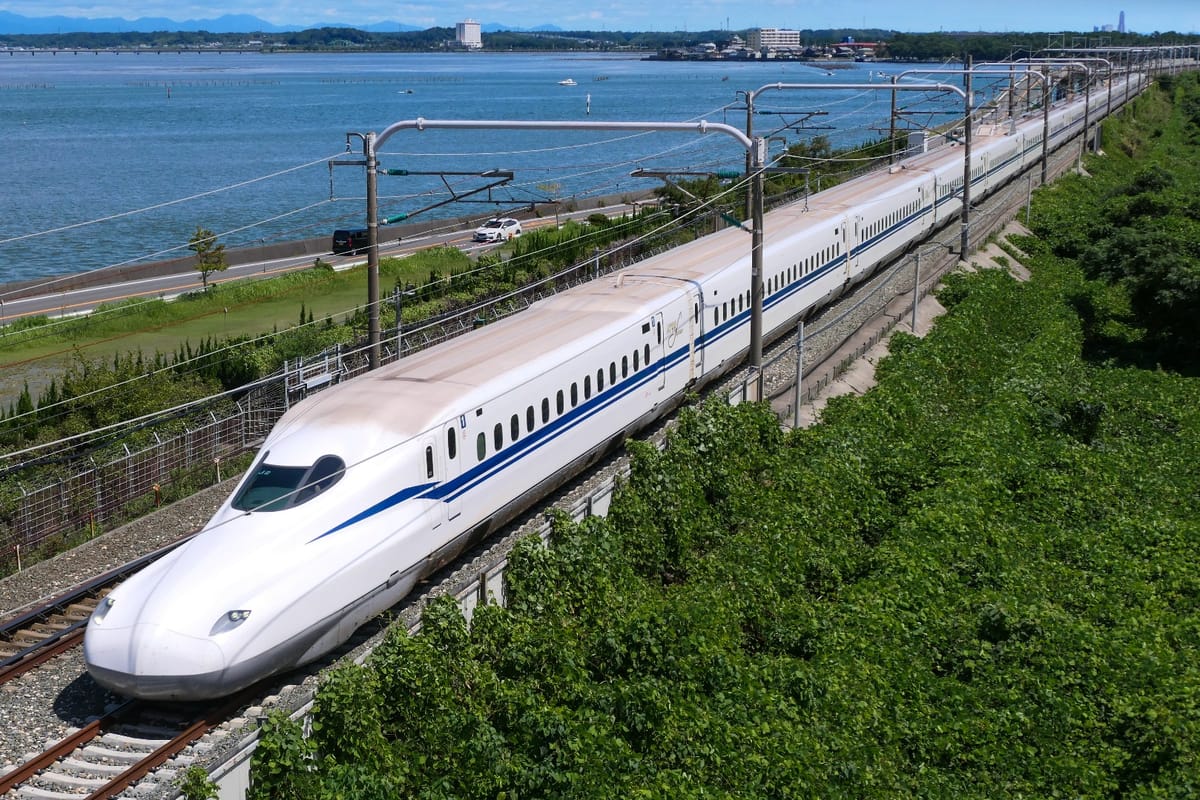
Japan runs two transport systems that happen to share the same tracks. The first is city travel: dense, cheap, and measured in minutes. The second is intercity travel: the Shinkansen network, where a single journey can cost more than a night in a hotel. They work on different logic and are paid for in different ways, and most first-time confusion comes from mixing them up.
This guide keeps them separate. It explains what an IC card does and where it stops working, how Shinkansen tickets and seat reservations fit together, what the big suitcase rule means in practice, and whether the Japan Rail Pass still earns its price, with worked examples using real fares checked in November 2026.
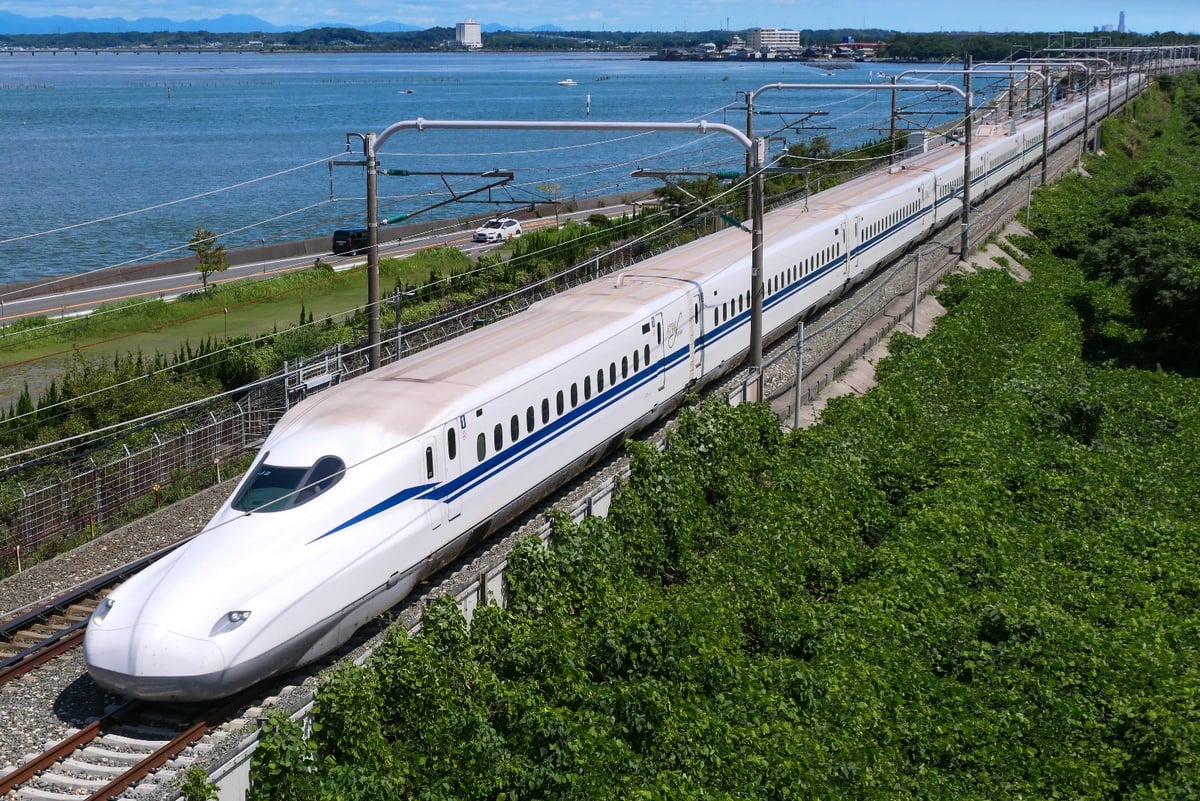
An N700S series Shinkansen. The Tokaido line it runs on carries the Tokyo to Kyoto route most visitors take first. Photo: MaedaAkihiko, CC BY-SA 4.0
City travel: many companies, one card
A big Japanese city does not have one railway. Tokyo has JR East, two subway operators and a crowd of private railways such as Keio, Odakyu and Tokyu, each with its own lines and stations. Kyoto and Osaka have their own tangles. On a map this looks chaotic. At the ticket gate it mostly is not, because almost every operator accepts the same payment method: the IC card, covered in the next section.
Transfers are the part to plan. Changing lines within one company usually means a short walk inside the same station. Changing companies can mean leaving one set of gates and entering another, sometimes in a different part of a very large station. Navigation apps give platform numbers and transfer times; follow them rather than the wall map on your first days.
Signs help more than you might expect. Departure boards run in Japanese and English, lines are colour coded, and stations carry a number as well as a name (Shinjuku is JY17 on the Yamanote line). Platform floor markings show where each carriage will stop. If you can read the next two station names on the board above the door, you are doing it right.
City fares are distance based and modest: most hops across central Tokyo cost between ¥150 and ¥220. There is no daily cap, and no visitor day pass worth hunting for in most cases.
IC cards: the tap that runs the country
An IC card is a rechargeable smart card. Load yen onto it, tap the reader at the entry gate, tap again at the exit, and the fare is deducted. The brands are regional (Suica in Tokyo, ICOCA in Osaka and Kyoto, Pasmo alongside Suica in Tokyo) but work on each other's networks, so one card bought in Tokyo taps you through gates in Kyoto, Osaka and Fukuoka. The balance also pays in convenience stores, vending machines, coin lockers and many taxis and buses.
Three limits matter, and all three surprise people.
A card cannot carry you between regions on local trains. Your journey must start and finish inside one IC area. Tap in at Tokyo and ride local trains towards Nagoya, and the card fails at the boundary. Intercity journeys belong on proper tickets, not on a card balance.
A card does not pay for the Shinkansen. Tapping a Suica at a Shinkansen gate without a ticket behind it gets you nowhere. What you can do is register the card with a booking service (smartEX for the Tokaido and Sanyo lines, JR East's Shinkansen e-ticket service for its lines) so the gate reads your card and the fare is charged to your bank card. The card becomes the key, not the wallet.
The balance caps at ¥20,000. Enough for weeks of city travel, another reason intercity fares do not belong on it.
Physical card or phone?
Both work at the same gates. The differences are in how you get one and how you top up.
A physical card is topped up with cash at station machines and convenience stores. The standard Suica carries a ¥500 deposit, refundable on return, and ordinary cards went back on general sale in March 2025 after the chip shortage years, so the airport scramble in older guidebooks is out of date. The visitor version, the Welcome Suica, skips the deposit: it is sold at JR East travel service centres and dedicated machines at Narita, Haneda and major Tokyo stations, with a starting balance of ¥1,000 to ¥10,000. Two catches. It expires 28 days after the day you buy it, counting that day, and nothing on it is ever refunded, so top up lightly in your final week.
On a phone, Mobile Suica lives in Apple Wallet on any iPhone, whatever country it was bought in, and tops up by Apple Pay in seconds. JR East's free Welcome Suica Mobile app for visitors is also iPhone only, valid for 180 days, and can be set up before you land. Android is the awkward case: mobile IC cards need FeliCa hardware that, in practice, means a phone sold in Japan. If your Android phone was bought elsewhere, plan on a physical card.
So, does mobile IC depend on your phone? Yes, completely. iPhone, any origin: yes. Android bought outside Japan: almost certainly no.
Intercity travel: the Shinkansen, in two parts
The Shinkansen network is run by separate JR companies (JR Central runs Tokyo to Osaka, JR East runs north from Tokyo, JR West and JR Kyushu continue west), but to a passenger it behaves as one system with one rulebook. Trains are graded by stopping pattern: on the Tokyo to Osaka line, Nozomi stops least and runs fastest, Hikari stops a few more times, and Kodama stops everywhere. Names change by line (Hayabusa is the fastest in the north), but the name always tells you how many stops, not how nice the train is.
A Shinkansen fare has two parts. The base fare pays for the distance, like an ordinary train ticket. The limited express charge pays for the fast train and, if you choose it, your reserved seat. Buy at a station and you may receive two paper tickets for one journey; both go into the gate together. Book online and the two parts arrive as one QR code or one card registration.
Seat reservations deserve a decision, not a default. Non-reserved cars cost a little less and suit quiet midweek travel: walk in, take any free seat. Reserved cars guarantee a seat together, a window if you book early, and space rules for big luggage (below). Reservations open one month ahead, at 10:00 Japan time, through the official channels: smartEX for Tokyo, Kyoto, Osaka, Hiroshima and Fukuoka; JR East Train Reservation for the north; station machines and ticket offices for everything. At busy periods (New Year, Golden Week, Obon) some trains, including all Nozomi services over the 2026 to 2027 New Year, run as all-reserved, and the non-reserved option disappears.
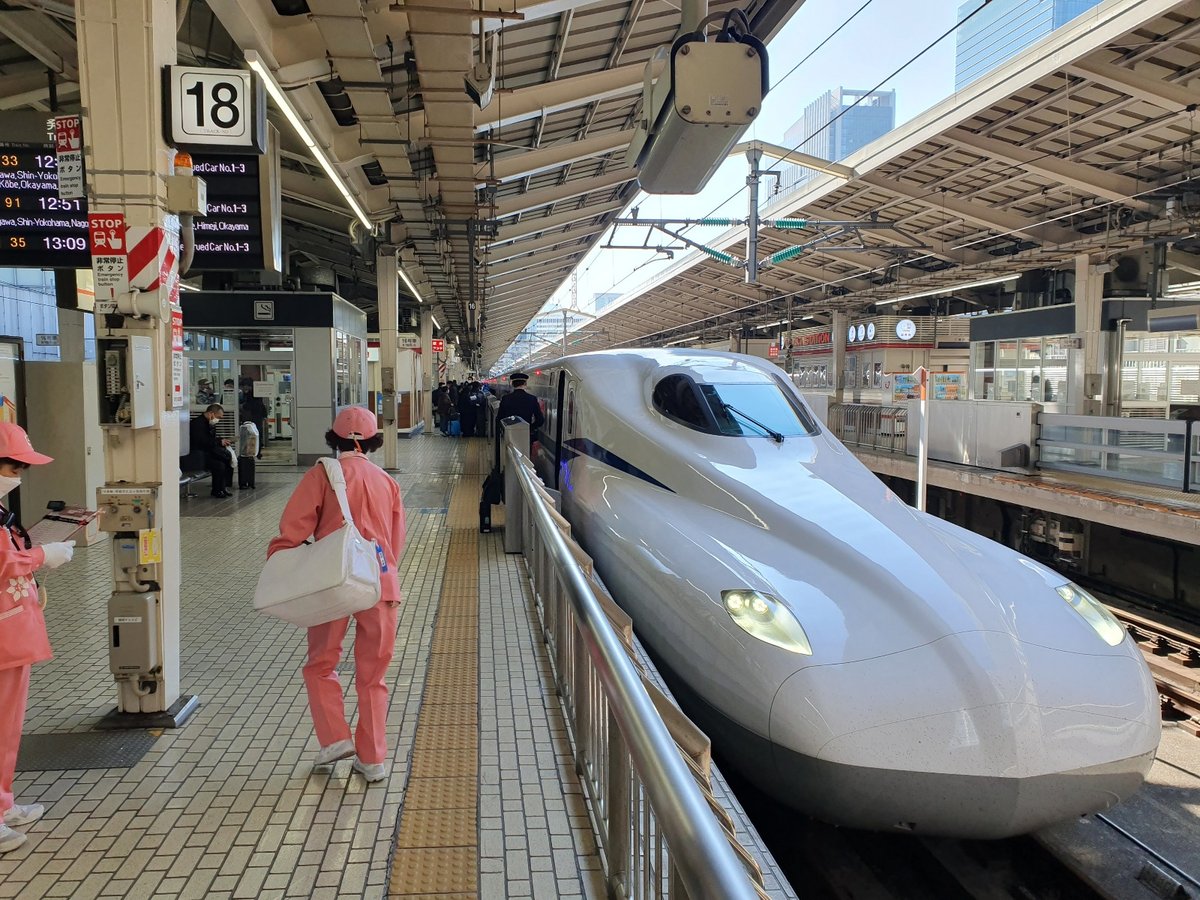
A Shinkansen platform at Tokyo Station. Your ticket names a car number, and the platform floor tells you where that car will stop. Photo: Syced, CC0
The suitcase rule, measured in centimetres
On the Tokaido, Sanyo, Kyushu and Nishi-Kyushu Shinkansen (the Tokyo to Fukuoka corridor), luggage is sorted by one measurement: the total of its length, width and height, wheels and handles included.
Up to 160 cm in total: no action needed. Overhead racks or the space by your feet handle it.
Over 160 cm, up to 250 cm: reserve a seat with an oversized baggage area when you book. It costs nothing extra; the bag goes behind the last row of your car. Board without that reservation and the conductor charges ¥1,000 and decides where the bag goes. Oversized bags are not allowed in non-reserved cars at all.
Over 250 cm, or heavier than 30 kg: not allowed on board. Send it by courier instead.
A typical large check-in suitcase, around 80 by 55 by 32 cm, totals about 167 cm, so it needs the reservation. The northern lines run by JR East have no such system, which is why this rule confuses people who read about only one half of the country.
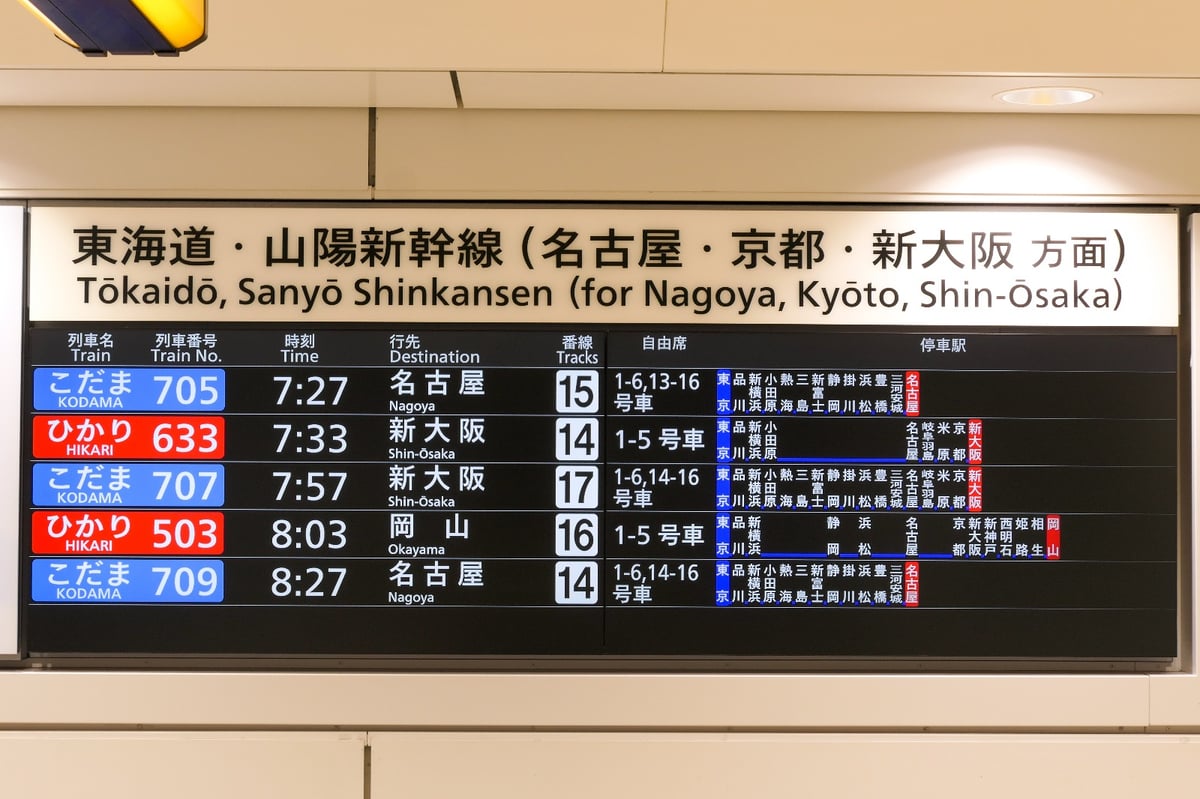
Departure screens in the Shinkansen concourse at Tokyo Station. Train name, departure time and platform, in English as well as Japanese. Photo: MaedaAkihiko, CC BY-SA 4.0
The Japan Rail Pass, priced honestly
The nationwide Japan Rail Pass gives unlimited travel on JR trains, including Shinkansen, for 7, 14 or 21 consecutive days. It is sold to visitors entering Japan on a temporary visitor status. Current prices, from the official Japan Rail Pass site, checked November 2026:
| Pass | Ordinary | Green Car |
|---|---|---|
| 7 days | ¥50,000 | ¥70,000 |
| 14 days | ¥80,000 | ¥110,000 |
| 21 days | ¥100,000 | ¥140,000 |
Children aged 6 to 11 pay half. Where you buy changes the price. Bought on the official site, the figures above apply, and you can reserve seats online before you collect the pass. Bought as an exchange order through an overseas agent, the same passes cost more since 1 October 2026 (¥53,000, ¥84,000 and ¥105,000 for ordinary), and JR calls the lower online price a limited-time arrangement, so check on the day you buy. An exchange order must be swapped for the pass within 30 days of purchase, and you choose the start date at the swap, up to 30 days ahead.
Two gaps in the coverage matter. The pass does not include the fastest trains, Nozomi and Mizuho, unless you buy a separate pass-holder ticket for each ride (¥4,960 between Tokyo and Kyoto, checked November 2026). And it covers JR only: subways, private railways and most buses sit outside it, so city travel still runs on your IC card. Seat reservations with a pass are free, at machines, ticket offices or online, and worth making on any train you cannot afford to miss.
Will a pass save you money? Three worked examples
Fares below are ordinary reserved seats at paper ticket prices, regular season, checked November 2026: Tokyo to Kyoto ¥13,850 on a Hikari, Kyoto to Hiroshima ¥11,300, Hiroshima to Tokyo ¥18,910 (Hikari with a change of train), Tokyo to Sendai ¥11,630 on a Hayabusa. Booking through smartEX trims a few hundred yen off the Tokaido fares, which only widens the gaps below.
Example 1: Tokyo and Kyoto, 7 days. Tokyo to Kyoto and back: 2 × ¥13,850 = ¥27,700. The 7 day pass costs ¥50,000. Individual tickets win by ¥22,300, and you may ride the faster Nozomi. This is the most common first trip in Japan, and the pass is the wrong buy for it.
Example 2: the classic loop, 7 days. Tokyo to Kyoto (¥13,850), Kyoto to Hiroshima (¥11,300), Hiroshima back to Tokyo (¥18,910). Total ¥44,060. Still ¥5,940 short of the pass price, even with Hiroshima in the trip. The pass starts to make sense only once a route like this gains another long leg.
Example 3: the packed week, 7 days. The loop above, plus a Tokyo to Sendai return (2 × ¥11,630 = ¥23,260) fitted into the same week. Total ¥67,320 against a ¥50,000 pass: the pass now saves ¥17,320. That is the post-2023 reality. Since the price rise of October 2023, the pass pays on heavy, long-distance itineraries and loses on ordinary ones. Do the addition for your own route before buying; it takes five minutes and the fares are all published.
The decision table
| Your travel | Compare | Usually wins |
|---|---|---|
| Local trips inside one city | IC card taps against a city day pass | The IC card. Fares are low and no cap or pass is needed |
| One intercity trip, or a return to one city | Individual reserved tickets (check smartEX early fares) against a pass | Individual tickets, unless the single return alone nears the pass price |
| Repeated long-distance travel inside 7, 14 or 21 days | The sum of every JR leg, priced one by one, against the matching pass | The pass, only when your sum passes its price; otherwise tickets |
Regional passes sit between the second and third rows: a JR West or JR East regional pass can pay off on a route the nationwide pass cannot. Price the one for your area before deciding.
Your first Shinkansen journey, step by step
Say you are staying in Shinjuku and leaving for Kyoto after breakfast.
Tap your IC card at Shinjuku and ride the JR Chuo line rapid to Tokyo Station, about 15 minutes. Follow the Shinkansen transfer signs, a long walk inside the station; allow 10 minutes for it.
At the Shinkansen gates, feed in both parts of a paper ticket, scan the QR code from your booking, or tap the IC card you registered with smartEX. Take paper tickets back from the slot; you need them again at Kyoto.
Find your platform on the departure board by train name and time, then your carriage position on the floor markings. Queue at the marks; the train stops with the doors exactly there.
On board, your seat is the one on the ticket. Bags up to 160 cm in total go on the overhead rack. A bigger bag goes behind the last row, only if you reserved that area.
At Kyoto, pass the gates again (paper tickets are collected here), then tap your IC card for the bus or subway to your hotel. Kyoto's city buses are boarded at the back and paid with a flat fare, by card tap, as you get off at the front.
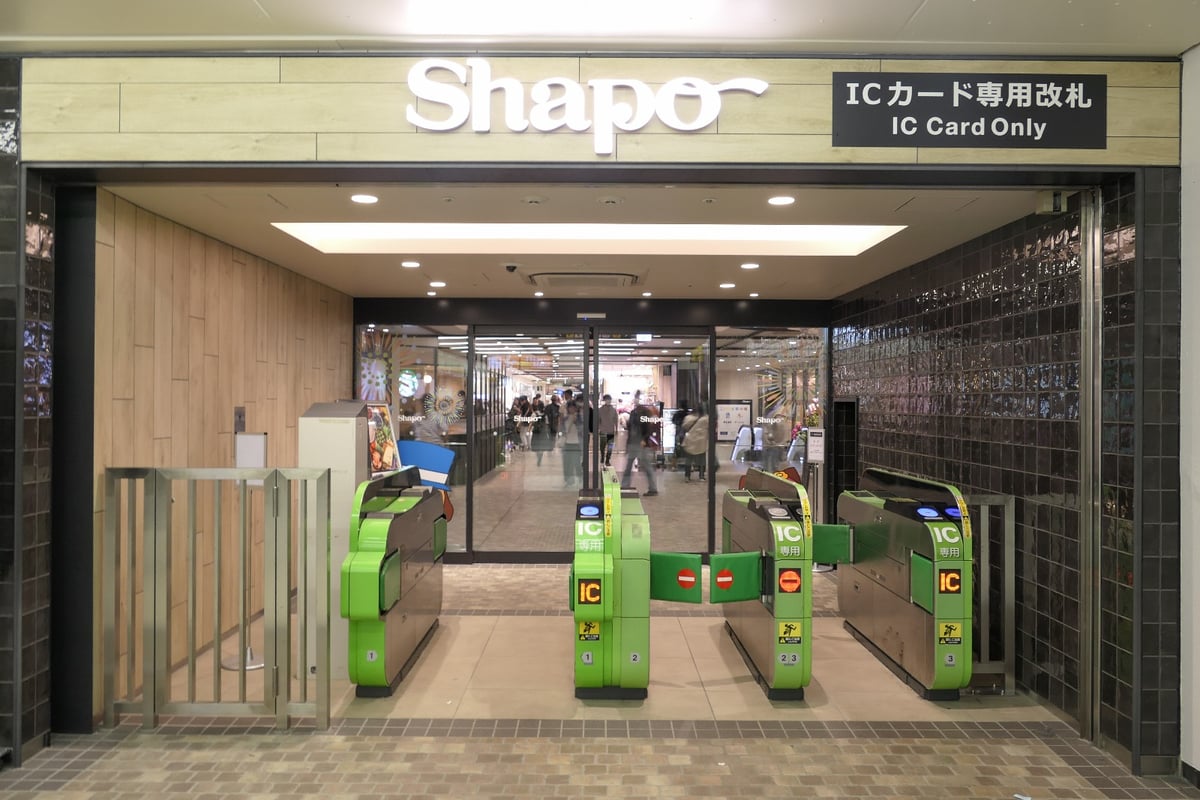
An IC card gate on a JR East station. One tap in, one tap out, and the fare settles itself. Photo: MaedaAkihiko, CC BY-SA 4.0
If you miss the train
A reserved ticket is for one specific train, but a missed departure is not a total loss. Under JR's rules, an unused reserved seat ticket can be used the same day in a non-reserved car of a later train on the same route; you give up the seat, not the journey. If you know in advance that you will miss it, change the reservation instead: changes are free before departure at machines, offices and in the booking apps. What you cannot do is board a different train in a reserved seat on the old ticket and hope; the conductor's check will find it.
Miss a connection because a JR train ran late, and staff at the transfer station will rebook you. Keep your tickets until you have arrived; the rebooking starts from them.
Quick answers
Does an IC card cover the Shinkansen? No. The fare is never taken from the card balance. You need a Shinkansen ticket, though you can register a card with smartEX or JR East's e-ticket service and tap through the gate with the charge going to your bank card.
Does mobile IC depend on my phone? Yes. iPhones from any country can hold a Suica in Apple Wallet. Android phones bought outside Japan generally lack the FeliCa hardware, so their owners need a physical card.
Will a pass save me money? Only if your JR legs, added up one by one, cost more than the pass. On a Tokyo and Kyoto trip they do not come close. On a week stacking Kyoto, Hiroshima and another long return, they can.
Getting to and from the airports is a separate puzzle, covered in Narita or Haneda to Tokyo (https://yonihon.com/travel-guide/narita-or-haneda-to-tokyo/), and what all of this adds up to across a whole trip is in How Much Does a Trip to Japan Cost (https://yonihon.com/travel-guide/how-much-does-a-trip-to-japan-cost/)?
8 minutes · November 23, 2026
10 minutes · November 23, 2026
9 minutes · November 23, 2026
