Tokyo has two airports, and they ask two different questions. Haneda sits inside the city, about 15 kilometres from Tokyo Station, so almost any way out of it works. Narita is in Chiba Prefecture, more than 60 kilometres away, and the wrong choice there can cost you an hour or several thousand yen.
The right answer depends on three things: which part of Tokyo your hotel is in, how much luggage you are carrying, and what time your flight lands. Here is every sensible option from both airports, with current fares and journey times, so you can pick before you fly.
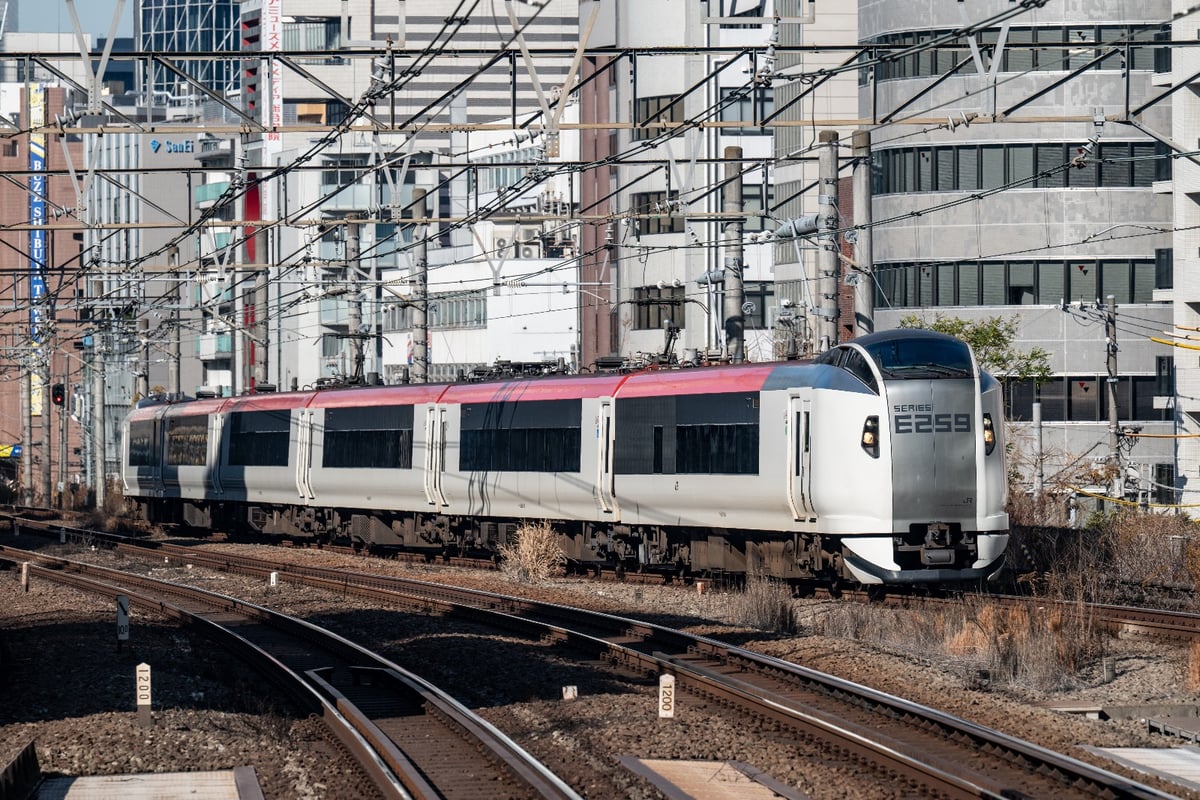
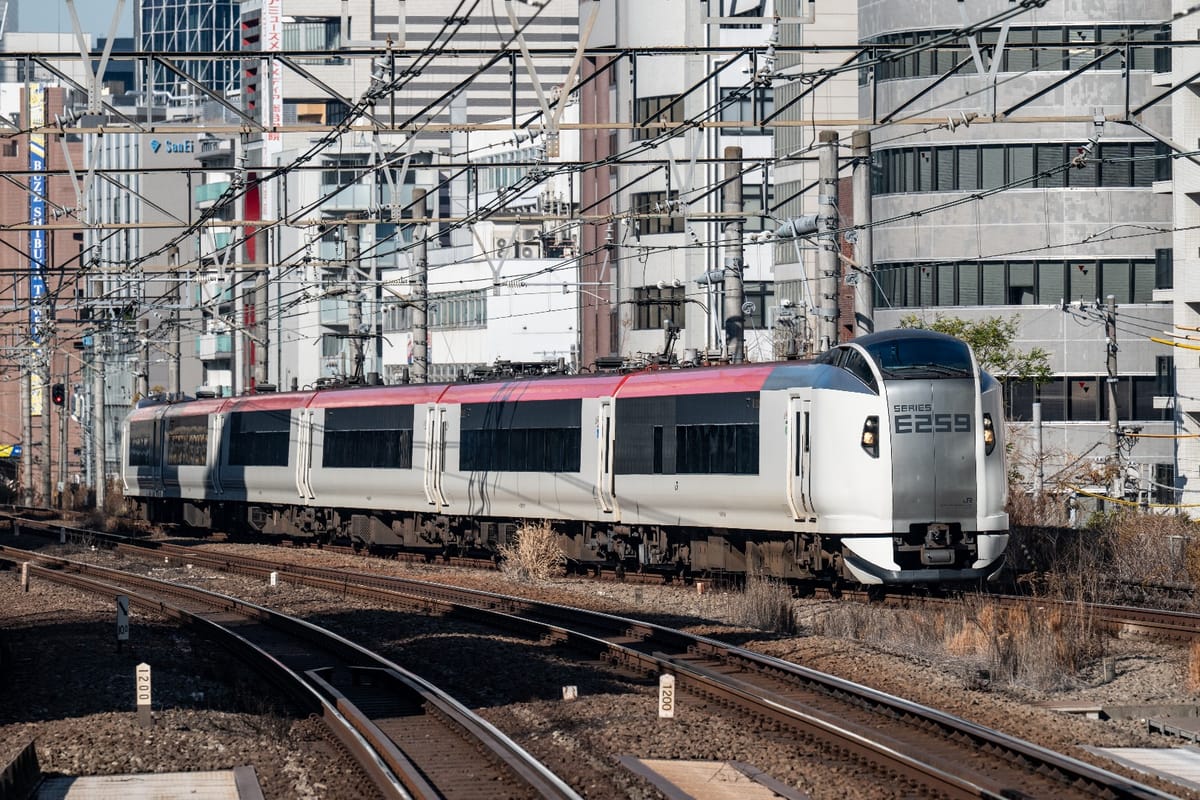
The Narita Express links Narita Airport with Tokyo, Shinagawa, Shibuya, Shinjuku and Yokohama without a change of train. Photo: Takeshi Aida, CC BY-SA 4.0
From Narita Airport
Narita's trains leave from two stations in the terminal basements: Narita Airport Terminal 1 Station, and Airport Terminal 2·3 Station, which serves Terminals 2 and 3. JR and Keisei are separate railways with separate ticket gates, and a ticket for one does nothing on the other, so decide which train you want before you pay
Narita Express (N'EX): the one-seat ride to the west side
JR East's Narita Express is the only train that runs from Narita to Tokyo Station and then carries on to Shinagawa, Shibuya and Shinjuku, the three areas where most visitors stay. Some trains continue to Yokohama.
The fastest train reaches Tokyo Station in 53 minutes, although most take between 55 and 65 minutes. Shinjuku takes about 80 to 85 minutes. An ordinary reserved seat costs ¥3,140 to Tokyo, ¥3,330 to Shinagawa, Shibuya or Shinjuku, and ¥4,480 to Yokohama. Every seat is reserved, there are luggage racks at the ends of each carriage, and there are power sockets at the seats. Trains run roughly every 30 minutes, and the last one leaves the airport at 21:44.
If you hold a non-Japanese passport and will fly out of Narita within 14 days, the N'EX TOKYO Round Trip Ticket is the fare to know: ¥5,200 return for adults and ¥2,600 for children, against ¥6,280 for two ordinary singles to Tokyo. Buy it at the JR EAST Travel Service Centers in the two airport stations, or reserve online through JR-EAST Train Reservation before you travel. The Japan Rail Pass also covers the N'EX, with a seat reservation.
Best for: Shinjuku, Shibuya, Shinagawa and Tokyo Station, especially with big suitcases or a return flight from Narita
Keisei Skyliner: the fastest train of all
The Skyliner is the quickest way off the Narita plain: 36 minutes to Nippori and 41 minutes to Keisei Ueno, running non-stop. At Nippori you step straight onto the JR Yamanote and Keihin-Tohoku lines in the same station; Keisei Ueno is a short walk from JR Ueno and the Ginza and Hibiya subway lines.
A one-way ticket costs ¥2,580, made up of a ¥1,280 fare and a ¥1,300 Skyliner ticket. Keisei's discount ticket, sold online and through travel agents, brings that down to ¥2,310 one way or ¥4,500 return; you exchange it for a seat reservation at the airport. All seats are reserved, trains run about every 20 minutes, and the last Skyliner leaves Narita at 23:00, later than any other express. Buy your ticket before boarding, because Keisei adds a ¥300 surcharge to the liner ticket bought on the train. One date for the diary: the Skyliner fare rises by ¥200 on 13 March 2027, to ¥2,780.
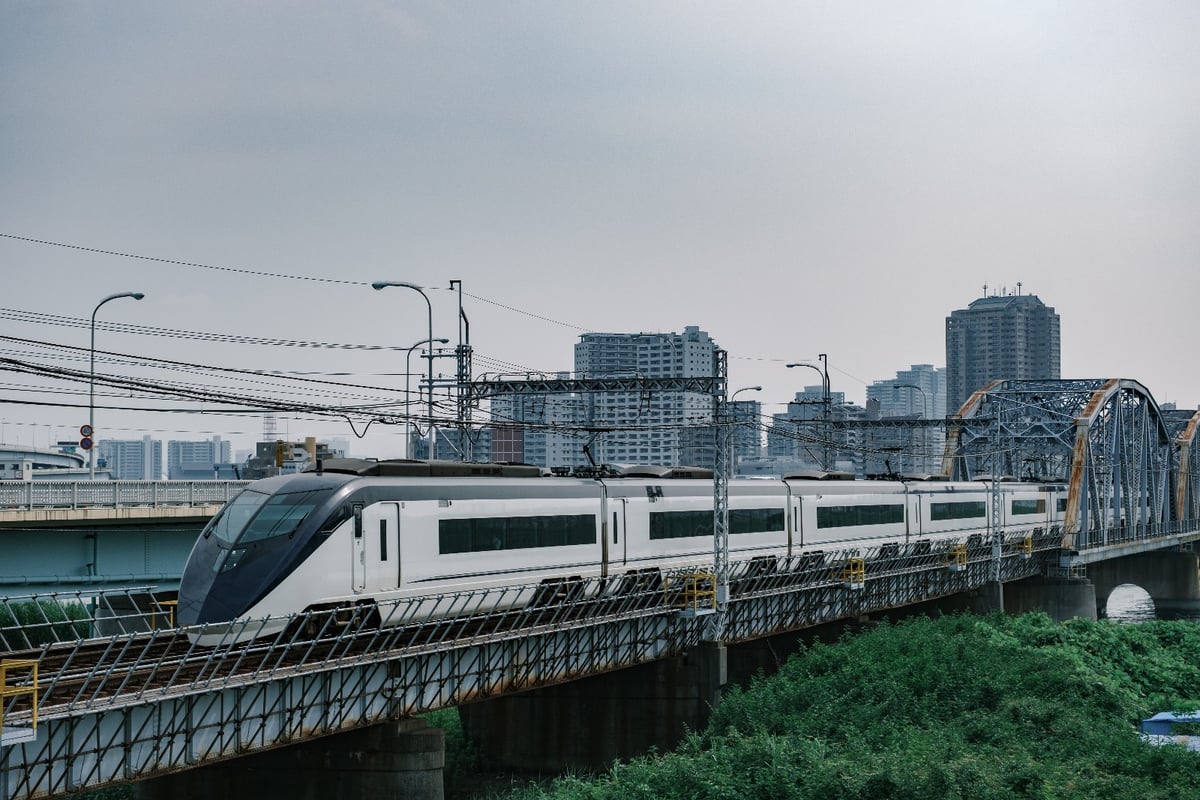
The Skyliner covers the run from Narita to Nippori in as little as 36 minutes. Photo: Real Estate Japan, CC BY 2.0
Best for: Ueno, Nippori and the east side of the Yamanote loop, and for anyone who values minutes over yen
Keisei Access Express: the quiet bargain to Asakusa
The Access Express uses the same fast Narita Sky Access route as the Skyliner, then runs straight onto the Toei Asakusa subway line. That gives you a one-seat ride to Oshiage (for Tokyo Skytree), Asakusa, Nihombashi, Higashi-ginza and Shimbashi, and some trains continue to Shinagawa or all the way to Haneda Airport.
Asakusa takes about 50 to 59 minutes and costs ¥1,290, or ¥1,276 with an IC card such as Suica or PASMO. There is no express surcharge and no reservation; it is an ordinary commuter train, so expect overhead racks rather than luggage space, and busy carriages at rush hour. Check the destination board before you board, because only the through trains reach Asakusa; you want one bound for the Asakusa Line, Nishi-Magome or Haneda Airport.
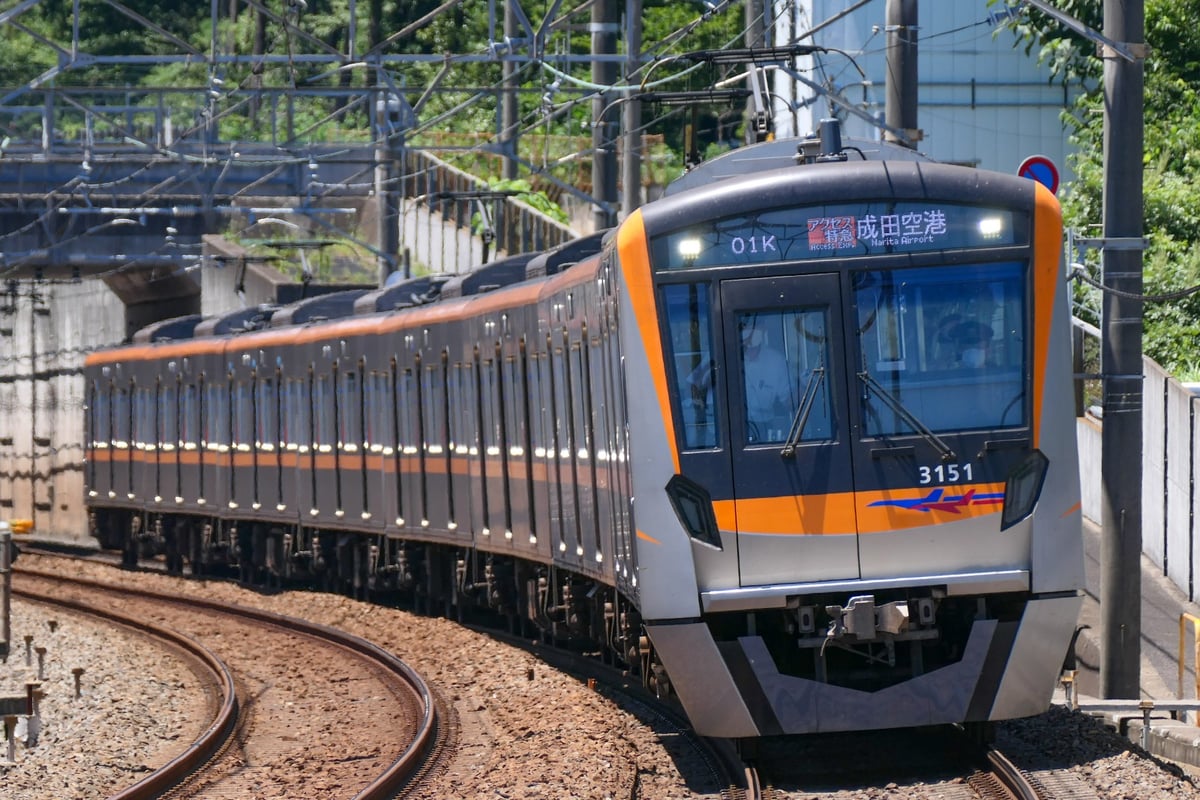
Access Express trains run through onto the Toei Asakusa Line, reaching Asakusa with no change. Photo: MaedaAkihiko, CC BY-SA 4.0
Best for: Asakusa and the east side on a budget, if you are travelling light.
The ordinary trains: Keisei Main Line and JR Rapid
Two slower trains undercut everything above. Keisei Main Line limited express trains reach Nippori and Keisei Ueno in about 70 to 80 minutes for ¥1,030 (¥1,025 by IC card), the cheapest rail fare from Narita. JR's Rapid trains on the Sobu and Narita lines take about 85 to 90 minutes to Tokyo Station for ¥1,410, need no reservation, and some continue to Shinagawa and Yokohama. The JR Rapid is covered by the Japan Rail Pass; the Keisei trains are not. Neither train has proper luggage space, and both fill up with commuters in the morning and evening peaks.
Best for: tight budgets and light bags, outside rush hour.
Buses from Narita: cheap and simple, or door to door
The Airport Bus TYO-NRT is the budget pick. It runs from all three terminals to Tokyo Station (Yaesu South Exit) and Ginza for ¥1,500, with the fastest journeys around 65 to 70 minutes and longer ones in traffic. Buses leave every few minutes at busy times, tickets come from the bus counters and machines in arrivals, and most departures need no reservation. Late-night and early-morning departures cost ¥3,000, which matters for the late arrivals covered below.
The Airport Limousine Bus costs more and does more. It is ¥3,100 to Tokyo Station and the Tokyo City Air Terminal, and ¥3,600 to the Shinjuku and Shibuya areas, with stops at major stations and a long list of hotels. Journey times run from about 85 minutes to two hours depending on traffic and how many stops your route makes. Your bags go in the hold (two pieces of up to 30 kg each), the driver loads them, and you sit down until your hotel. Book online in advance or buy at the airport counter.
Best for: TYO-NRT for Tokyo Station and Ginza on a budget; the Limousine Bus if it stops at or near your hotel and your bags are heavy.
Taxis from Narita: fixed fares, priced per car
From the airport taxi ranks you can take a fixed-fare taxi, priced by zone rather than by the meter. Fares to the central wards run from about ¥23,500 to ¥32,500, plus expressway tolls: the zone covering Chuo, Chiyoda and Taito (Tokyo Station and Asakusa) is ¥29,000 to ¥31,000 depending on the route, and Shinjuku and Shibuya come in at roughly ¥31,500 to ¥32,500. The drive takes about 60 to 90 minutes, longer in rush hour.
That is a lot of money for one person, and a reasonable deal split between three or four people with luggage, where the per-person cost lands near the price of an express train. Ask for the fixed fare at the rank before you set off.
Best for: groups of three or four, families with small children, and arrivals too late for the trains.
From Haneda Airport
Haneda is a different problem: a short one. Both of its railways reach a JR hub in under 15 minutes, and most of central Tokyo is inside 40 minutes door to door. International flights use Terminal 3, and both stations connect directly to the terminal buildings
Keikyu Line: cheap, quick, and usually the answer
Keikyu's red trains reach Shinagawa in 11 minutes from Terminal 3 and 14 minutes from Terminals 1 and 2, for ¥330 (¥327 by IC card). Shinagawa is a JR hub with the Yamanote Line and the Shinkansen, so most of Tokyo is one change away. Plenty of Keikyu trains run through instead: onto the Toei Asakusa Line to Shimbashi, Nihombashi and Asakusa (34 minutes from Terminal 3), or in the other direction to Yokohama (23 minutes, ¥370).
Trains are frequent, unreserved and take IC cards; Keikyu gates also accept contactless bank cards. The first train leaves Terminal 3 at 05:26 and the last at 00:08, the latest finish of any airport railway in Tokyo.
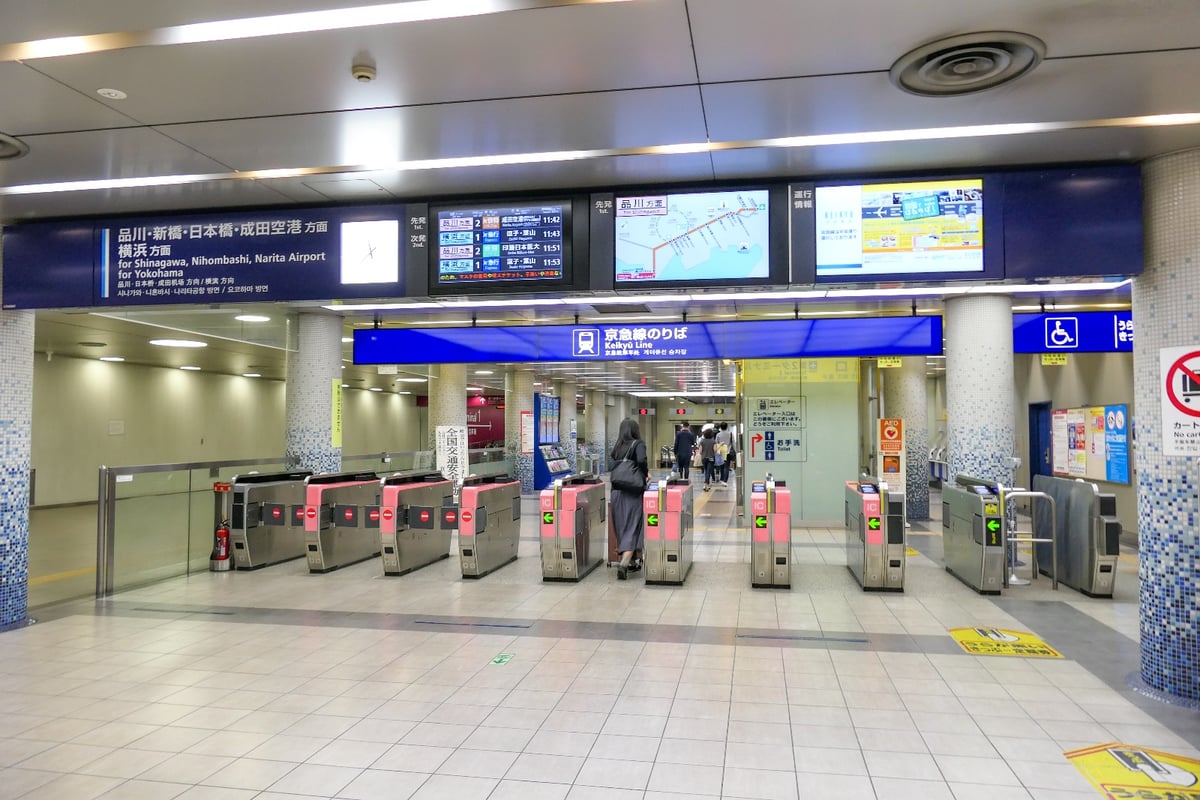
Keikyu's airport stations sit inside the terminals at Haneda, minutes from the arrival halls. Photo: MaedaAkihiko, CC BY-SA 4.0
Best for: almost everyone, and especially Shinagawa, Asakusa, Ginza's east side and Yokohama.
Tokyo Monorail: the scenic route to the Yamanote loop
The monorail glides along the bay and the canals to Monorail Hamamatsucho, where you change to the JR Yamanote and Keihin-Tohoku lines. The fastest trains, the Haneda Express services, take 13 minutes; local trains that stop everywhere take about 18. The fare is ¥520 (¥519 by IC card), and trains leave on average every five minutes.
Two things swing it for some visitors. The Japan Rail Pass covers the monorail in full. And on Saturdays, Sundays and public holidays, the Monorail and Yamanote Line Discount Ticket costs ¥590 and covers the monorail plus a ride to any station on the Yamanote loop; buy it from the ticket machines at the airport station on the day. There are luggage racks on board, which the Keikyu trains largely lack.
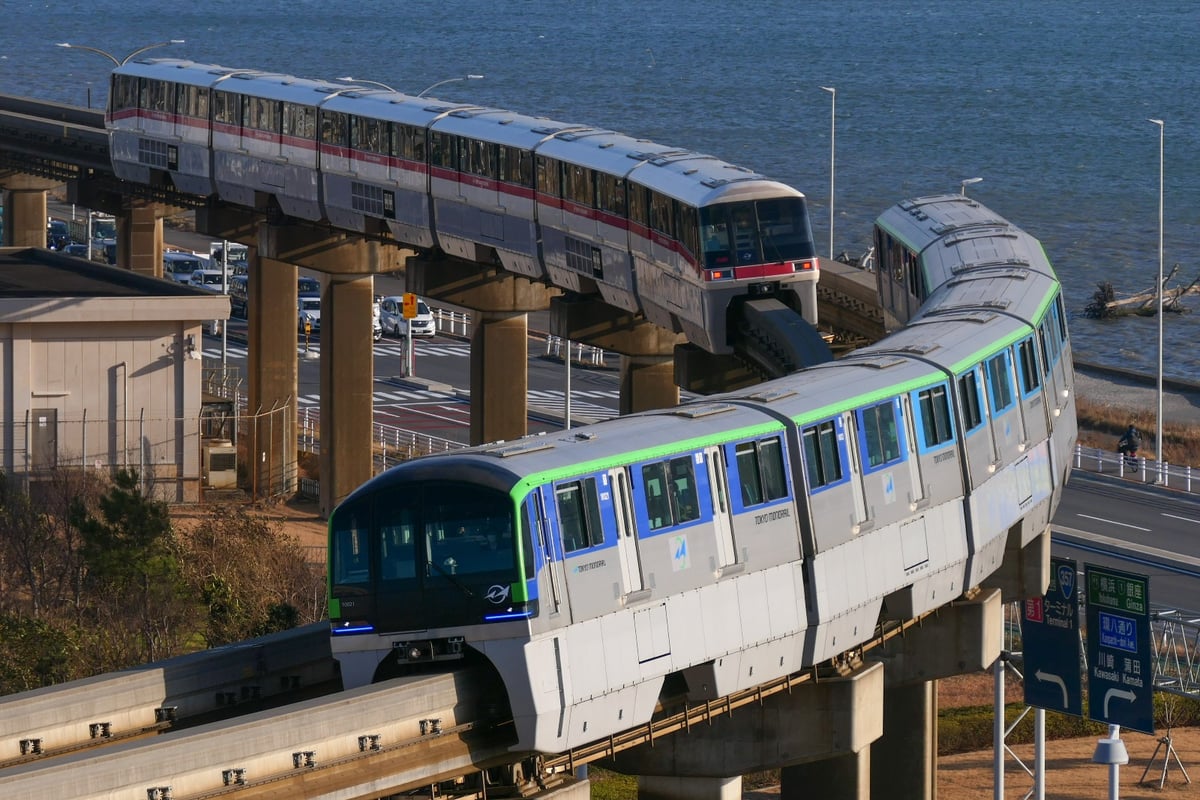
The monorail runs from all three Haneda terminals to Hamamatsucho, on the Yamanote loop. Photo: MaedaAkihiko, CC BY-SA 4.0
Best for: hotels on the east and north of the Yamanote loop (Tokyo Station, Ueno, Ikebukuro side), JR Pass holders, and weekend arrivals.
Buses and taxis from Haneda
The Airport Limousine Bus runs from Haneda to Tokyo Station for ¥1,200, Shibuya for ¥1,300 and Shinjuku for ¥1,400, with many hotel stops and journey times of about 40 to 45 minutes in normal traffic. It is the only one-seat ride to much of the city, and there are late-night and early-morning departures on some routes.
Fixed-fare taxis wait at the terminal ranks, no booking needed. By ward, daytime fares include Chiyoda (Tokyo Station) at ¥7,600, Shibuya at ¥8,500, Shinjuku at ¥9,000, Taito (Asakusa and Ueno) at ¥9,100 and Toshima (Ikebukuro) at ¥11,200, rising to ¥14,000 for Musashino. Between 22:00 and 05:00 the fixed fares rise (Shinjuku becomes ¥10,700), and expressway tolls are added either way. The wards nearest the airport, such as Minato, Shinagawa and Ota, are not in the fixed-fare scheme and simply run on the meter. The drive takes roughly 25 to 45 minutes depending on where you are headed.
Every option, side by side
| Route | From | Time | Fare | Best for |
|---|---|---|---|---|
| Narita Express (N'EX) | Narita | 53 min to Tokyo Station | ¥3,140 (¥5,200 return ticket) | Shinjuku, Shibuya, Shinagawa; big luggage; no change |
| Keisei Skyliner | Narita | 36 min to Nippori / 41 min to Keisei Ueno | ¥2,580 (¥2,310 discount ticket) | Speed; Ueno and the east side |
| Keisei Access Express | Narita | about 50-59 min to Asakusa | ¥1,290 | Asakusa and the east side on a budget |
| Keisei Main Line limited express | Narita | about 70-80 min to Nippori | ¥1,030 | The cheapest train from Narita |
| JR Rapid (Sobu and Narita lines) | Narita | about 85-90 min to Tokyo Station | ¥1,410 | Tokyo Station cheaply; JR Pass holders |
| Airport Bus TYO-NRT | Narita | about 65-90 min to Tokyo Station | ¥1,500 (¥3,000 late night) | Budget rides to Tokyo Station and Ginza |
| Airport Limousine Bus | Narita | about 85-120 min | ¥3,100-3,600 | A stop at your hotel; heavy bags |
| Fixed-fare taxi | Narita | about 60-90 min | ¥23,500-32,500 per car plus tolls | Groups; late arrivals; door to door |
| Keikyu Line | Haneda | 11 min to Shinagawa from Terminal 3 | ¥330 | Most people; Shinagawa, Asakusa, Yokohama |
| Tokyo Monorail | Haneda | 13 min to Hamamatsucho (fastest) | ¥520 (¥590 weekend ticket to the Yamanote loop) | Yamanote loop hotels; JR Pass holders |
| Airport Limousine Bus | Haneda | about 40-45 min | ¥1,200-1,400 | A stop at your hotel; one seat all the way |
| Fixed-fare taxi | Haneda | about 25-45 min | ¥7,600-14,000 per car plus tolls | Groups; late nights; door to door |
Fares are adult one-way prices checked against the operators in November 2026. Road times vary with traffic, and train times are the fastest or typical scheduled times to the first central stop.
The verdicts
Landing at Narita? Work out which side of Tokyo your hotel is on and let that decide. For Shinjuku, Shibuya, Shinagawa or Tokyo Station, take the N'EX and sit down until you arrive; the ¥5,200 return ticket makes it good value if you fly home from Narita within 14 days. For Ueno and Nippori, the Skyliner is faster and cheaper. For Asakusa, skip both and take the Access Express straight there for ¥1,290. Heading for Tokyo Station or Ginza with an eye on the budget, the TYO-NRT bus at ¥1,500 beats every train on price except the slowest ones. With heavy bags and a hotel on the Limousine Bus route, the bus earns its fare.
Landing at Haneda? Take the Keikyu Line unless you have a reason not to. It is the cheapest option at ¥330, the fastest to a JR hub, and its through trains cover Asakusa and Yokohama. Choose the monorail if your hotel sits on the Yamanote loop east of Shinagawa, if you hold a Japan Rail Pass, or if you land on a weekend and can use the ¥590 discount ticket. Save the bus for a hotel on its stop list, and the taxi for groups and late nights.
Landing late at night
The two airports behave very differently after dark.
At Narita, the trains finish early: the last N'EX leaves at 21:44, the last JR Rapid for Tokyo at 22:57 on weekdays, and the last Skyliner at 23:00. Immigration and baggage reclaim can easily take an hour, so a flight landing after about 21:30 is a flight that may miss the last express. Your remaining options are the late-night TYO-NRT buses to Tokyo Station and Ginza at ¥3,000, a fixed-fare taxi, or a hotel near the airport or in Narita city and a fresh start in the morning. Check the bus timetable for your date before you rely on it, because late-night departures are limited.
At Haneda, the night is kinder. Keikyu trains run until 00:08 from Terminal 3 and the monorail until a little before midnight, Limousine Buses run late-night departures on some routes, and fixed-fare taxis wait at the ranks with the night rate applied between 22:00 and 05:00. Terminal 3 stays open all night, so even a very late arrival has a civilised fallback.
Send your suitcase ahead instead
Whichever airport you land at, you do not have to drag your suitcase onto a train. Yamato Transport (the TA-Q-BIN service), Sagawa and JAL ABC all run delivery counters in the arrivals halls, and they will send your bags to your hotel while you travel in with a daypack.
Same-day delivery has a morning deadline. With Yamato, hand your bag over at Narita by 10:30 (by 9:50 at Terminal 3) and it reaches Tokyo hotels between 18:00 and 21:00 that evening; at Haneda the deadline is 11:00 for delivery after 18:00 to central Tokyo hotels. Sizes are measured by adding the three dimensions of the case; a large suitcase is usually the 160 size. From Narita, a 160-size case to a Tokyo hotel costs ¥3,580 with Yamato. From Haneda, same-day delivery of a 160-size case is quoted at ¥5,170 on Yamato's airport page and ¥5,780 on its general same-day page, so budget for the higher figure; next-day delivery from Haneda to within Tokyo costs ¥2,410 for the same size.
Two cautions. Delivery goes to addresses with someone to receive it, which in practice means hotels with a staffed front desk; unstaffed holiday rentals are usually refused. And on the way home, the flow reverses: send your bags to the airport with Yamato's Airport TA-Q-BIN two days before your flight (there is a ¥660 airport fee on top of the normal fare) and collect them at the departure counter.
Before you land: three small things
Sort an IC card early. A Suica or PASMO makes every ordinary train in this guide a tap rather than a ticket puzzle, and IC fares are often a few yen cheaper. Visitors can buy a Welcome Suica at the JR stations at Narita and at the Tokyo Monorail station in Haneda Terminal 3.
Reserve the express trains. The N'EX and Skyliner are all-reserved. In busy periods the first trains after a bank of arrivals fill up, so booking ahead online, or going straight to the ticket counter after customs, saves a wait.
Match the train to the hotel, not the airport. The fastest train to the wrong side of Tokyo is slower than the second-fastest train to the right station, once you add a cross-city change with suitcases. Find your nearest station first, then pick from the table.
8 minutes · November 23, 2026
9 minutes · November 23, 2026

9 minutes · November 23, 2026