
Three travellers, one itinerary, every yen counted
Stand in front of a ramen vending machine in Osaka and press one button. About ¥1,000 buys a bowl you may remember for years. Now think about the bullet train you took to get there: roughly ¥14,170 each way from Tokyo to Kyoto. Japan trip costs are made of moments like these, small and delicious one minute, large and unavoidable the next.
Add them up and one week lands somewhere between ¥98,000 and ¥310,000 per person, with flights not included. The gap between those numbers is the whole story, so let’s follow three travelers through it.
The short answer
Meet Asha, Ben and Cara. They are example travelers, not real people, but their bills are built from real 2026 prices. Each one shares a hotel room with a friend and follows the same route: Tokyo, then Kyoto.
| Traveller | 7 days | 14 days | What the money buys |
| Asha, careful | ¥98,120 | ¥195,940 | Basic business hotel, convenience-store breakfasts, ramen and set lunches, mostly free sights. |
| Ben, balanced | ¥180,870 | ¥366,440 | Mid-range hotel, café breakfasts, a sit-down dinner most nights, a few paid highlights. |
| Cara, comfortable | ¥310,170 | ¥632,540 | Upscale hotel, restaurant dinners, first-class bullet-train seat, more paid sights. |
per person, in Japanese yen, room shared by two, excluding international flights. Prices checked 7 October 2026.
Two weeks costs a little over double one week for all three travellers.
The ground rules
• Per person, room shared by two. A solo traveller pays more per person, because a single room costs only a little less than a double.
• Nights. “7 days” means 6 nights and “14 days” means 13, so arrival and departure days both count.
• Route. For 7 days: Tokyo, then Kyoto, with one bullet-train journey and one day trip. For 14 days: Tokyo, Kyoto and Osaka, then back to Tokyo, with two bullet-train journeys and three day trips.
• Season. Ordinary weeks, outside cherry blossom season, Golden Week, peak autumn colour and New Year.
A day in each wallet
Before the big totals, look at an ordinary day. These are running costs only, before one-off items such as trains, airport transfers and sights.
Asha’s Tuesday
She splits a business-hotel room and pays ¥5,000 for her half plus ¥200 lodging tax. Breakfast is a convenience-store onigiri (¥500), lunch is ramen (¥1,000), dinner is a simple set meal (¥1,800), and ¥200 goes on drinks. A few subway rides add ¥700. The shrine she visits is free.
5,000 + 200 + 500 + 1,000 + 1,800 + 200 + 700 = ¥9,400
Ben’s Tuesday
His half of a mid-range room is ¥11,000, plus ¥400 tax. A café breakfast costs ¥700, a set lunch ¥1,500, an izakaya dinner ¥3,500, and coffee and snacks ¥800. Transport is ¥1,000.
11,000 + 400 + 700 + 1,500 + 3,500 + 800 + 1,000 = ¥18,900
Cara’s Tuesday
Her share of an upscale room is ¥20,000, plus ¥1,000 tax. Breakfast is ¥1,500, lunch ¥2,500, a restaurant dinner ¥6,000, and extras ¥1,000. Transport, with the occasional taxi, is ¥1,500.
20,000 + 1,000 + 1,500 + 2,500 + 6,000 + 1,000 + 1,500 = ¥33,500
Notice what separates them. The food gap is real, but the hotel gap is bigger. Hotels set the shape of the whole budget.
Japan cost for 7 days
Now add the one-offs. Each cell shows the result, with the sum underneath.
| Line | Asha | Ben | Cara |
| Accommodation | ¥31,200 6 × (5,000 + 200) | ¥68,400 6 × (11,000 + 400) | ¥126,000 6 × (20,000 + 1,000) |
| Food | ¥24,500 7 × 3,500 | ¥45,500 7 × 6,500 | ¥77,000 7 × 11,000 |
| Local transport | ¥4,900 7 × 700 | ¥7,000 7 × 1,000 | ¥10,500 7 × 1,500 |
| Intercity transport | ¥14,820 13,320 + 1,500 | ¥16,170 14,170 + 2,000 | ¥21,970 (14,170 + 4,800) + 3,000 |
| Attractions | ¥3,000 6 × 500 | ¥7,800 6 × 600 + 4,200 teamLab | ¥13,700 8 × 800 + 4,800 teamLab + 2,500 Himeji |
| Airport transfers | ¥6,500 2 × 3,250 | ¥6,500 2 × 3,250 | ¥6,500 2 × 3,250 |
| eSIM | ¥2,000 | ¥2,000 | ¥2,000 |
| Luggage | ¥1,200 2 locker days × 600 | ¥2,500 1 forwarded suitcase | ¥2,500 1 forwarded suitcase |
| Shopping and sundries | ¥10,000 | ¥25,000 | ¥50,000 |
| Total | ¥98,120 about ¥14,000 a day | ¥180,870 about ¥26,000 a day | ¥310,170 about ¥44,000 a day |
7 days, 6 nights, per person, in yen. Prices checked 7 October 2026.
The bullet-train fares behind these sums need a footnote. Sources round the Tokyo to Kyoto fare differently, from ¥13,850 to ¥14,370, because the seat charge shifts with the season. This article uses ¥14,170 for a reserved Nozomi seat and ¥13,320 for an unreserved one, so confirm the exact fare when you book.
Where the yen actually goes
Same week, three very different shapes. Each bar is one traveler's 7-day total, split into five groups.
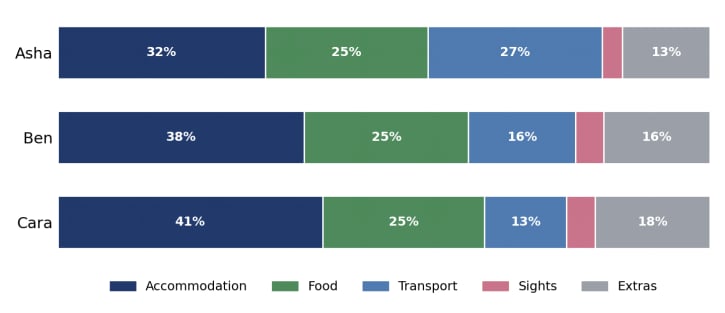
Share of each traveller’s 7-day total. Transport includes local trips, the bullet train, day trips and airport transfers. Percentages are rounded.
Two things jump out. Food takes a steady quarter of every budget, whatever the style. And for Asha, transport is the second-biggest slice, because a bullet train, two airport transfers and a day trip cost much the same for her as for the others, so they weigh more in a small total.
Japan cost for 14 days
Stretch the trip to two weeks and the daily rhythm barely changes. Each traveller adds a return bullet train and two more day trips.
| Line | Asha | Ben | Cara |
| Accommodation | ¥67,600 13 × (5,000 + 200) | ¥148,200 13 × (11,000 + 400) | ¥273,000 13 × (20,000 + 1,000) |
| Food | ¥49,000 14 × 3,500 | ¥91,000 14 × 6,500 | ¥154,000 14 × 11,000 |
| Local transport | ¥9,800 14 × 700 | ¥14,000 14 × 1,000 | ¥21,000 14 × 1,500 |
| Intercity transport | ¥31,140 2 × 13,320 + 3 × 1,500 | ¥34,340 2 × 14,170 + 3 × 2,000 | ¥46,940 2 × 18,970 + 3 × 3,000 |
| Attractions | ¥6,000 12 × 500 | ¥13,900 12 × 600 + 4,200 + 2,500 | ¥20,100 16 × 800 + 4,800 + 2,500 |
| Airport transfers | ¥6,500 2 × 3,250 | ¥6,500 2 × 3,250 | ¥6,500 2 × 3,250 |
| eSIM | ¥3,500 | ¥3,500 | ¥3,500 |
| Luggage | ¥2,400 4 locker days × 600 | ¥5,000 2 × 2,500 | ¥7,500 3 × 2,500 |
| Shopping and sundries | ¥20,000 | ¥50,000 | ¥100,000 |
| Total | ¥195,940 about ¥14,000 a day | ¥366,440 about ¥26,000 a day | ¥632,540 about ¥45,000 a day |
Once you know your style, a rough total is your daily figure times your days. This is a rule of thumb, not a quote, and it works best for trips of five days or more, because one-off costs weigh more on short trips.
| Days | Asha (¥14,000 a day) | Ben (¥26,000 a day) | Cara (¥45,000 a day) |
| 5 days | ¥70,000 | ¥130,000 | ¥225,000 |
| 10 days | ¥140,000 | ¥260,000 | ¥450,000 |
| 21 days | ¥294,000 | ¥546,000 | ¥945,000 |
The prices behind the story
| Item | Typical 2026 price | Note |
| Business-hotel room | ¥7,000–¥15,000 a night | Tokyo, Kyoto, Osaka in ordinary weeks. Osaka is usually cheapest. |
| Mid-range hotel room | ¥12,000–¥25,000 a night | Wide spread by city and date. |
| Upscale hotel room | ¥35,000+ a night | Japan’s tourism board lists four-star doubles from about ¥30,000. |
| Lodging tax | ¥100–¥300 per night | Tokyo and Osaka. Kyoto’s five tiers run from ¥200 up to ¥10,000 per person per night. |
| Ramen or set lunch | ¥900–¥1,500 | Convenience-store breakfast is ¥400–¥600. |
| Conveyor-belt sushi meal | ¥1,500–¥3,000 | Plates start around ¥100–¥150. |
| Izakaya dinner | ¥2,000–¥5,000 | Food plus a few drinks. |
| Tokyo Subway Ticket | ¥1,000 / ¥1,500 / ¥2,000 | 24 / 48 / 72 hours. Raised on 14 March 2026. |
| Tokyo to Kyoto bullet train | About ¥14,170 one way | Reserved Nozomi seat. Unreserved is ¥13,320. A Green Car seat adds roughly ¥4,800. |
| Temple entry | About ¥500 | Fushimi Inari and Senso-ji are free. |
| teamLab Planets | From ¥3,600 (adult) | Price varies by date and time slot. |
| Himeji Castle | ¥2,500 | Since 1 March 2026. Himeji residents pay ¥1,000. |
Reference prices, checked 7 October 2026. Always confirm on the operator’s own site before booking.
The plot twist is the hotel
One 2026 price survey measured the same Kyoto business hotels on four different dates and found nightly rates differing by as much as 3.3 times, for example ¥6,999 on a quiet date and ¥22,955 on a busy one. Another puts the cherry blossom premium at about 40 percent. For Ben, that premium on his week is 6 × ¥11,000 × 0.4 = ¥26,400, which lifts his total from ¥180,870 to ¥207,270. Treat any single sample hotel rate, including the ones in this article, as a starting point, and check your own dates.
Bullet train or rail pass?
A 7-day Japan Rail Pass costs ¥50,000, while a Tokyo to Kyoto return costs about ¥28,000 in single tickets. For this route, the pass loses.
The extras that sneak up on you
Luggage
Forwarding one large suitcase between Tokyo and Kyoto or Osaka costs roughly ¥2,310–¥2,630 and usually arrives the next day. Station coin lockers cost about ¥300–¥800 a day. Bags over 160 cm in combined length, width and height now need a reserved oversize-baggage spot on certain bullet-train routes, which is another reason to forward them.
Connectivity
A 7-day, 10 GB eSIM was listed at about ¥1,800 in July 2026. The budgets here use ¥2,000 for a week and ¥3,500 for two. Unlimited plans cost more.
The shopping line is a placeholder, because it is entirely your choice. If you buy after 1 November 2026, tax-free shopping becomes refund-based: you pay the full tax-inclusive price at the till and claim the refund at departure. Keep the goods in your carry-on, because you may need to show them to customs, and do not use consumables before you fly.
A tea ceremony is the easiest cultural activity to price. A shared 45-minute session near Kinkaku-ji in Kyoto starts at ¥3,300 per adult, and adding a kimono costs ¥3,000 more, so ¥6,300 in total. A private session is ¥7,700. Another Uji class charges ¥4,000 for kimono rental plus a ¥1,000–¥2,000 tea-room fee. Add the exact price of your chosen session as a separate line.
How much cash should I carry?
Cards work at most hotels, stations and big restaurants, but cash still rules at small ramen shops with ticket machines, many temples, lockers and some buses. A practical rule is to hold about one third of your day-to-day spending on food, local transport and sights in cash. For Ben’s week that is (¥45,500 + ¥7,000 + ¥7,800) ÷ 3 ≈ ¥20,100. By the same sum, Asha needs about ¥10,800 and Cara about ¥33,700.
Bring ¥20,000–¥30,000 in cash for your first days, then top up at 7-Eleven or Japan Post ATMs, which reliably accept foreign cards. You do not need to carry the whole trip’s budget.
Which costs vary the most?
• Accommodation. Dates, city and hotel type can change this by a factor of three.
• Dinner. A ramen dinner costs about ¥1,200, an izakaya evening ¥3,000–¥5,000, and a kaiseki or omakase dinner from ¥10,000 into the tens of thousands.
• Shopping. It can be ¥0 or more than the rest of the trip.
• Transport and sights. These move the least. Bullet-train fares and temple tickets are close to fixed.
Seven ways to keep your yen...
• Dodge the peaks. Cherry blossom season, Golden Week, peak foliage and New Year add the biggest premium to the biggest line.
• Sleep in Osaka. One survey put business-hotel rooms at ¥7,000–¥11,000 in Osaka against ¥10,500–¥15,000 in Kyoto. Kyoto and Nara are easy day trips.
• Make lunch the big meal. Set lunches cost ¥1,000–¥1,500, and the same kitchens often charge several times that at dinner.
• Skip the rail pass on a simple route. ¥50,000 loses to about ¥28,000 of single tickets for a Tokyo to Kyoto return.
• Use the Tokyo Subway Ticket only on busy days. At ¥1,000, it beats single rides of ¥180–¥330 from about four rides.
• Book timed tickets early. teamLab prices change with the date, and popular slots sell out.
• Use lockers for short hops. At ¥300–¥800 a day, a locker is cheaper than forwarding if you only need to park a bag for an afternoon.
The rule of thumb: pick your style, multiply its daily figure by your number of days, then add flights. Use ¥14,000, ¥26,000 or ¥45,000 a day.
How these prices were checked
Prices were checked on 7 October 2026 against these sources: the Tokyo Metropolitan Government’s notice of the 14 March 2026 Subway Ticket fares, teamLab Planets’ official ticket page, the Japan National Tourism Organization’s budget guide for dining and accommodation reference points (it notes that prices may differ from the latest information), and published 2026 price pages for hotels, bullet-train fares, luggage forwarding, eSIMs, Himeji Castle and tea ceremonies.
Hotel figures are ranges from published price surveys, not a live search of specific dates. Day-trip costs, airport transfers, lodging tax per tier, the daily food split and the shopping allowance are estimates. Prices change, so confirm each one with the operator before you book.
8 min read · October 3, 2026