Japan is one of the easiest countries in the world to travel around without your luggage. That is not a figure of speech. There is a national delivery network that will take a suitcase from one hotel front desk and put it in the next one, usually by the following day, for roughly the price of a station lunch set for two. There are lockers in almost every station for the hours in between. And there is one train rule, about big bags on the shinkansen, that catches visitors out every single day.
This guide covers all three: how luggage forwarding (takkyubin) works and what it costs, how to fill in the form when your Japanese is limited to greetings, when to send bags to the airport instead, what coin lockers cost, and the oversized baggage rule for the bullet train.
The service is called takkyubin, written TA-Q-BIN in English. The biggest operator is Yamato Transport, whose logo is a black cat carrying a kitten. You will see the sign at hotel front desks, in convenience stores such as 7-Eleven and FamilyMart, at Yamato's own offices, and at counters in airports and major stations. Sagawa Express and Japan Post run similar services, and most hotels work with one of them as a matter of routine.
The standard pattern for a trip looks like this. On the morning you leave Tokyo, you hand your big suitcase to the front desk, fill in one form, and pay. You travel to Kyoto with a day bag. The suitcase arrives at your Kyoto hotel the next day, and the hotel holds it until you check in. Repeat as often as you change cities.
Two habits make it work smoothly. Keep one overnight bag with you, with a change of clothes, chargers, medication and anything you need for the first night, because the big case travels a day behind you. And send the case the day before you move, or on the morning of the move at the latest, so it is never far behind.
Yamato prices by size, and size means the length, width and height of the bag added together, in centimetres. Weight matters too: if your bag is heavier than the limit for its size, you pay for the size above. A normal medium suitcase lands in size 140 (up to 140cm and 20kg). A large suitcase lands in size 160 (up to 160cm and 25kg). Yamato will not take anything over size 200 or 30kg.
Current one-way fares from Tokyo to Kyoto or Osaka, tax included, paying cash:
Size 120 (up to 120cm, 15kg, a large cabin bag): ¥2,170
Size 140 (up to 140cm, 20kg, a medium suitcase): ¥2,780
Size 160 (up to 160cm, 25kg, a large suitcase): ¥3,160
Size 180 (up to 180cm, 30kg, a very large case): ¥4,480
So for most travellers the honest figure is roughly ¥2,800 to ¥3,200 per bag between big cities. Shorter hops cost less, and dropping the bag at a Yamato office or convenience store rather than having it collected takes ¥100 off. One caution when comparing prices online: Yamato revised its fares on 1 October 2025, and plenty of older guides still quote the old, lower table. The figures above are the current ones.
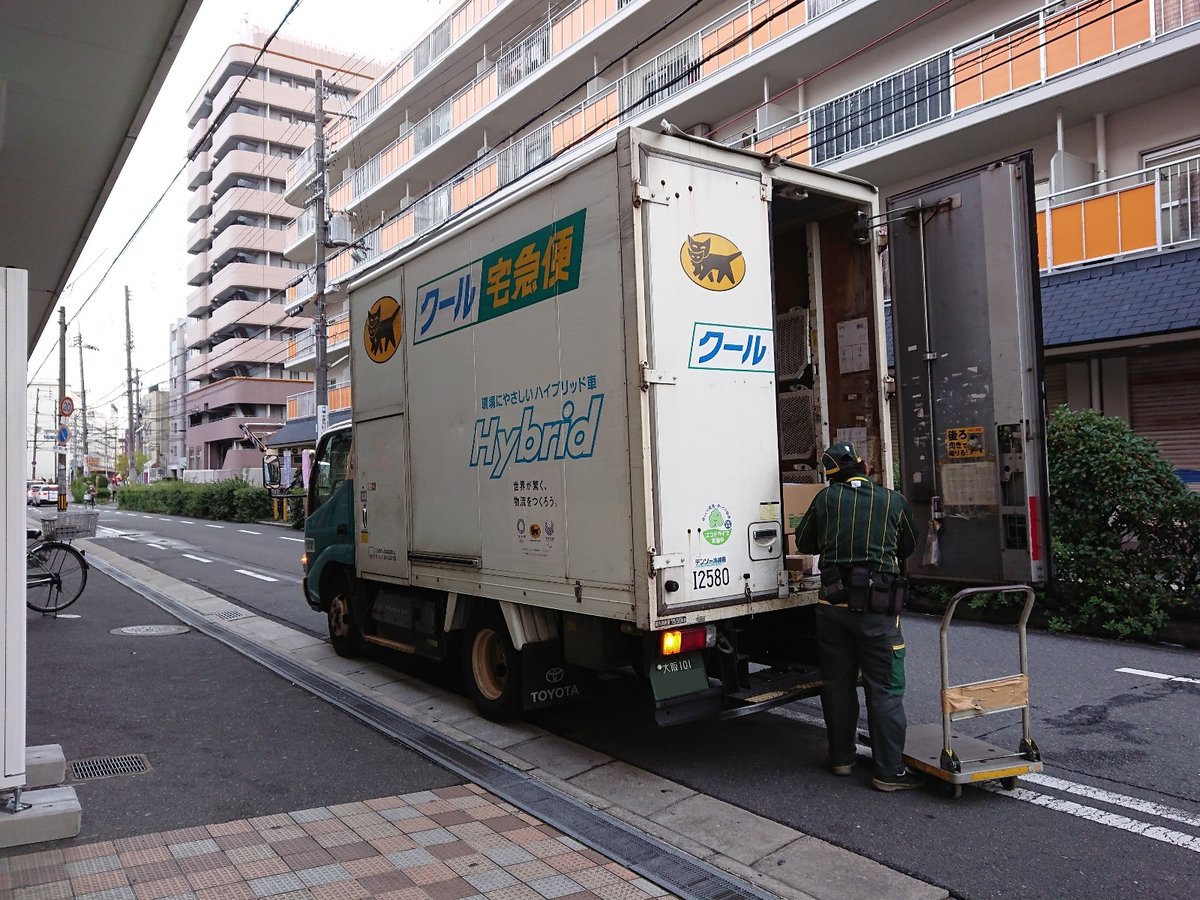
Yamato Transport, the black cat company. Its TA-Q-BIN network is the one most hotels use for luggage forwarding. Photo: Rebirth10, CC BY 3.0
The form is called a waybill, and it is the part visitors worry about. In practice, hotel staff fill in most of these every day and will help you. What the form needs for the destination is:
The hotel's full address
The hotel's phone number
Your name, matching the name on your reservation
Your check-in date, so the hotel knows when to expect both you and the bag
The sender side is simply the hotel you are leaving, which the desk can stamp or write in for you. You choose a delivery date, and you can pick a rough time slot at no extra cost. Have the next hotel's address and phone number ready on your phone, from your booking confirmation, and the whole thing takes five minutes.
If you want to ask in Japanese, this one sentence does the job at any front desk:
「次のホテルに荷物を送りたいです。」
Tsugi no hoteru ni nimotsu wo okuritai desu.
"I would like to send my luggage to my next hotel."
And if the form defeats you, this follow-up is perfectly normal to ask:
「伝票の書き方を手伝ってもらえますか。」
Denpyou no kakikata wo tetsudatte moraemasu ka.
"Could you help me fill in the waybill?"
Two situations where forwarding does not work. First, destinations with nobody to receive the bag: Yamato and the other carriers generally cannot deliver to an unstaffed holiday rental, so check with your host or use a nearby Yamato office or convenience store as the pickup point instead. Second, same-day arrival between cities is not the standard service. Next day is the promise on routes like Tokyo to Kyoto, and two days for Hokkaido, Okinawa and some rural areas. Plan around the gap rather than hoping to beat it.
Forwarding also works in the direction of home, and this is where the timing rule matters most. Yamato's Airport TA-Q-BIN sends your suitcase to your departure airport, where you collect it at the Yamato counter on the day you fly. The airport fare includes a ¥660 airport fee, so a large case from Tokyo to Narita or Haneda costs ¥3,680.
The catch: you must hand the bag over two days before your flight, and three days before from some areas. The bag is delivered to the airport the day before departure and waits for you there. Lead times on airport deliveries lengthened after the 2024 reforms to driver working hours tightened delivery schedules across the industry, and Yamato's two-day deadline is the published rule, not a suggestion. Sending a bag to the airport the day before you fly is the classic way to end a trip carrying it yourself after all.
The same network works on arrival day, in reverse. Counters at Narita, Haneda and Kansai airports will send your bags on to your first hotel, which pairs well with a light first evening in the city. Our airport transport comparison walks through the options for getting yourself into town while the bags take the truck: Narita or Haneda to Tokyo (https://yonihon.com/travel-guide/narita-or-haneda-to-tokyo/).
Forwarding handles the days. Lockers handle the gaps: the morning between checkout and an afternoon train, a stopover city you are visiting between two trains, the shopping you do not want to carry to lunch.
Lockers sit in almost every station, usually near the ticket gates, and at airports. JR East's typical station prices give you the shape of it:
Small (S): about ¥500 a day, for a cabin bag or rucksack
Medium (M): about ¥700 to ¥800 a day, for a medium suitcase
Large (L): about ¥900 to ¥1,000 a day, for a large checked suitcase
Airport lockers run a little cheaper at the big end (a large locker is ¥600 a day at Haneda and ¥800 at Narita). Most modern lockers take an IC card such as Suica or PASMO instead of coins, and the card becomes your key, so do not lose it. Station lockers are charged by the day rather than by the hour, and most let you leave a bag for up to three days.
The one real problem is supply. Large lockers are a small minority of any bank, and at the big stations they are often all taken by mid-morning. If your plan depends on a large locker, go early, and have a fallback: the staffed baggage counters at major stations, or a luggage storage shop near the station, charge a bit more but rarely turn a bag away.
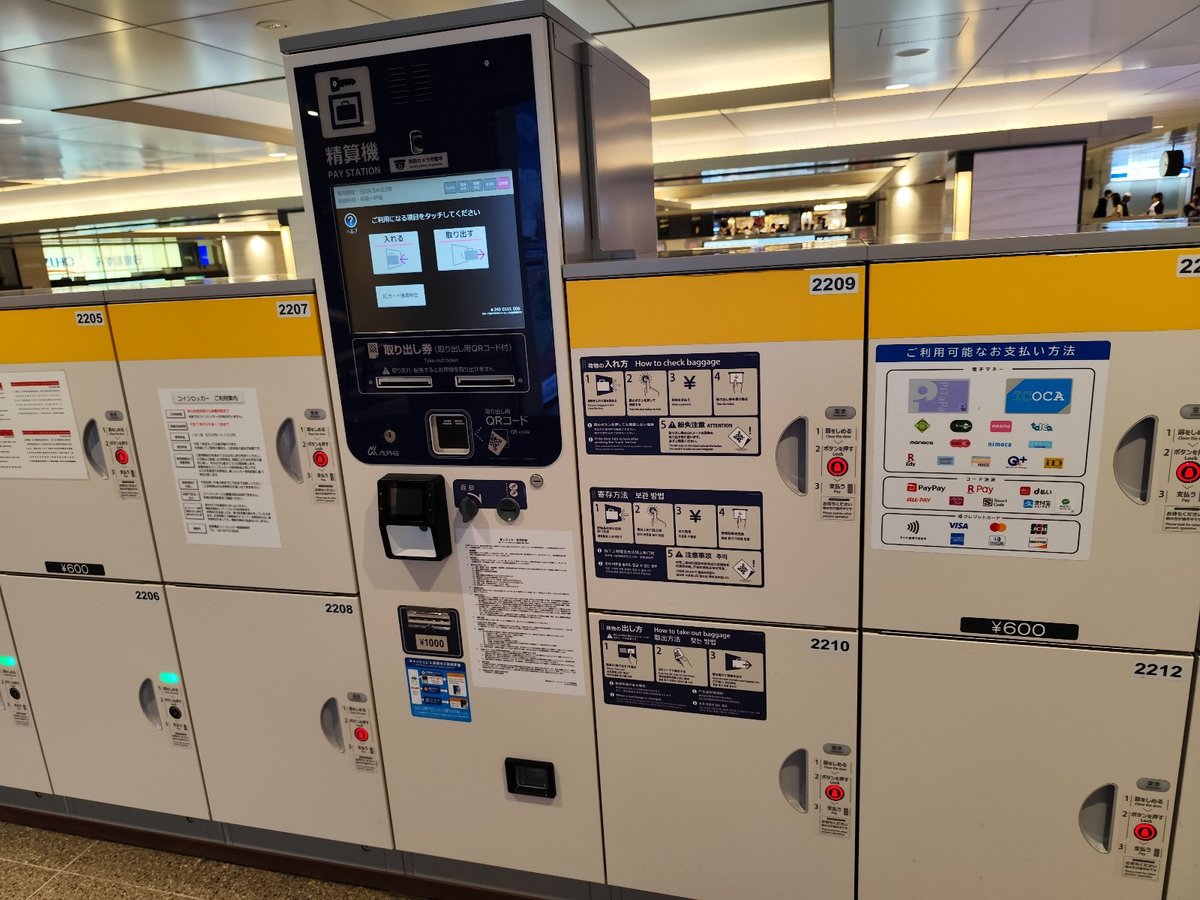
Coin lockers at Osaka Station. Small and medium sizes are plentiful; the large ones go first. Photo: TKdows 2026, CC0
Now the rule that matters on the train itself. On the shinkansen, measure your bag's length, width and height, wheels and handles included, and add them together.
Over 160cm and up to 250cm: on the Tokaido, Sanyo, Kyushu and Nishi-Kyushu shinkansen (the Tokyo to Nagoya, Kyoto, Osaka, Hiroshima, Fukuoka and Kagoshima corridor), you must reserve a seat with an oversized baggage area in advance. These are the last-row seats in certain cars, with storage space behind them. The reservation costs nothing extra on top of the normal reserved seat fare, but the seats are limited, so book early in busy seasons.
Board with an oversized bag and no reservation and the crew will charge you a ¥1,000 carry-on oversized baggage fee and decide where the bag goes. Oversized bags are also not allowed in non-reserved cars on those lines, which rules out the hop-on-any-train approach with a giant case.
The reservation requirement applies to the JR Central, JR West and JR Kyushu lines listed above. The JR East shinkansen (Tohoku, Joetsu, Hokuriku and the lines north and west of Tokyo) run no reservation system for big bags, though the 250cm ceiling still applies. The full picture of lines, passes and booking sits in our transport guide: Getting Around Japan: Trains, IC Cards and the JR Pass (https://yonihon.com/travel-guide/getting-around-japan-trains-ic-cards-jr-pass/).
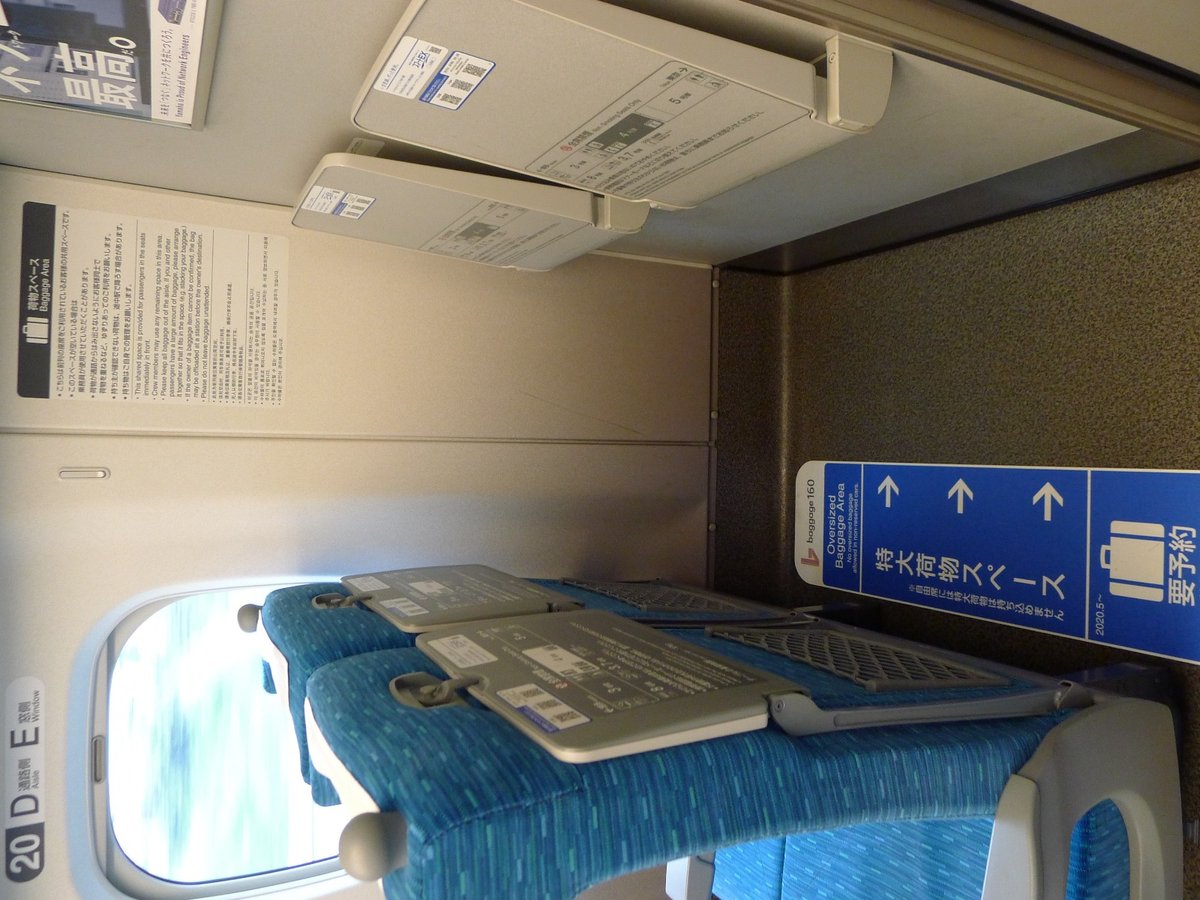
The oversized baggage area behind the last row of seats, reserved along with the seat in front of it. Photo: Indiana jo, CC BY-SA 4.0
Changing cities tomorrow: forward the big case today, travel with the overnight bag, and let the next hotel hold the case until you arrive.
A few hours between trains: a coin locker, the bigger the station the earlier you should claim one.
Flying home in three days: send the suitcase to the airport now, enjoy the last two days unencumbered, and collect it at the Yamato counter before check-in.
Taking a big case on the Tokaido Shinkansen: measure it first. Over 160cm in total means booking a seat with an oversized baggage area when you reserve, not at the platform.
Once you have done it once, the system becomes the way you travel in Japan. The suitcase takes the truck. You take the train, the stairs, the little back street and the standing bar, none of which were designed for a 25kg case, and all of which are better without one.
8 minutes · November 23, 2026
9 minutes · November 23, 2026