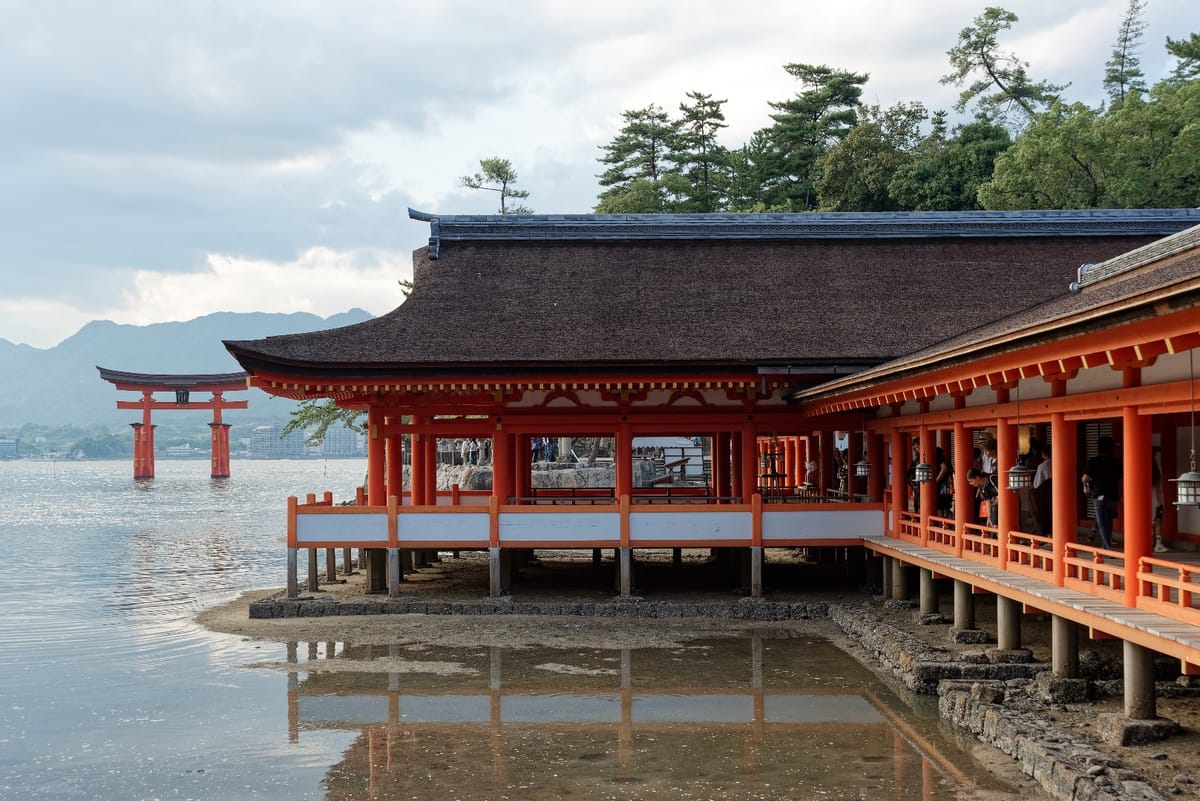
Hiroshima asks something of you, and Miyajima gives something back. That is why the pairing works so well as a day trip, and why the order matters. Do the Peace Memorial Museum first, in the quiet of the early morning, walk the park while the experience settles, and then take the train and the ferry out to an island of shrines, deer and grilled oysters for the afternoon. People who reverse the order usually say the museum felt rushed, or that they carried it around the island with them. This guide sets out the timings that make the day work, the one booking you must not skip, and the tide table check that decides what the famous torii gate will be doing when you arrive.
The Peace Memorial Museum closes for almost a week in mid February 2027, from Monday 15 February to Saturday 20 February 2027, while the exhibition is changed over. It also closes every year on 30 and 31 December. If your trip falls in that February window, the museum will not be open no matter how early you arrive, so either shift the day or build it around the park, the A-Bomb Dome and the National Peace Memorial Hall instead, and give Miyajima the longer visit it deserves anyway. Check the museum's official site for your date before you book trains around it.
The Peace Memorial Museum opens at 7:30 in the morning, all year. Hours run to 19:00 from March to July and September to November, 20:00 in August, and 18:00 from December to February, with last entry 30 minutes before closing. Admission is ¥200 for adults and ¥100 for high school students, and younger children enter free.
Here is the detail most visitors miss. Entry between 7:30 and 8:30, and entry in the last hour or so of the day, is by online reservation only. There are no counter sales in those windows, and each early slot is capped, at around 300 people. In practice this makes the 7:30 slot the calmest way to see the museum's main building, before the school groups and tour parties arrive and the central hours of the day, roughly 11:00 to 15:00, fill up. Web tickets go on sale well in advance, up to 90 days ahead, and the early slots on busy dates sell out. Book the earliest one you can, the moment your travel dates are fixed. At other times of day you can simply buy a ticket at the counter or machines in the East Building, though a web ticket bought ahead still saves queueing.
Allow 90 minutes to two hours inside. The main building's exhibition follows the events of 6 August 1945 and the lives they changed, and it is not a place to hurry. Go in the morning, when you are fresh, and let it be the emotional weight of the day rather than its ending.
The museum sits inside the Peace Memorial Park, which is free, open around the clock, and designed for exactly the decompression you will want afterwards. Walk it in this order. The Cenotaph, the arched monument aligned with the museum, holds the register of victims' names. Beyond it, the Flame of Peace has burned since 1964 and is meant to burn until nuclear weapons are gone. Further north, the Children's Peace Monument, topped by the figure of Sadako Sasaki holding a paper crane, is usually surrounded by colourful crane offerings sent by schoolchildren from around the world. Cross the river at the end for the A-Bomb Dome, the skeletal remains of the former Industrial Promotion Hall, which stood almost directly below the explosion and has been kept as it was left.
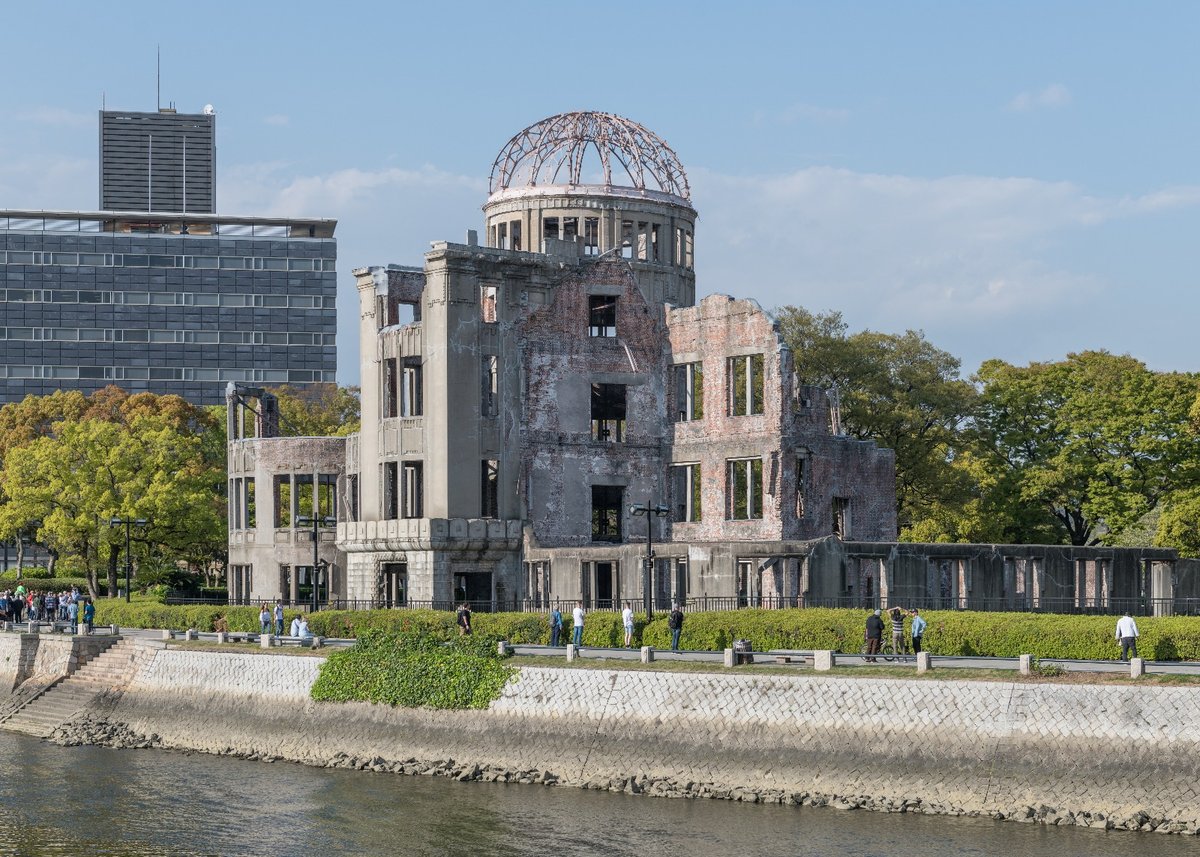
The A-Bomb Dome, Hiroshima. The park walk ends here, and the morning usually ends quietly. Photo: DXR, CC BY-SA 4.0
Give the park 45 minutes to an hour without rushing. Sit down if you need to. There is a rest house in the park with a cafe and a shop, and nobody in Hiroshima will think any less of you for needing a coffee and a pause before the afternoon. This pacing is not wasted time. It is what makes the second half of the day feel like a gift rather than a whiplash.
From Hiroshima Station, take the JR Sanyo Line to Miyajimaguchi, about 25 to 30 minutes and around ¥420, then walk a few minutes to the ferry terminal. From the Peace Park area you can also ride the Hiroden streetcar to Miyajimaguchi, which takes about an hour, slower but scenic and covered by some passes. The ferries themselves cross in about ten minutes and run roughly every 15 minutes through the day.
Two companies sail the same crossing from the same terminal, and both charge ¥200 each way for adults, half for children.
The JR Miyajima ferry. Rail pass holders ride this one free, apart from the ¥100 island visitor tax. Photo: Naokijp, CC BY-SA 4.0
Since October 2023, every visitor to Miyajima pays a visitor tax of ¥100 per person, per visit, set by Hatsukaichi City to help look after the island. You will probably never handle it as a separate payment. Buy a normal ferry ticket and the ¥100 is added to the fare on the way over, so the outbound crossing costs ¥300 and the return ¥200. Pay by IC card and the gates deduct fare and tax together. The exception is rail pass holders. The JR Pass covers the ferry fare but not the tax, so buy the little ¥100 tax ticket from the machine at the pier before you board. Preschool children are exempt, as are island residents. It is a small amount doing visible work, and the island, which receives several million visitors a year onto one small waterfront, spends it on exactly the upkeep you are there to enjoy.
The great torii, the vermilion gate standing in the bay, is the image everyone comes for, and it has two completely different moods. At high water it floats on the sea, reflections and all. At low water the bay empties, and you can walk across the sand and stand at the foot of its pillars, close enough to see the barnacles and the camphor wood grain. Neither is better. They are different experiences, and on a good day, with the right timing, you can sometimes have both about six hours apart.
The mistake is assuming that high tide on the timetable automatically means floating, or that low tide guarantees the walk. What matters is the height, in centimetres, on the Hiroshima Port tide table, which the Miyajima Tourist Association publishes for every day of the year.
Tides run about 50 minutes later each day, so the pattern on your date is yours alone. Look up the table the week before, find the high and low heights for your day, and then set your island schedule around them. If the good high tide falls in the late afternoon, so much the better. The torii is lit in the evening, and the JR ferry runs late enough to enjoy it.
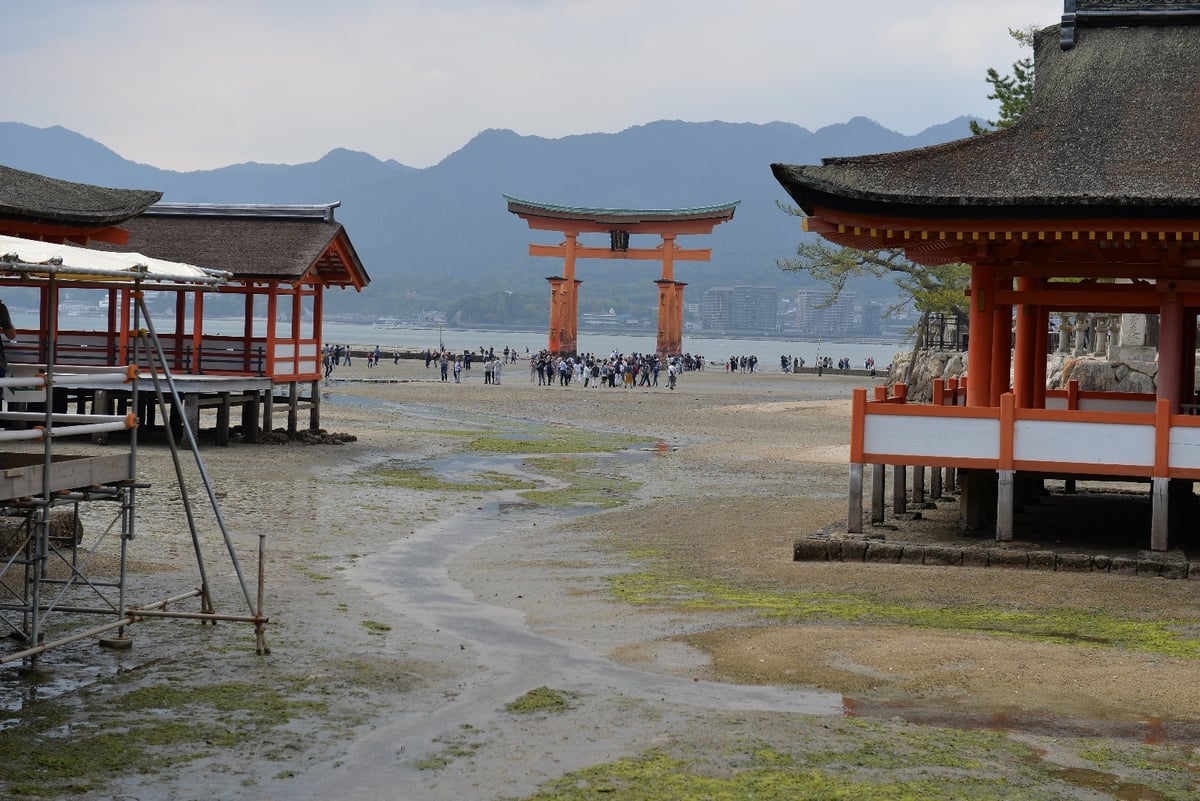
Low tide at the great torii. Below about 100 cm on the tide table, this walk out across the sand is possible. Photo: shankar s., CC BY 2.0
Itsukushima Shrine itself, the complex of lacquered pavilions built over the water on stilts, costs ¥300 for adults to enter, cash, with a combined ticket including the Treasure Hall at ¥500. It opens at 6:30 and closes around 17:00 to 17:30 depending on the season. Walk its corridors at whatever the tide is doing, because the buildings were designed for this exact relationship with the sea.
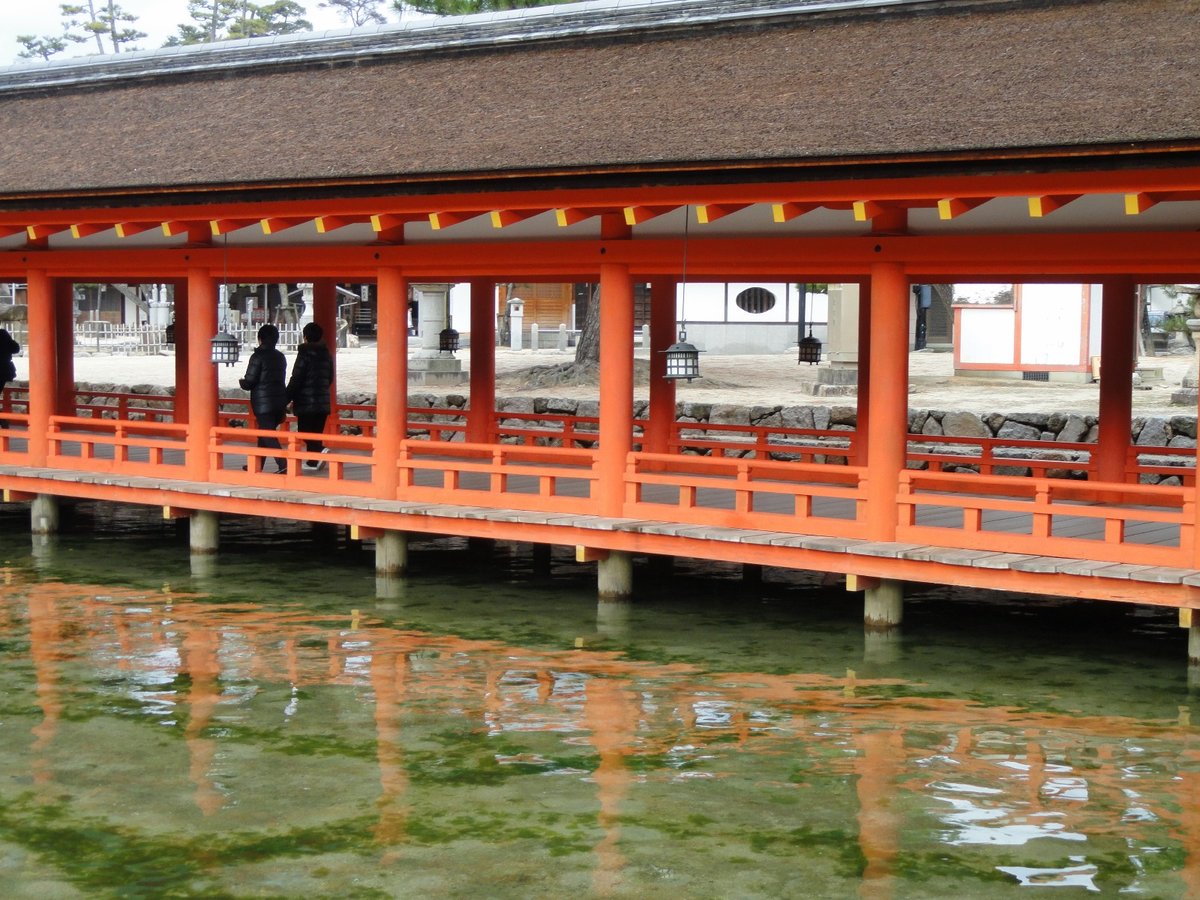
The corridors of Itsukushima Shrine, Miyajima. Photo: Daderot, CC0
Beyond the shrine, the Omotesando shopping street runs from the ferry pier towards the shrine and does a brisk trade in the island's edible souvenirs. Grilled oysters, which Miyajima farms in the bay, anago eel on rice, and momiji manju, the maple leaf shaped cakes filled with red bean paste, some shops frying them fresh or dipping them in batter as age momiji. The deer wandering the waterfront are wild residents, not a petting zoo, so admire them, photograph them, and keep your snacks and paper tickets out of reach, because the deer have strong views on both. If the tide is in its in between phase and you have two spare hours, the ropeway up Mount Misen gives you the Seto Inland Sea spread out below, though on a strict day trip from Osaka it is the first thing to cut.
Starting from Hiroshima city. Museum entry at 7:30 or 8:30, out by 10:00. Park walk until 11:00. Train and ferry, on the island by about 12:30. Shrine, street food lunch and the tide window through the afternoon, ferry back around 17:00 to 18:00, and an evening in Hiroshima, ideally with the local style of okonomiyaki, layered and cooked on a hotplate with noodles inside, before bed or the train home.
Starting from Osaka. This is the version most people attempt, and it works if you start early. The Nozomi shinkansen from Shin Osaka reaches Hiroshima in about 80 to 90 minutes, with a reserved seat costing roughly ¥10,400 to ¥11,150 one way depending on train and season. Leave on a train around 7:00, be at the museum by 9:00 to 9:30 with a web ticket, and the day runs as above, an hour later at every step. Take the JR ferry's late return seriously, leave the island by about 19:30 to 20:00, and you can be back in Osaka around 22:30. It is a long day. It is also, done in this order, a deeply satisfying one. If you are building Hiroshima into a longer route, our 10 Days in Japan itinerary (https://yonihon.com/travel-guide/10-days-in-japan-itinerary/) shows where a Hiroshima night fits, and staying over is the one upgrade that improves everything, because Miyajima at dawn, before the day trippers land, is a different island.
The pass question. If Hiroshima is part of a wider western Japan trip, the Kansai Hiroshima Area Pass (¥17,000 for five days at the time of checking) covers the Sanyo Shinkansen between Shin Osaka and Hiroshima, including reserved seats, plus the JR ferry. Two discounted one way shinkansen tickets can work out cheaper for the day trip alone, so run your own numbers. Our guide to Getting Around Japan (https://yonihon.com/travel-guide/getting-around-japan-trains-ic-cards-jr-pass/) explains how the national JR Pass and the regional passes compare, and whether either pays off for your route.
People sometimes worry that pairing a memorial museum with a pretty island in one day is somehow disrespectful. Hiroshima itself does not see it that way. The city's whole postwar identity is built on holding both things at once, remembrance in the morning and ordinary, joyful life continuing around it. Go to the museum properly, without a phone in your hand and without one eye on the ferry timetable. Then go to Miyajima and eat the oysters and enjoy the gate in the evening light, properly too. That is not a contradiction. That is the day the city would want you to have.
8 minutes · November 23, 2026
9 minutes · November 23, 2026
9 minutes · November 23, 2026