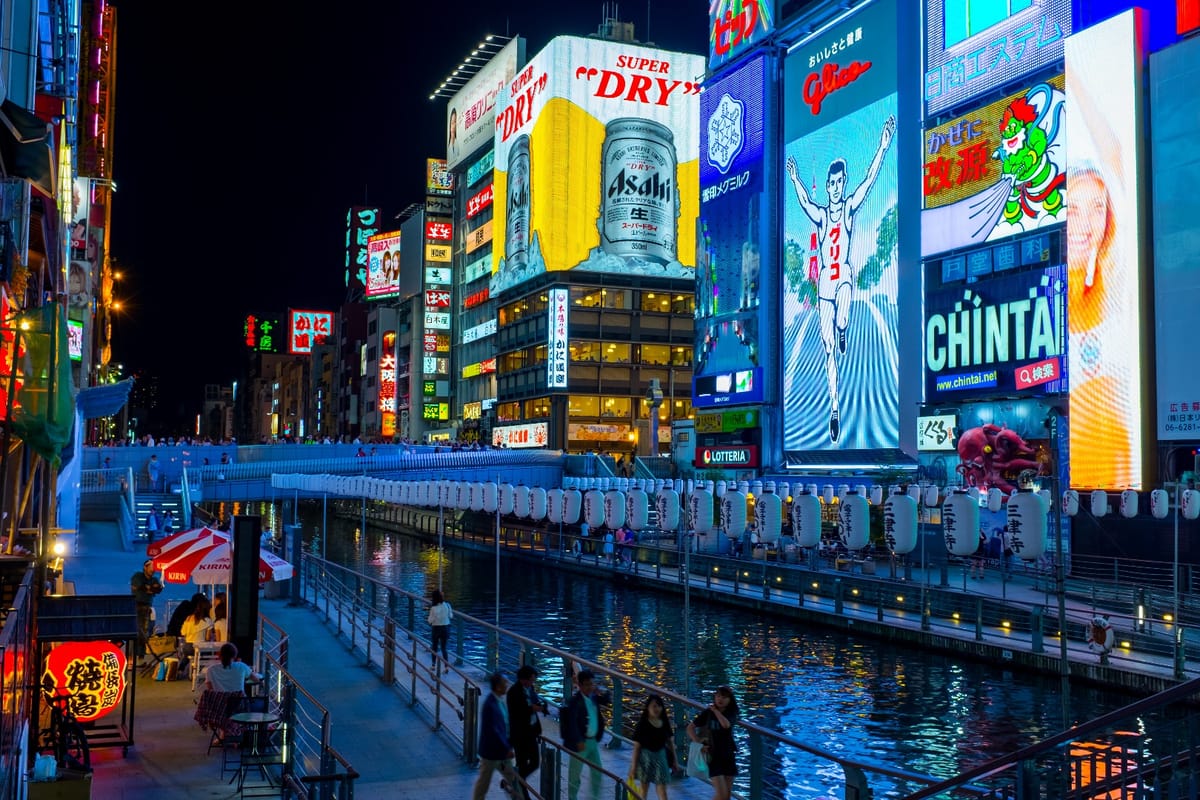
Osaka runs on a different setting to Tokyo. The signs are bigger, the portions are bigger, and strangers will talk to you. It is also a city that punishes a vague plan. The castle, the neon and the food sit in three different corners, and if you zigzag between them you will spend your two days inside subway stations.
So split the city the way this guide does. Day one is the north and the history: Osaka Castle in the morning, Umeda in the afternoon. Day two is the south and the eating: Shinsekai, Namba and Dotonbori, timed so you reach the canal when the lights come on. Two days done this way cover Osaka properly. A third day buys you Universal Studios Japan, a day trip, or a slower version of day two.
Two full days is the honest minimum, and three is comfortable. One day forces a choice between the castle and Dotonbori that nobody enjoys making.
A useful way to think about it: Osaka is often the base, not the stop. Kyoto is 15 minutes away by shinkansen and under an hour by ordinary express trains, and Nara is about 40 minutes. Plenty of travellers sleep in Osaka for four or five nights and treat it as the hub for the whole of Kansai, which works well because Osaka's evenings are better than anywhere else in the region and its hotel prices usually undercut Kyoto's.
The two sensible bases are Namba in the south and Umeda in the north. Both are big rail hubs. They feel like different cities.
Namba puts Dotonbori, the covered shopping arcades and most of the famous food within walking distance of your hotel door. Evenings need no planning: you step out and you are in it. The trade-off is that Namba is a tangle. The station complex stacks several railway and subway companies on top of each other, first-time visitors routinely surface from the wrong exit, and the streets stay busy and a little gritty late into the night. Choose Namba if food and nightlife are the point of your Osaka stay.
Umeda is the business end: wider streets, department stores, and Osaka Station, which is the better hub for Kyoto, Kobe and the airport trains. Hotels here skew larger and more corporate, and the area is tidier and easier to read. The trade-off is that Umeda goes quiet earlier, and you will ride the subway south to eat in Dotonbori most nights. Choose Umeda if Osaka is your transport base for Kansai and you like your evenings calm.
Either way, stay within a few minutes' walk of a Midosuji Line subway station if you can. That one line connects Umeda, Shinsaibashi, Namba and Tennoji, which is most of where you will go.
Go first thing. The castle keep opens at 9:00, and arriving near opening time means you walk the top floor viewing deck before the tour groups reach it. The keep is a 1931 reconstruction, and it is honest about it: inside is a museum, eight floors of armour, models and the story of Toyotomi Hideyoshi, the warlord who built the original in the 1580s. The stone walls and moats, though, are the real thing, and they are the most impressive part. Some of the stones are the size of a room.
Entry to the keep costs ¥1,200 for adults. University and high school students pay ¥600 with ID (overseas students should show an ISIC card), and children aged 15 and under are free with proof of age. Last entry is 17:30 and the keep closes at 18:00. The park around it is free, so if castles bore you, walk the grounds and skip the museum without guilt.
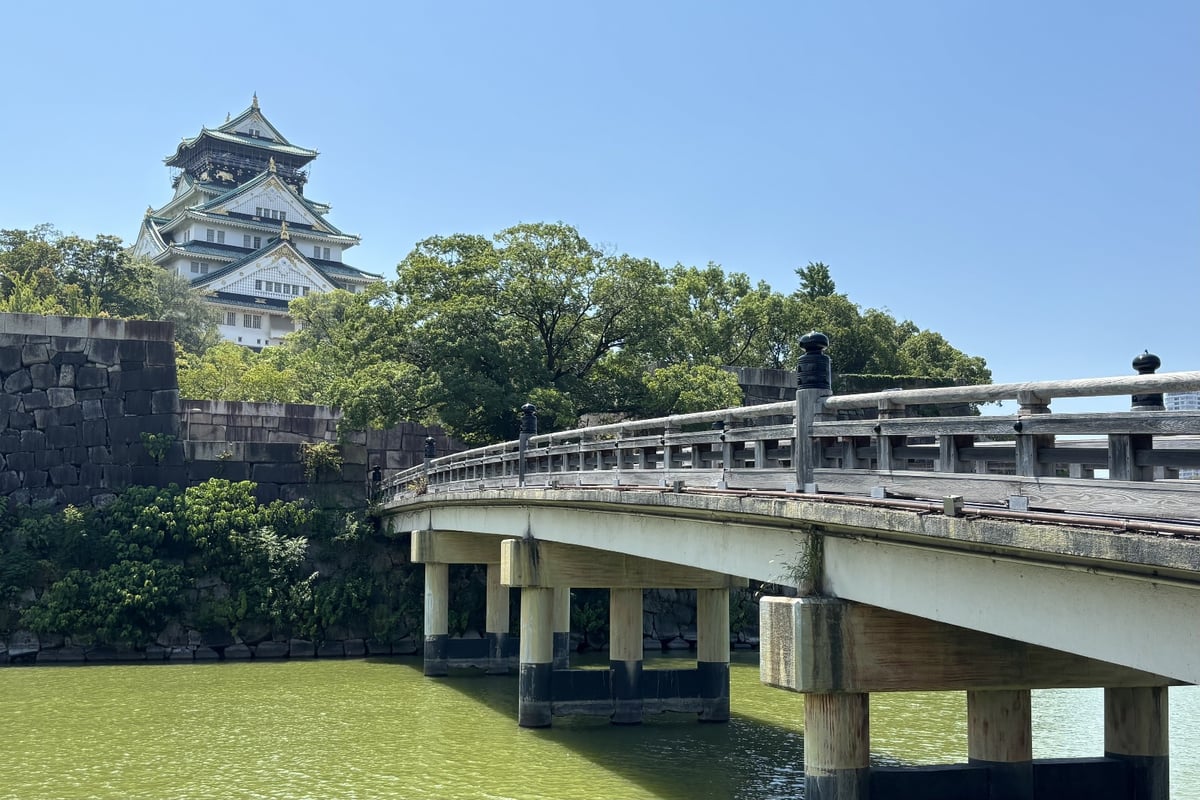
Osaka Castle from Gokurakubashi Bridge. The walls and moats are original; the keep is a museum. Photo: Sakai Yayoi, CC0
Give the castle and park about two hours. Nearest stations are Osakajokoen on the JR Loop Line and Tanimachi Yonchome or Morinomiya on the subway. Afterwards, drift north to Umeda. It is a short ride on the JR Loop Line from Osakajokoen to Osaka Station.
Umeda rewards a loose plan. The department stores around Osaka Station (Grand Front Osaka, Lucua, the Hankyu and Hanshin stores) are a full afternoon if shopping is your sport, and their basement food floors are worth the trip alone.
The one fixed point is the Umeda Sky Building, about a ten-minute walk west of the station. Two towers joined at the top by the Floating Garden Observatory, an open-air rooftop ring 173 metres up. On a clear late afternoon you can time it for the shift from daylight to city lights, which is the best hour to be up there. It is also a sensible place to get your bearings: Dotonbori's glow to the south, the castle park's green rectangle to the east.
Eat dinner in Umeda if you like. The streets around the station and the Kitashinchi district just south of it are full of places aimed at people who work here rather than people passing through, which is usually a good sign.
Start day two in Shinsekai, the retro district under the Tsutenkaku Tower. It was built in 1912 to look futuristic, spent a century getting shabby, and now its faded neon and lantern-strung lanes are exactly the charm. Come hungry: this is kushikatsu country, and lunch here is the day's main event (the food section below explains what to order).
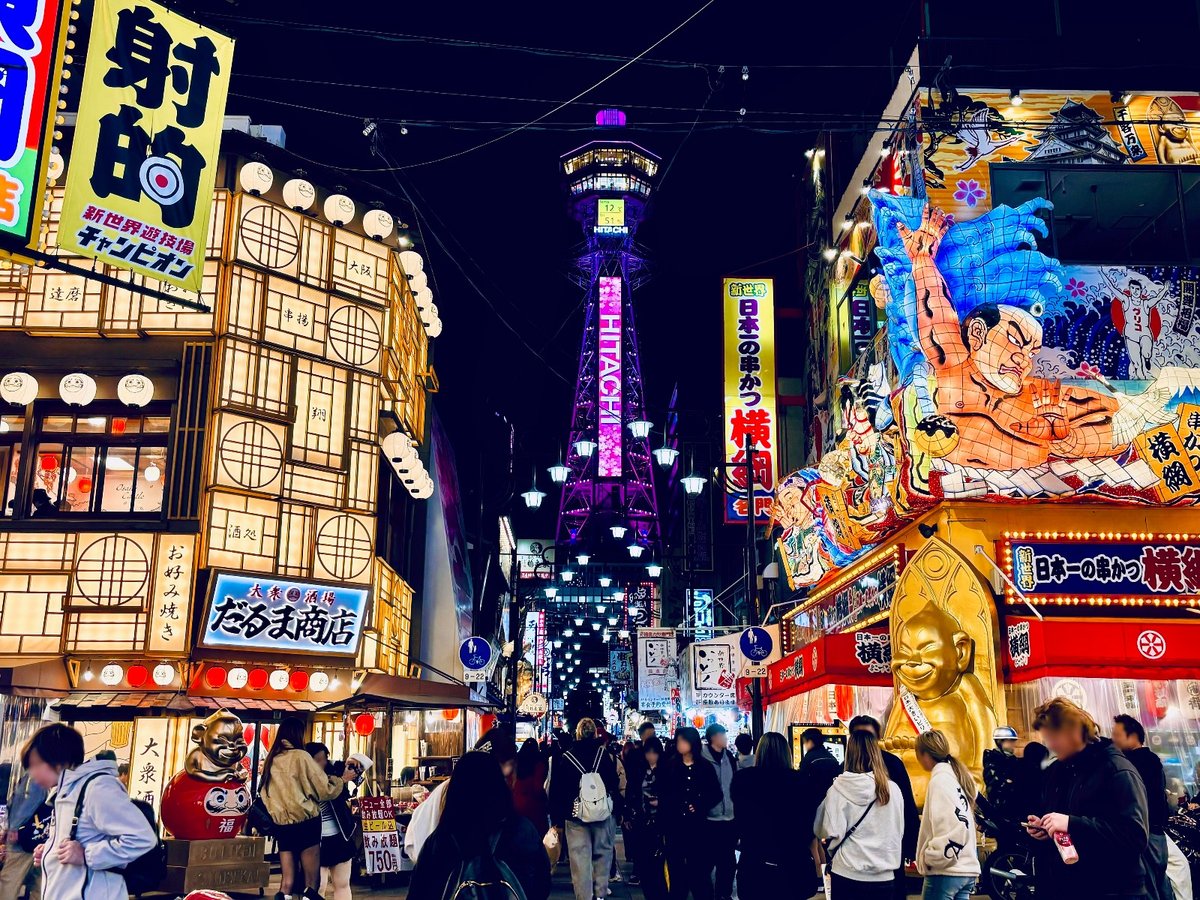
Tsutenkaku Tower over Shinsekai, Osaka's retro eating district. Photo: Sakai Yayoi, CC0
Tsutenkaku itself can be admired from street level. Go up only if the queue is short. The streets below are the attraction.
Walk or ride one stop north to Namba and spend the afternoon in the arcades. Shinsaibashi-suji runs north from Dotonbori under a glass roof for hundreds of metres of shops. Amerikamura, west of it, is Osaka's youth district, all vintage clothing and record shops. Den Den Town, east of Namba, is the electronics and anime quarter, Osaka's answer to Akihabara and usually cheaper.
If you want one market, Kuromon Ichiba sits just east of Namba station: a covered food market of roughly 150 stalls where you can graze on grilled seafood, wagyu skewers and fruit so expensive it needs its own security mindset. Prices are tourist-facing, so treat it as a tasting walk rather than lunch.
Save Dotonbori for the evening. In daylight it is a canal with signs. At night, with everything lit and reflected in the water, it becomes the postcard. Walk the canal path on both banks, cross at Ebisubashi Bridge, and take the obligatory photo with the Glico running man, which has been sprinting over the canal in one form or another since 1935. Everyone does the arms-up pose. You will too.
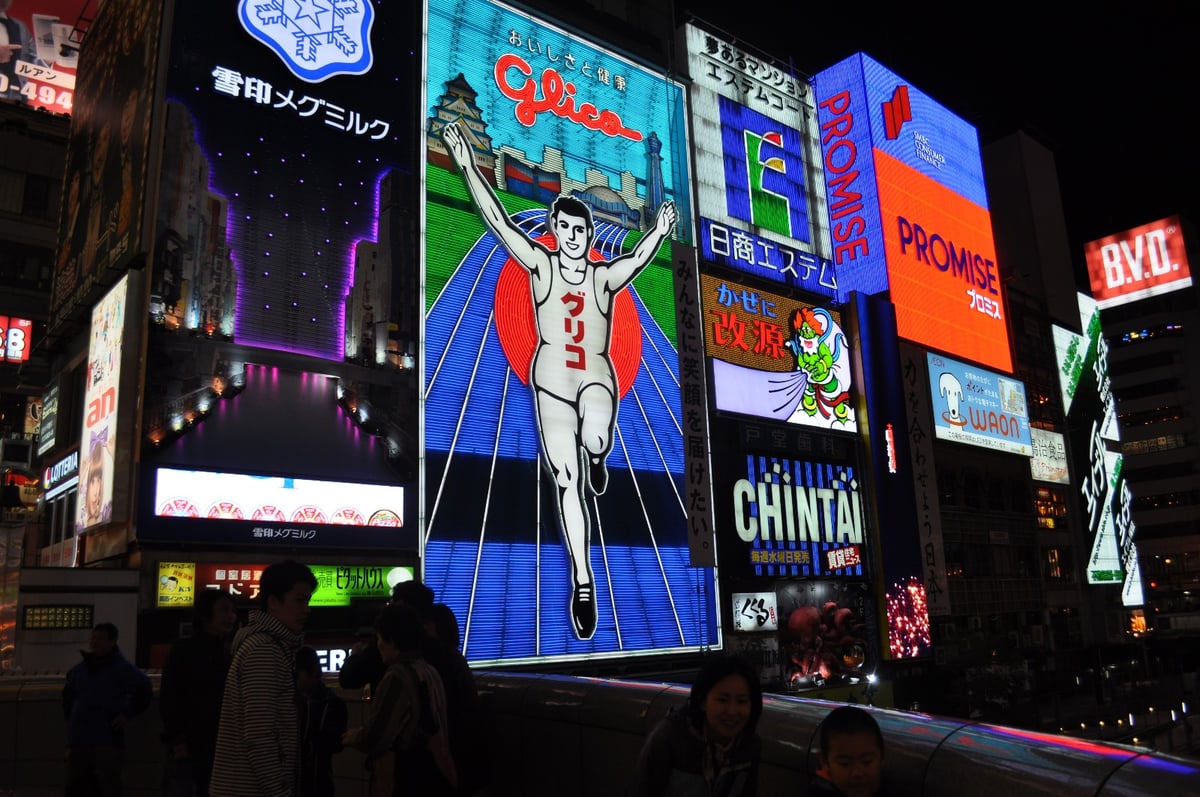
The Glico running man, Dotonbori's meeting point since long before smartphones. Photo: Schellack, CC BY-SA 3.0
Then eat your way along the side streets rather than the canal frontage itself. Hozenji Yokocho, a stone-paved lane just south of Dotonbori's main strip, is quieter, older and better for a sit-down dinner, and the moss-covered Fudo statue at Hozenji Temple, splashed with water by generations of wish-makers, is worth the two-minute detour.
Osaka's nickname is tenka no daidokoro, the nation's kitchen, and the local verb is kuidaore: eat until you drop. Three dishes carry the city's reputation. Our full rundown of Japanese dishes, including these three in more depth, is in What to Eat in Japan: 15 Must-Try Dishes (https://yonihon.com/travel-guide/what-to-eat-in-japan/).
Takoyaki. Balls of batter with a piece of octopus inside, turned in a dimpled iron pan until they are crisp outside and almost liquid in the middle, then sauced, mayonnaised and covered in bonito flakes that wave in the heat. Roughly ¥600 to ¥800 for eight. Two warnings every Osakan gives: the centre is far hotter than you expect, and the famous shops on the Dotonbori strip charge more than the same quality a street back. Wanaka and Kukuru are the names everyone queues for; Aizuya, which claims to have invented takoyaki in the 1930s, serves an older, sauce-free style worth trying for contrast.
Okonomiyaki. A thick cabbage batter pancake, mixed (in Osaka style, everything is stirred together before grilling, unlike Hiroshima's layers) with pork, seafood or both, finished with sauce, mayo and aonori seaweed. Roughly ¥900 to ¥1,500 depending on toppings, with noodle-stuffed modan-yaki at the top of that range. Mizuno in Dotonbori is the famous queue; Chibo and Fukutaro in Sennichimae are where you go when the queue wins.
Kushikatsu. Skewers of meat, seafood and vegetables in a fine breadcrumb coat, deep fried and dunked in a thin, tangy sauce. Roughly ¥120 to ¥300 a skewer, so a satisfying session with a beer lands around ¥1,500 to ¥2,500. The rule, posted on every table and enforced with feeling: no double dipping. The sauce pot is shared, so your skewer goes in once, before you take a bite. Cabbage leaves are provided free as a sauce spoon and palate cleanser. Daruma, founded in 1929, is the Shinsekai institution; its Dotonbori branches charge more for the same skewers.
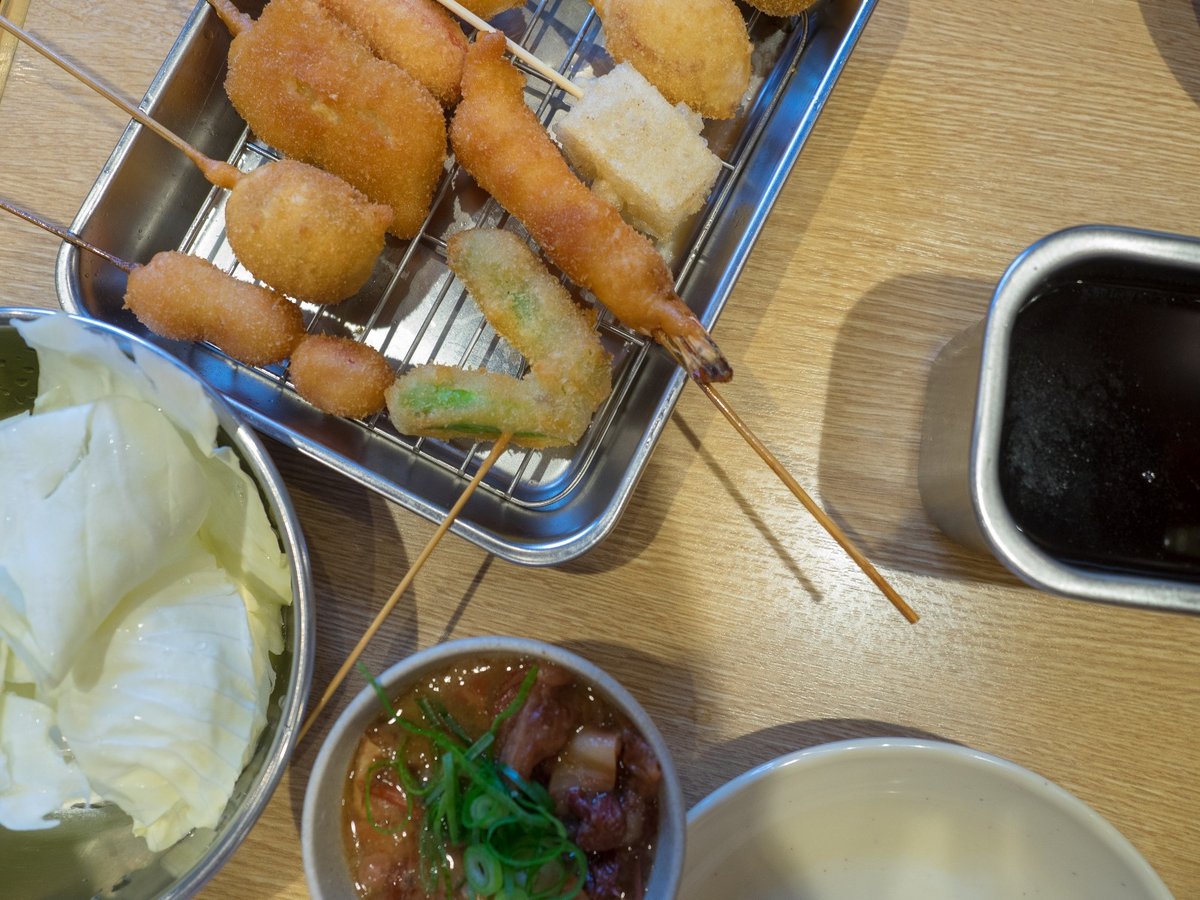
Kushikatsu in Shinsekai, where the dish was born. One dip in the sauce, never two. Photo: Ajay Suresh, CC BY 2.0
Carry cash for the food crawl. Stalls and small shops in Dotonbori and Shinsekai are still heavily cash based, and the ones that take cards are rarely the ones with the queue you want to join.
USJ sits on Osaka Bay, about 11 minutes by JR train from Osaka Station to Universal City Station. It is a full day, not a half day bolted onto sightseeing, so the real question is whether it deserves one of your two or three days. That depends on one thing: how much Super Nintendo World matters to you.
The mechanics, verified on USJ's official site. You need a dated Studio Pass, priced by the day, and prices can rise as a date fills, so the calendar on the official ticket store is the only reliable figure (recent adult 1-Day prices have run roughly ¥8,600 to ¥11,900). Entry to Super Nintendo World is separately controlled. On most days you need an Area Timed Entry Ticket: free, but only obtainable in the official USJ app after you have entered the park, and on busy days the day's slots can be gone by mid-morning. Once they run out, the app switches to a standby lottery, which is luck, not a plan.
The alternative is a Universal Express Pass. It is an add-on, not admission, and versions that include a Nintendo ride (Mario Kart, Yoshi's Adventure or Mine Cart Madness in Donkey Kong Country) come with guaranteed timed entry to Super Nintendo World printed on them. The trade-off is money: Express Passes are priced by date and ride line-up and commonly cost as much again as the Studio Pass, and the Nintendo versions sell out weeks ahead for weekends and holidays.
The honest verdict. If Nintendo is the reason you are coming, buy the Express Pass and treat the day as a theme park day, full stop. If you are curious but not devoted, go on a weekday, be at the gates before opening (the park often opens ahead of its published time), claim the free timed entry in the app the moment you are through the turnstiles, and accept the small risk. If neither sounds appealing, Osaka will feed you better for a third of the cost, and Kyoto is half an hour away. Our guide to the hands-on side of Kyoto, Best Things to Do in Kyoto Beyond Temples (https://yonihon.com/travel-guide/kyoto-beyond-temples/), is the place to plan that swap.
8 minutes · November 23, 2026
10 minutes · November 23, 2026
9 minutes · November 23, 2026
