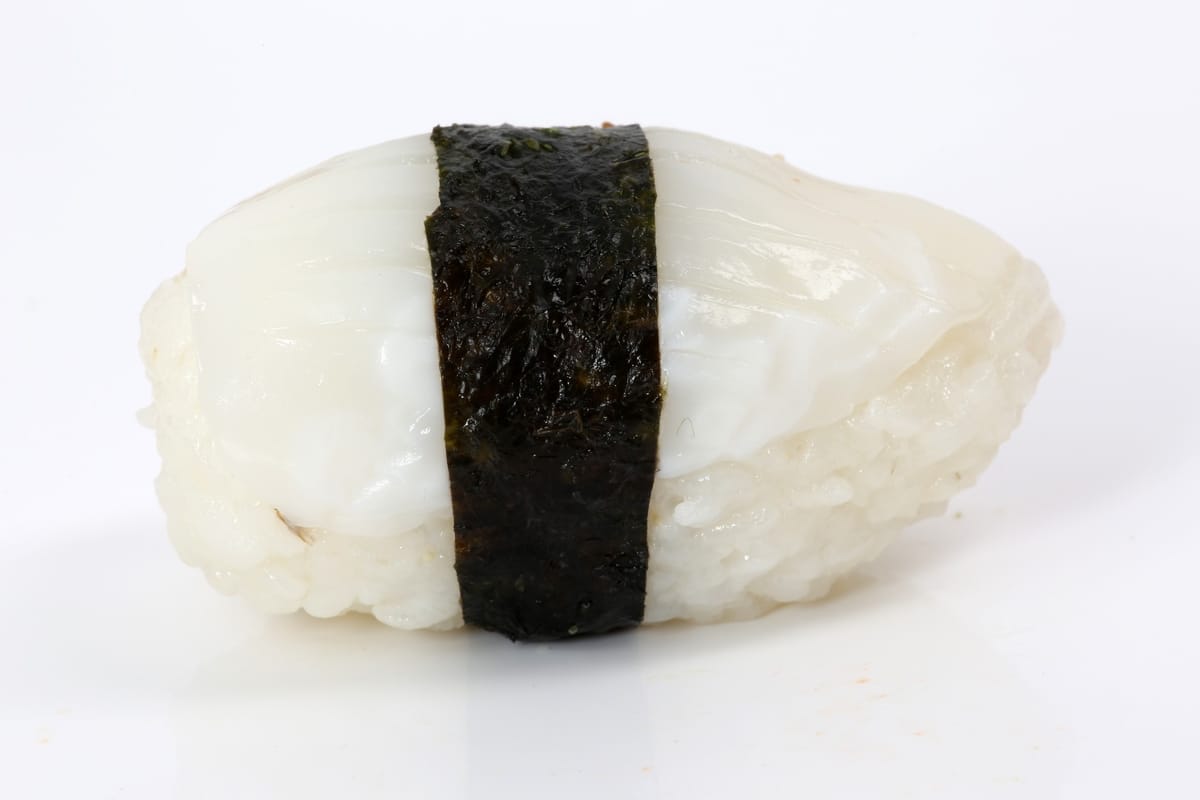
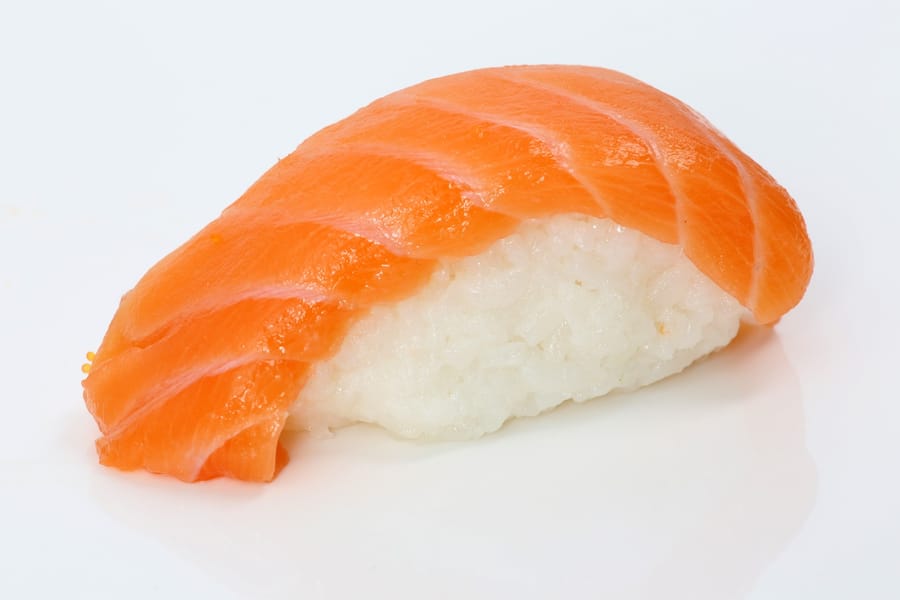
Sushi, the dish most visitors arrive dreaming about, and only the start of the list. Photo: Tim Reckmann, CC BY 2.0
Eating well in Japan rarely depends on finding a famous restaurant. It depends on knowing what things are called. The best lunch of a trip is often a ¥900 bowl in a six seat shop with a Japanese only menu, and the only barrier between you and it is vocabulary.
Here are fifteen dishes worth knowing by name: what each one is, what goes into it, where you will find it, and what it usually costs. After the dishes comes the part that worries people most, how ordering actually works, from ticket machines to asking what is in the stock. Prices are typical ranges for ordinary shops, checked in November 2026, tax included. Famous names and big city centres can sit above them.
The main events
Vinegared rice seasoned with rice vinegar, sugar and salt, paired with seafood, egg or vegetables. Nigiri is a hand pressed mound of rice with the topping draped over it; maki are the rolls cut from a seaweed wrapped cylinder.
Where to find it: almost everywhere. Conveyor belt shops (kaitenzushi) price by plate colour, counter restaurants put the chef in front of you, and department store food floors sell excellent boxed sushi to take away.
Typical price: conveyor plates start at ¥120 at the big chains (Sushiro, November 2026); a satisfying conveyor meal runs ¥1,000–2,500 per person. Lunch sets at counter shops are often ¥1,500–3,000. An omakase dinner, where the chef chooses, starts around ¥8,000 and climbs steeply.
One useful habit: dip the fish side of nigiri lightly in soy sauce, not the rice, which soaks up too much and falls apart.
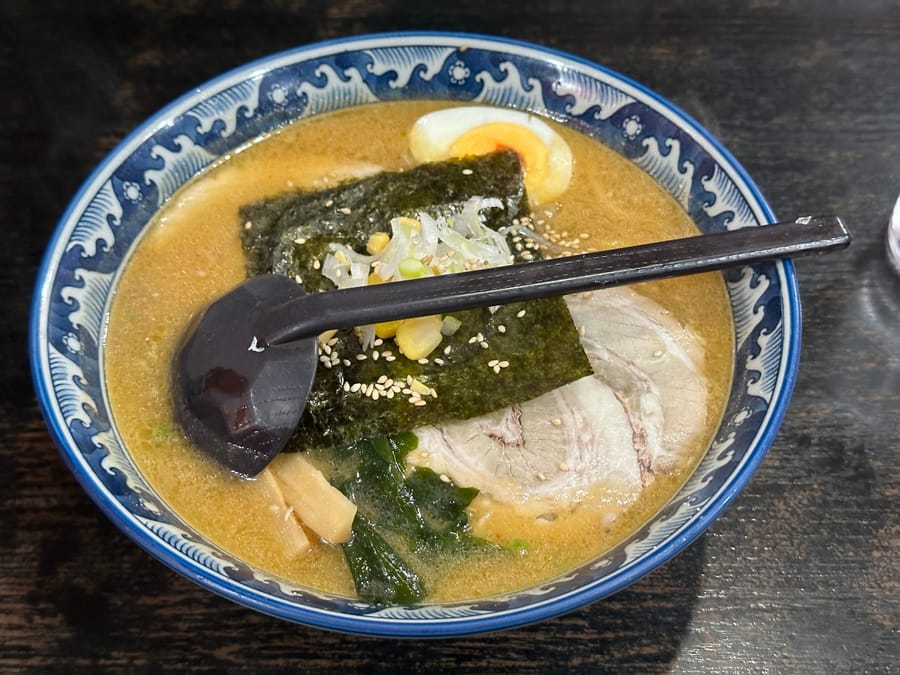
Wheat noodles in a hot, deeply flavoured broth, topped with sliced roast pork (chashu), a seasoned soft egg, spring onions, nori seaweed and pickled bamboo shoots (menma). The broth defines the bowl: shio (salt) is the lightest, shoyu (soy sauce) the Tokyo classic, miso the hearty northern style from Sapporo, and tonkotsu a milky, slow cooked pork bone broth from Fukuoka.
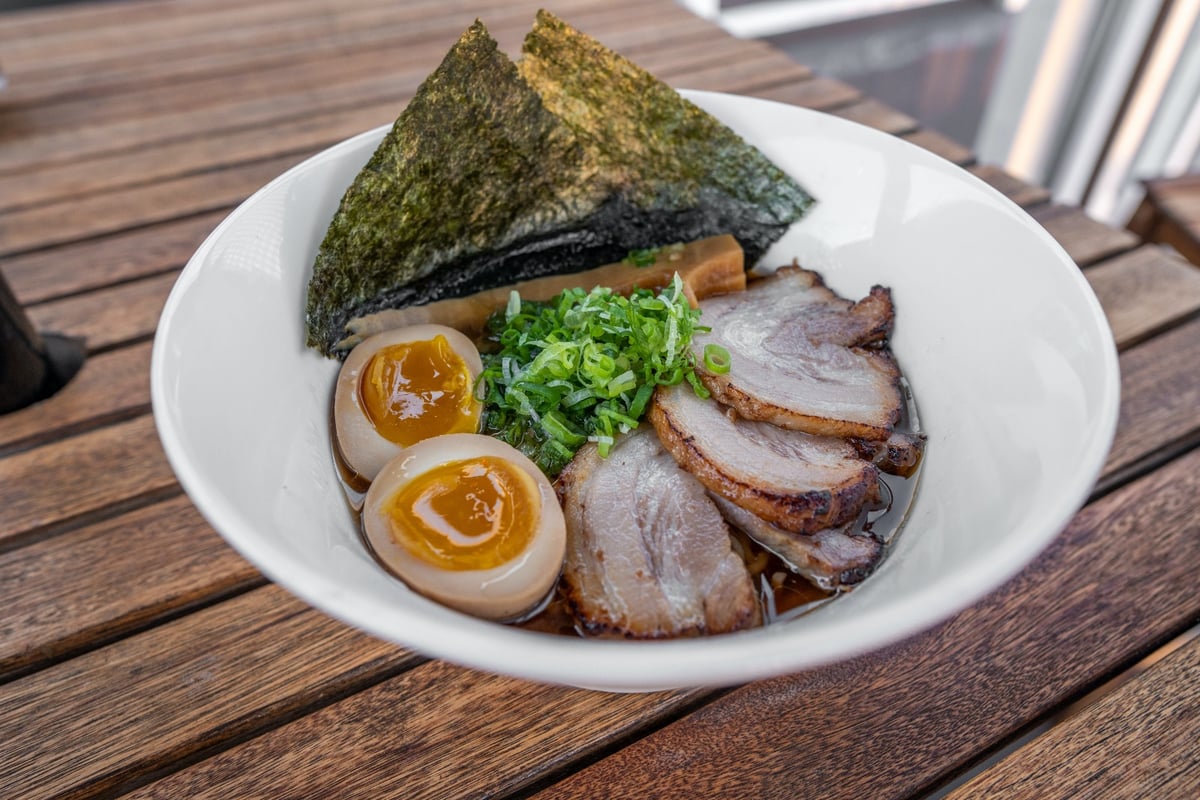
Ramen, with the two toppings that matter most: chashu pork and a seasoned egg. Photo: 0Zephiron0, CC BY-SA 4.0
Where to find it: dedicated ramen shops, usually small, fast and focused on one style. Many use a ticket machine (see the ordering section below).
Typical price: ¥800–1,200 for a standard bowl. Ichiran, the best known tonkotsu chain, charges ¥980–1,180 (2026). Extra noodles (kaedama) cost ¥100–200, extra toppings ¥100–150.
Slurping is normal and expected. It cools the noodles and nobody will blink.
Noodles made from buckwheat flour, sometimes cut with a little wheat. Eaten cold on a woven tray (zaru or mori soba) with a concentrated dipping sauce (tsuyu), or hot in a lighter broth. Wasabi and spring onion go into the dip, not on the noodles. After a cold soba meal, staff may offer soba-yu, the hot noodle cooking water, to mix with the leftover dip and drink like soup.
Where to find it: soba restaurants from neighbourhood shops to smart specialists, plus standing soba counters inside stations, which serve commuters in about four minutes flat.
Typical price: ¥500–900 for a plain bowl or tray. A set with tempura runs ¥1,100–1,600.
Keep soba in mind for the dietary section below: buckwheat is one of Japan’s major allergens.
Prawns, white fish, squid and vegetables such as sweet potato, pumpkin, aubergine and shiso leaf, coated in a very light batter of flour, egg and cold water and fried for a minute or two. Good tempura is crisp, pale and not at all greasy. It comes with tentsuyu, a warm dip of dashi, soy sauce and mirin with grated daikon and ginger stirred in, or simply with salt.
Tempura at Kobayashiya in Itakura, Gunma, a restaurant in front of Raiden Shrine that has been frying since 1836. Photo: Fred Cherrygarden, CC BY-SA 4.0
Where to find it: tempura specialists, soba shops, and as tendon, a bowl of rice topped with tempura under a sweet soy glaze, one of the great cheap lunches.
Typical price: a tendon lunch is usually ¥900–1,400. Tempura sets run ¥1,500–2,500, and counter restaurants, where each piece arrives straight from the fryer, cost considerably more.
A thick pork cutlet coated in panko breadcrumbs and deep fried until the crust shatters. Rosu (loin) is juicier and fattier, hire (fillet) leaner. It arrives sliced, on a mountain of shredded cabbage, with a thick, sweet, Worcestershire style sauce. As a set (teishoku) it comes with rice, miso soup and pickles, and cabbage and rice refills are often free.
Where to find it: tonkatsu restaurants everywhere, from chains to old family shops. Nagoya does a famous variation, miso katsu, under a dark red miso sauce.
Typical price: ¥1,100–1,800 for a set.
A thick, dark, gently sweet curry sauce, closer to a rich stew than to an Indian or Thai curry, served over white rice with red fukujinzuke pickles at the side. The standard version carries onion, carrot, potato and pork or beef.
Where to find it: curry shops, station restaurants and chains. CoCo Ichibanya, the largest, lets you choose rice quantity, heat level and toppings from a long list; its pork curry with 300 g of rice is ¥646 on the official menu (November 2026).
Typical price: ¥650–1,100 for a standard plate, around ¥1,000–1,200 with a pork cutlet on top (katsu curry).
The representative rice bowl (donburi). Chicken and sliced onion are simmered in dashi, soy sauce and mirin, then bound with beaten egg cooked just until it sets in soft folds, and slid over rice. The name means parent and child: the chicken and the egg.
Where to find it: donburi shops, soba restaurants and casual chains, often as a fast lunch. Its bowl mates are worth knowing too: gyudon (beef and onion in sweet soy sauce, ¥480 for a regular at Sukiya in 2026) and katsudon (a tonkatsu cutlet given the same egg treatment).
Typical price: ¥600–900.
Thin slices of beef simmered at the table in a shallow iron pot of warishita, a sweet blend of soy sauce, sugar and mirin, with tofu, spring onion, greens, mushrooms and glassy shirataki noodles. Each piece is lifted out and dipped in beaten raw egg, which cools it and softens the sweetness. Its close relative shabu-shabu cooks the same ingredients in plain hot water, with ponzu and sesame dips instead.
Where to find it: sukiyaki specialists, often in handsome old buildings, and all you can eat chains for a more relaxed budget.
Typical price: ¥3,500–7,000 per person, with lunch the cheaper way in. This is the celebratory entry on the list, priced accordingly.
From the grill and the griddle
Chicken on bamboo skewers, grilled over charcoal and seasoned either with tare, a sweet soy glaze, or shio, plain salt. Order by the skewer and by the cut: momo (thigh), negima (thigh with spring onion), tsukune (minced chicken balls), kawa (crisp skin) and reba (liver) for the committed.
Where to find it: yakitori shops and izakaya, in the evening. For the alley bars and market streets where yakitori smoke drifts over the lane, see our guide to Tokyo’s yokocho alleys and shotengai streets (https://yonihon.com/travel-guide/tokyo-yokocho-and-shotengai-guide/).
Typical price: ¥150–280 per skewer. A handful of skewers and a drink makes a light dinner for ¥1,500–2,500.
Crescent dumplings with thin skins and a filling of minced pork, cabbage, garlic, ginger and nira chives. The standard serving is yaki-gyoza, fried on one side until the base crisps, then steamed in the same pan so the tops stay tender. The dip is soy sauce, rice vinegar and a few drops of chilli oil, mixed to your taste. Utsunomiya and Hamamatsu both claim to be Japan’s gyoza capital, and both make a decent case.
Where to find it: gyoza specialists, ramen shops (as the classic side order), Chinese restaurants and izakaya.
Typical price: ¥300–600 for a plate of five or six.
A savoury pancake of wheat flour batter, egg and shredded cabbage, with pork, seafood or cheese worked in, cooked on a hot iron plate (teppan) and finished with a sweet brown sauce, mayonnaise in fine lines, aonori seaweed powder and bonito flakes that curl in the heat. The name means grilled as you like it.
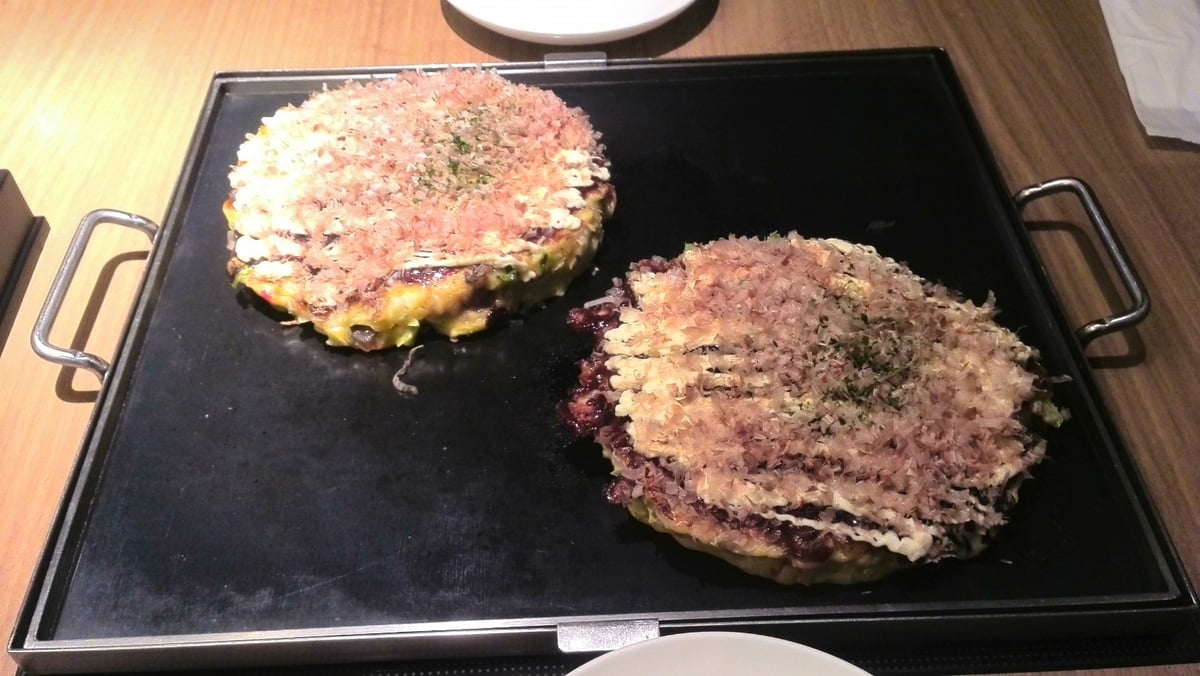
Okonomiyaki on the teppan, under the bonito flakes. In many shops you cook it yourself, with staff rescuing first attempts. Photo: Grueslayer, CC BY-SA 4.0
Two regional styles divide opinion. Osaka mixes everything into the batter. Hiroshima layers instead: a thin crepe like base, a pile of cabbage, yakisoba noodles, and an egg on top.
Where to find it: okonomiyaki restaurants, thickest on the ground in Osaka and Hiroshima. Some cook for you; some hand you the bowl and the spatulas and watch with interest.
Typical price: ¥800–1,300.
Osaka’s signature street snack: balls of wheat batter cooked in a dimpled iron pan, each holding a piece of octopus (tako) with pickled ginger, spring onion and tenkasu (crunchy tempura scraps). The cook turns them with picks until they are round and browned, then they are sauced like okonomiyaki. The centres stay molten for longer than you expect. Give them a minute.
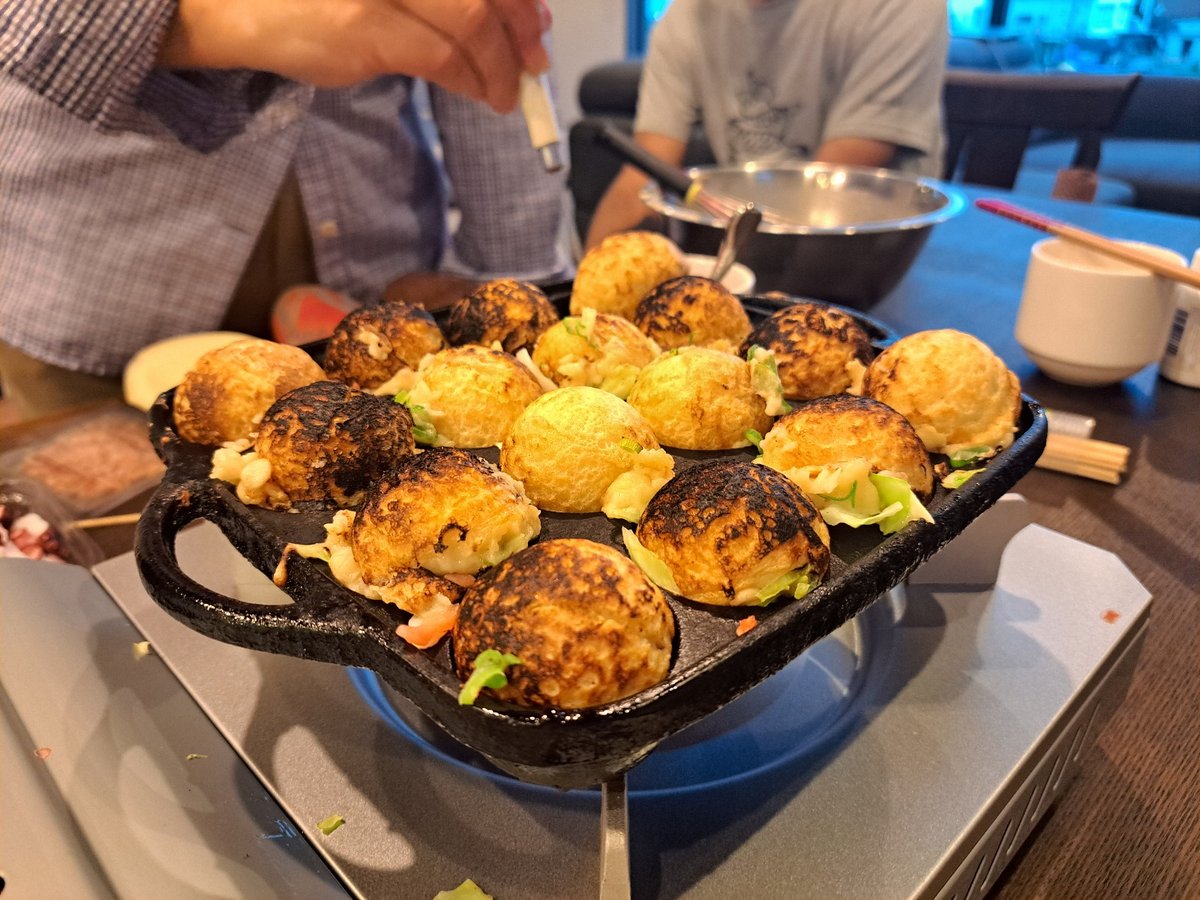
Takoyaki in the pan. The turning, done with two picks, is half the show. Photo: GiveMeMollusks, CC0
Where to find it: takoyaki stands and shops, festival stalls, and the food streets of Osaka above all.
Typical price: ¥500–800 for six to eight balls.
Tokyo’s own griddle dish, the okonomiyaki family’s unruly relative. The batter is far runnier and the ingredients (cabbage, seafood, mentaiko cod roe, cheese, mochi) are chopped fine. It cooks as a thin, bubbling layer on the teppan and is eaten straight off the iron with a small spatula, scraping up the crisped edges as you go. It tastes far better than it photographs.
Where to find it: Tsukishima in Tokyo, where Nishinaka-dori, nicknamed Monja Street, holds dozens of monja shops in a few hundred metres.
Typical price: ¥900–1,500 per pan, usually shared between two or more people. Staff will happily cook the first one and show you the technique.
Small, quick and sweet
A ball or triangle of salt seasoned rice around a filling, wrapped in crisp nori seaweed. Fillings run from the traditional (umeboshi pickled plum, grilled salmon, kombu seaweed, okaka bonito flakes with soy) to tuna mayonnaise, the modern convenience store champion. Onigiri is breakfast, train food, picnic food and the 3 pm rescue, all in one.
Where to find it: convenience stores everywhere, plus specialist onigiri shops where the rice is shaped to order and the fillings get more ambitious.
Typical price: ¥130–250 in a convenience store, ¥250–400 at a specialist. If the seaweed comes separately in the wrapper, pull the tabs in the numbered order printed on the packet, 1, 2, 3, and the nori stays crisp.
A fish shaped cake, griddled in a heavy iron mould, with a crisp, waffle like crust and a soft filling. The fish is a sea bream (tai), a symbol of good luck. The classic filling is anko, sweet red bean paste; custard cream is the other standard, and chocolate, sweet potato and seasonal specials rotate through.
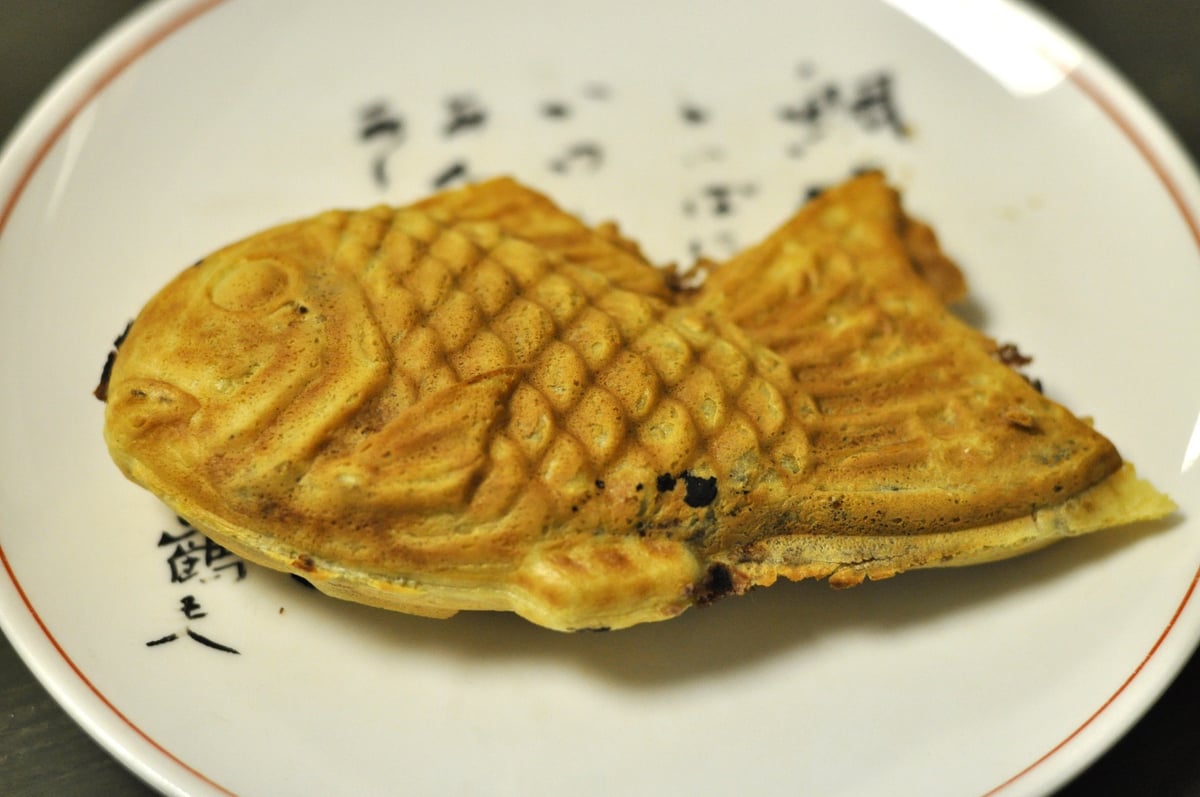
Taiyaki, named for the sea bream it is shaped like. The head first or tail first question has no correct answer. Photo: Ocdp, CC0
Where to find it: street stalls, festival stands, shopping streets and taiyaki specialists, where the queue tells you the batch timing.
Typical price: ¥150–300 each. Eat it hot, on the spot.
The fifteen at a glance
| Dish | What it is | Usual ingredients | Where to look | Typical price |
|---|---|---|---|---|
| Sushi | Vinegared rice with seafood, egg or vegetables | Rice, rice vinegar, fish and seafood, nori, wasabi | Conveyor belt shops, sushi counters, depachika food floors | Plates from ¥120; meals ¥1,000–2,500 |
| Ramen | Noodles in a rich broth with toppings | Wheat noodles, pork or chicken broth, chashu, egg, nori | Ramen shops, often ticket machine | ¥800–1,200 |
| Soba | Buckwheat noodles, cold with dip or hot in broth | Buckwheat flour, dashi based tsuyu, spring onion, wasabi | Soba restaurants, station standing counters | ¥500–900 |
| Tempura | Seafood and vegetables in light batter, fried | Prawn, fish, vegetables, flour and egg batter, dashi dip | Tempura shops, tendon lunch shops, soba shops | ¥900–2,500 |
| Tonkatsu | Breaded deep fried pork cutlet, usually a set | Pork loin or fillet, panko, cabbage, tonkatsu sauce | Tonkatsu restaurants | ¥1,100–1,800 |
| Japanese curry | Thick, mild curry sauce over rice | Curry roux, onion, carrot, potato, pork or beef, rice | Curry shops and chains such as CoCo Ichibanya | ¥650–1,100 |
| Oyakodon | Chicken and egg simmered over rice | Chicken, egg, onion, dashi, soy sauce, mirin, rice | Donburi shops, soba shops, chains | ¥600–900 |
| Sukiyaki | Beef simmered at the table in sweet soy | Beef, soy sauce, sugar, mirin, tofu, greens, raw egg dip | Sukiyaki specialists, hotpot restaurants | ¥3,500–7,000 per person |
| Yakitori | Charcoal grilled chicken skewers | Chicken cuts, tare glaze or salt | Yakitori shops, izakaya | ¥150–280 per skewer |
| Gyoza | Pan fried dumplings with crisp bases | Pork, cabbage, garlic, nira chives, wheat skins | Gyoza shops, ramen shops | ¥300–600 |
| Okonomiyaki | Savoury cabbage pancake from a hot plate | Flour batter, egg, cabbage, pork or seafood, sauce, mayonnaise | Okonomiyaki restaurants in Osaka and Hiroshima | ¥800–1,300 |
| Takoyaki | Batter balls with octopus, turned in a pan | Wheat batter, octopus, pickled ginger, spring onion, sauce | Takoyaki stands, Osaka food streets, festivals | ¥500–800 |
| Monjayaki | Runny griddle batter eaten off the iron | Thin batter, cabbage, seafood, mentaiko, cheese, mochi | Tsukishima Monja Street, Tokyo | ¥900–1,500 per pan |
| Onigiri | Rice ball with a filling, wrapped in nori | Rice, salt, nori, plum, salmon or tuna mayonnaise | Convenience stores, onigiri specialists | ¥130–400 |
| Taiyaki | Fish shaped griddled cake with a sweet filling | Wheat batter, anko red bean paste or custard | Street stalls, taiyaki shops, festivals | ¥150–300 |
How to order: the ticket machine, step by step
Many ramen, soba, curry, gyudon and set meal shops take your order before you sit down, through a machine by the door called a shokkenki. It looks forbidding and is actually simple:
Counter ordering and table service
At a sushi counter or a yakitori shop you order gradually, a few pieces or skewers at a time, which lets you pace the meal and the bill. At a sushi counter you can order your own choices piece by piece (okonomi) or take the chef’s set course (omakase), whose price should be stated or posted. Unsure where to start? Osusume, the chef’s recommendation, does the job.
At table service restaurants the pattern is closer to home, with two differences. Many tables have a call button; press it rather than waving. And menus very often carry photographs of every dish, while the plastic food models (sampuru) in the window outside are accurate enough to order from: plenty of people photograph the model and show the picture to staff. So yes, picture menus are common, in chains almost universal. The exceptions are small specialist shops with a short handwritten Japanese menu, where the osusume trick earns its keep. QR code and tablet ordering, usually with an English option, is spreading fast in city restaurants.
Paying, without the awkward moment
If you used a ticket machine, you have already paid. Everywhere else, the bill arrives at your table, often face down or on a small clipboard. In most restaurants you take it to the register by the door when you are ready to leave; in smarter places you pay at the table.
At registers and counters you will see a small tray. Money and cards go on the tray, not directly into the staff member’s hand, and your change and receipt come back on it.
Cards and IC cards are accepted in most city restaurants and all chains, but small family shops still run on cash, so carry some. There is no tipping in Japan, at any point, and leaving cash on the table can result in staff running after you to return it. To split the bill, ask at the register: betsubetsu de onegaishimasu (separately, please).
A few phrases that do real work
Checking what is in it: allergies and diets
Here is the honest difficulty. A dish’s name tells you its headline ingredient, not everything in the bowl, and the gap matters if you have an allergy or you do not eat meat or fish.
The main thing to understand is dashi, the stock that underpins a large share of Japanese cooking. Miso soup, noodle broths and dipping sauces, simmered dishes, the dip served with tempura, even the egg in an oyakodon are usually built on dashi made from katsuobushi (dried bonito flakes), sometimes combined with kombu seaweed. A dish that looks entirely vegetable based may still be cooked in a fish stock. Vegetarian and vegan travellers meet this constantly: there is no malice in it, dashi is simply the default seasoning, and many kitchens cannot swap the base stock of a dish made in bulk. Some can offer a kombu or mushroom dashi if asked, and shōjin ryōri, the Buddhist temple cuisine, is fully plant based by design. But ask; do not assume from the menu description.
For allergies, packaged food in Japan must label eight allergens: egg, milk, wheat, buckwheat (soba), peanut, shrimp, crab and walnut, which makes convenience store labels genuinely useful. Restaurant menus are less standardised, although chains increasingly publish allergen charts. Buckwheat deserves a special warning: soba is a serious allergen, and soba shops commonly cook udon in the same water, so cross contact is a real question to ask about.
The reliable method is to ask the staff directly, in words or in writing:
A written allergy or dietary card in Japanese, printed before the trip or saved on your phone, is worth the small effort: staff take written requests seriously and will often take the card to the kitchen to check. If the answer comes back uncertain, believe it and choose a different dish.
9 min · November 24, 2026
8 min · November 24, 2026