Sushi is the one meal almost every visitor to Japan plans in advance, and the one with the widest price range in the country. The same word covers a ¥120 plate grabbed off a moving belt and a ¥30,000 counter course booked a month ahead. Both can be excellent. The trick is knowing which format you are walking into, what it should cost, and how ordering works once you sit down, or in one format below, stand up.
This guide walks through the four main ways Japan eats sushi: conveyor belt shops, standing bars, mid-range set restaurants, and high-end omakase counters. For the wider menu beyond sushi, see our guide to what to eat in Japan (https://yonihon.com/travel-guide/what-to-eat-in-japan/). Prices are typical ranges checked in November 2026, tax included.
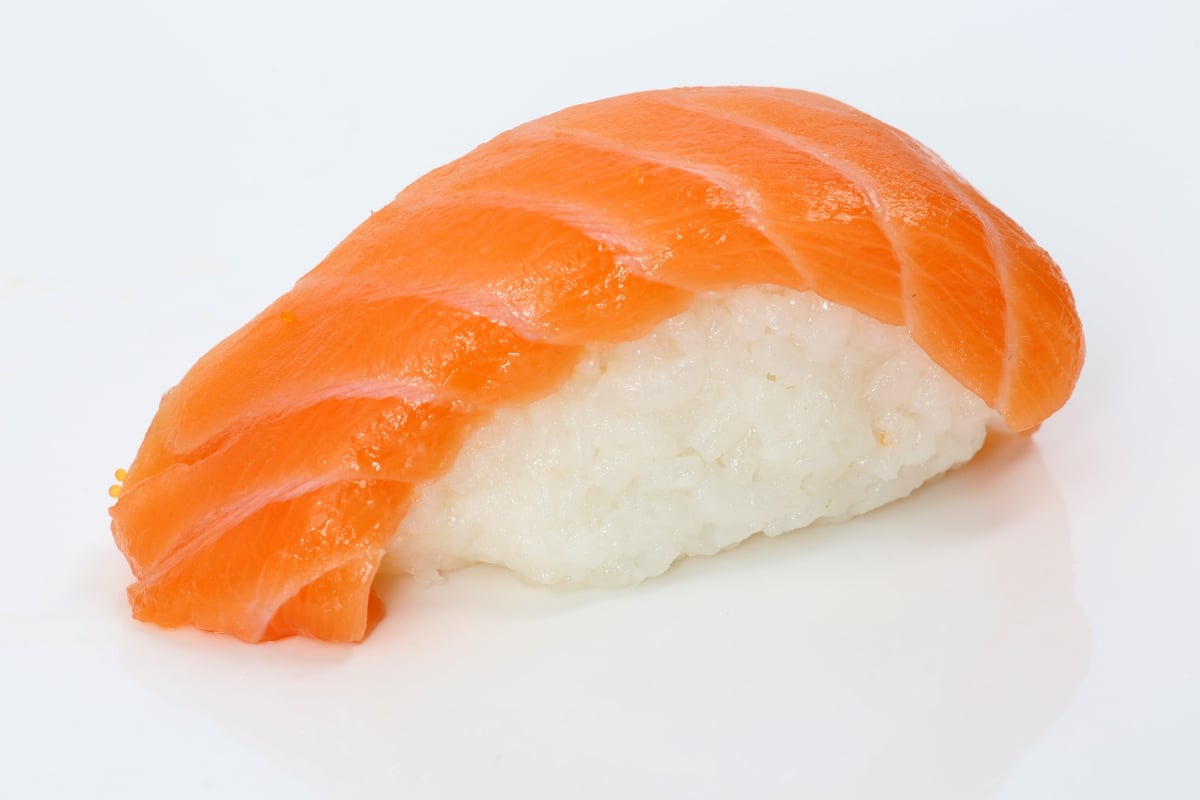
Nigiri, one piece at a time: salmon, tuna, prawn, tamago omelette, mackerel and a salmon roe gunkan. Photo: Tim Reckmann, CC BY 2.0
Kaitenzushi, conveyor belt sushi, is the easiest first sushi meal in Japan. You are seated at a counter or booth in front of a moving belt, plates circulate, and anything that takes your fancy comes off the belt and onto your table. Each plate holds one or two pieces. At the big chains the colour or pattern of the plate sets the price, and your bill is a count of the stack in front of you.
Modern chains run a second system alongside the belt. A touch panel at your seat, usually with an English option, lets you order specific items, and they arrive on a fast express lane above the belt, sometimes on a little shinkansen shaped carrier. Order this way when you want something particular: it arrives fresher than a plate that has been doing laps, and at Sushiro, the largest chain, the menu runs to more than 100 items including ramen and desserts.
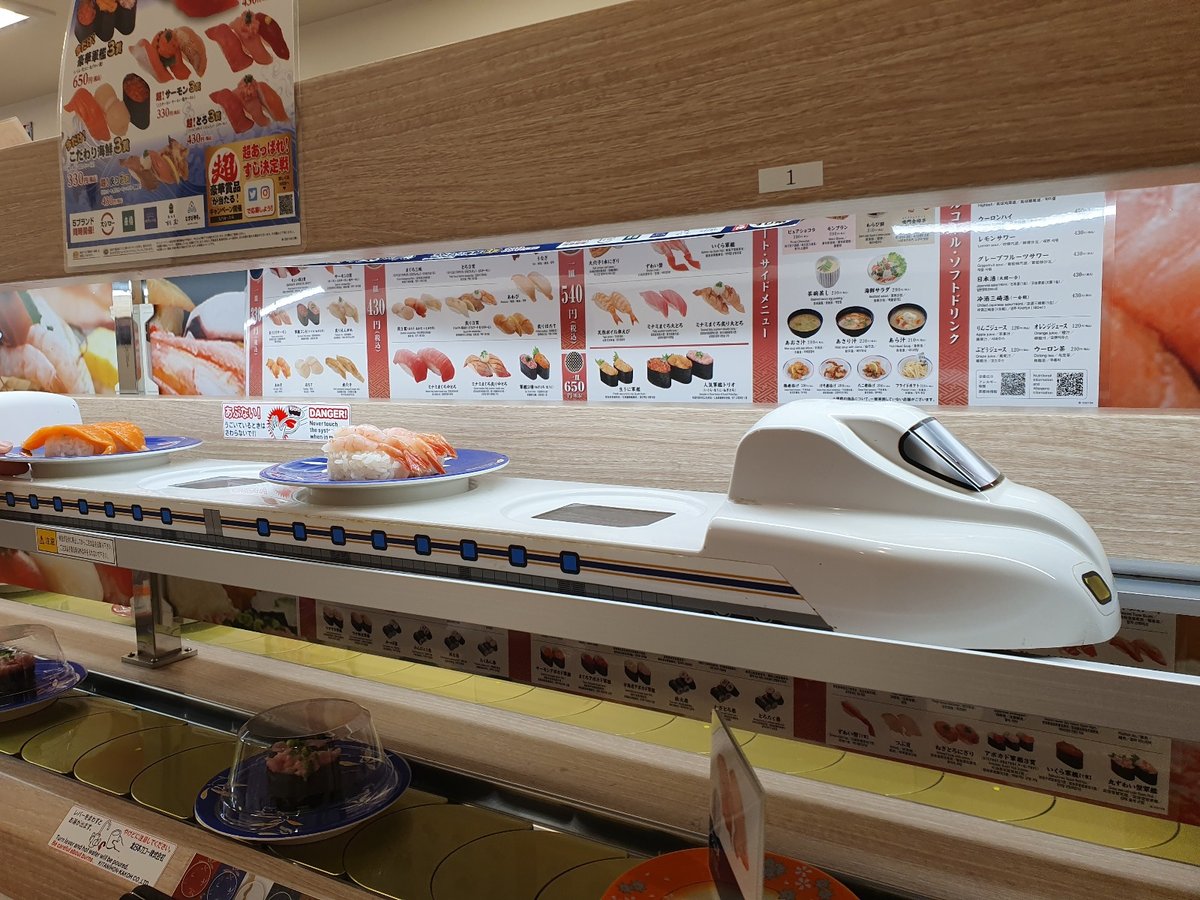
Order on the touch panel and your plate rides the express lane. The ordinary belt still circulates below. Photo: Syced, CC0
What it costs: plates at Sushiro start at ¥120 including tax, although the chain is upfront that prices vary by shop, and central city branches start higher. Premium plates, fatty tuna, sea urchin, a small tower of salmon roe, run ¥300 to ¥650. A normal adult meal of eight to twelve plates lands between ¥1,000 and ¥2,500. Green tea is free: there is a tin of powdered tea and a hot water tap at your seat. Help yourself.
Two belt rules worth knowing. Once you take a plate it is yours; putting it back is the one real offence in the building. And if a plate has clearly been circling a while, skip it and order the same thing on the panel instead.
Tachigui, standing sushi, is Tokyo's fast lunch tradition. There is no seating at all. You stand at a narrow counter, the chef works on the other side of a glass case of fish, and you order piece by piece, usually in pairs. Each piece is shaped to order and set directly in front of you. You eat it, order the next, and most people are back on the street within twenty minutes.
Because you order by the piece, vocabulary matters more here than anywhere. Pointing at the case works, but the glossary further down will carry you further. Start with osusume, the chef's recommendation, and you will get whatever came in best that morning.
What it costs: this is the surprise of the format. Uogashi Nihon-Ichi, the best known standing chain and an offshoot of a Toyosu Market wholesaler, starts at ¥75 per piece, and most pieces at standing bars sit between ¥100 and ¥500. A satisfying stand-up lunch of ten or so pieces usually comes to ¥1,000 to ¥2,000, for fish that would cost far more at a seated counter. The trade is comfort, not quality: no lingering, no big groups, and at lunch hour a short queue of office workers who all know exactly what they want.
Standing bars cluster around big stations, Shinjuku, Shibuya, Ikebukuro and Tokyo Station among them, and in the bar alleys where people eat on their feet. Our guide to Tokyo's yokocho alleys and shotengai streets (https://yonihon.com/travel-guide/tokyo-yokocho-and-shotengai-guide/) covers the lanes where this kind of eating fits best.
Between the belt and the splurge sits the format most Japanese families use for a sushi treat: the seated neighbourhood restaurant with set menus. The standard offer is a nigiri set, eight to twelve pieces chosen by the chef on a lacquered board or tray, usually with a small bowl of miso soup and sometimes a steamed egg custard, chawanmushi. Chirashi, a bowl of seasoned rice scattered with sashimi, is the other regular.
Ordering here is simple. Sets are listed with photographs, in three grades often named matsu, take and ume (pine, bamboo, plum), with matsu the most generous. Or order okonomi, your own choices piece by piece, at prices on the menu board. If the board is handwritten Japanese, the glossary below plus pointing will do it.
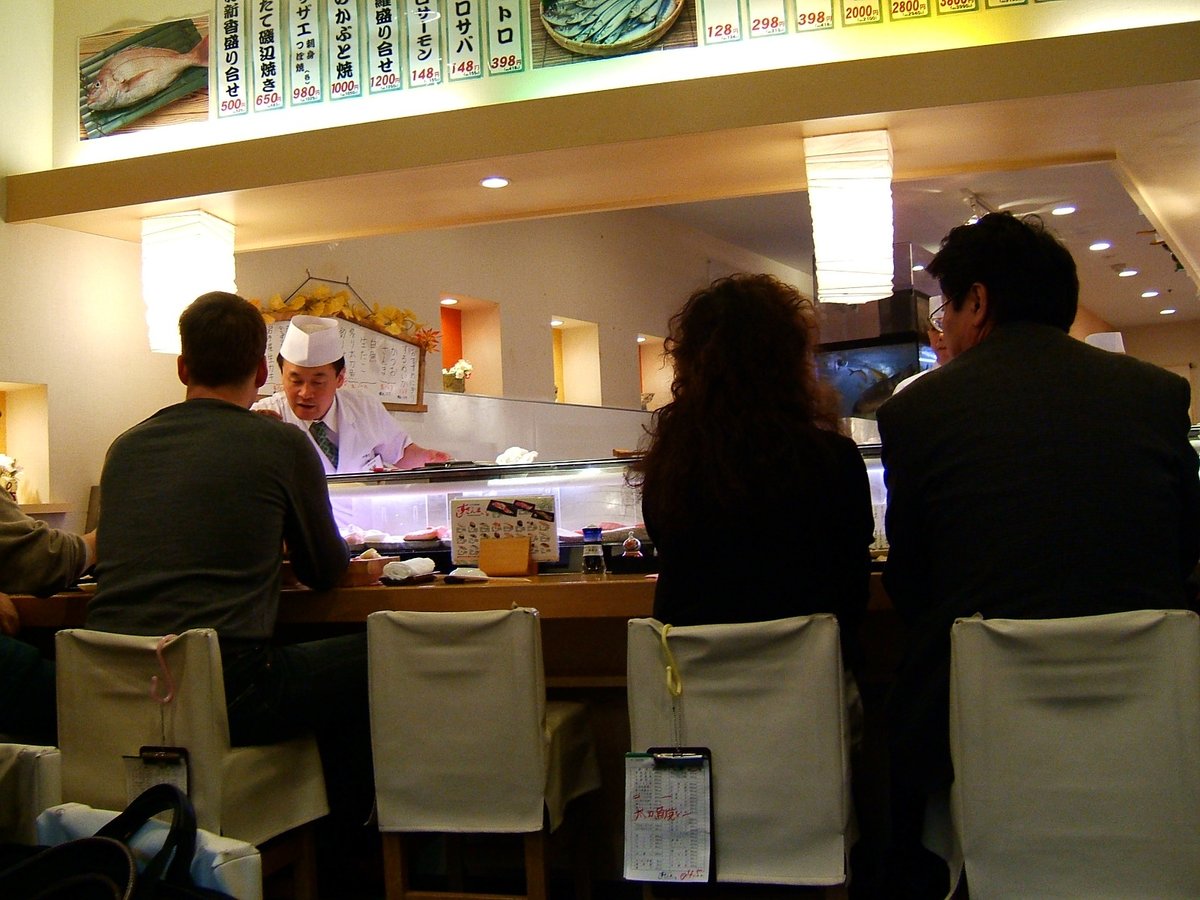
At a seated counter the chef works in front of you and the day's fish sits in the case between you. Photo: Peter Van den Bossche, CC BY-SA 2.0
What it costs: a lunch set in a neighbourhood shop runs ¥1,000 to ¥2,000; at a smarter counter in a city centre, ¥1,500 to ¥3,000. Dinner sets and a few pieces ordered individually take the same meal to ¥3,000 to ¥5,000. Quality at this level is genuinely high, because the fish comes from the same markets as the famous names.
If you take one tactic from this page, take this one: eat your best sushi at lunch. Sushi restaurants across Japan discount hard at midday, because the fish is already bought and the counter would otherwise sit empty. Lunch sets at good city restaurants commonly cost half to a third of the dinner price for similar fish.
The pattern holds even at the top end. At Sushi Yu in Ginza, to take one published example, the lunch omakase starts at ¥10,000 while the dinner course is ¥30,000. Department store restaurant floors and station buildings are reliable hunting grounds, and many shops post the lunch menu outside with photographs and prices. The catches are mild: lunch menus end early, often with last orders around 13:30 or 14:00, and the keenest sets sell out. Arrive before noon and you will rarely be disappointed.
At the top of the market there is no menu at all. Omakase means you leave it to the chef: a fixed course, served piece by piece to a counter of eight or ten seats, two seatings a night. The meal runs through a progression, lean white fish first, then richer cuts, fatty tuna near the peak, and closes with a hand roll, sweet tamago and soup. The chef seasons every piece for you, a brush of nikiri soy glaze, a dab of salt or citrus, so the soy dish in front of you is mostly for sashimi courses.
What you are paying for is sourcing and years. The fish is bought at Toyosu Market at dawn by the chef personally, some cuts are aged or cured in the Edomae tradition, and the rice, seasoned with red vinegar in many Ginza shops, is mixed in small batches through the service so it stays at body temperature.
What it costs: lunch at a high-end counter runs ¥8,000 to ¥15,000. Dinner is ¥20,000 to ¥40,000 at most famous names, and the very top of Ginza goes above that; Sushi Yu's published dinner courses, for example, are ¥30,000 for the standard omakase and ¥40,000 for the deluxe. Drinks and, at some houses, a service charge sit on top. Reservations are essential, often a month out for the famous rooms, and many counters take bookings only through hotel concierges, booking platforms or regulars. Cancellation rules are strict, because ten seats cannot absorb an empty chair. If your plans are not firm, the lunch seating is the safer booking as well as the cheaper one.
The wholesale market moved from Tsukiji to Toyosu in 2018, and its two most famous sushi counters moved with it. Inside the market buildings at Toyosu, a row of small restaurants opens from around 5:30 in the morning and serves the fish that came off the auction floor hours earlier. This is sushi as a working breakfast, eaten at a counter of a dozen seats with the market day going on around you.
The two names everyone queues for are Sushi Dai and Daiwa Sushi. Both serve a set omakase as the main order: at Sushi Dai it is currently around ¥5,500, at Daiwa around ¥6,600, and other counters in the market start far lower, from about ¥1,600 for a set. Treat the exact figure as changeable, because these prices have moved several times in recent years. Practicalities matter more than the menu. The famous two are cash only or close to it, take no reservations, and the market is closed on Sundays, most Wednesdays and public holidays, which closes the restaurants too. Sushi Dai now hands out timed return slots from early morning rather than holding one long line, so go early, take your slot, and use the wait to watch the tuna auction from the viewing deck. If the slot is long, the less famous counters nearby serve the same morning's fish with a fraction of the wait.
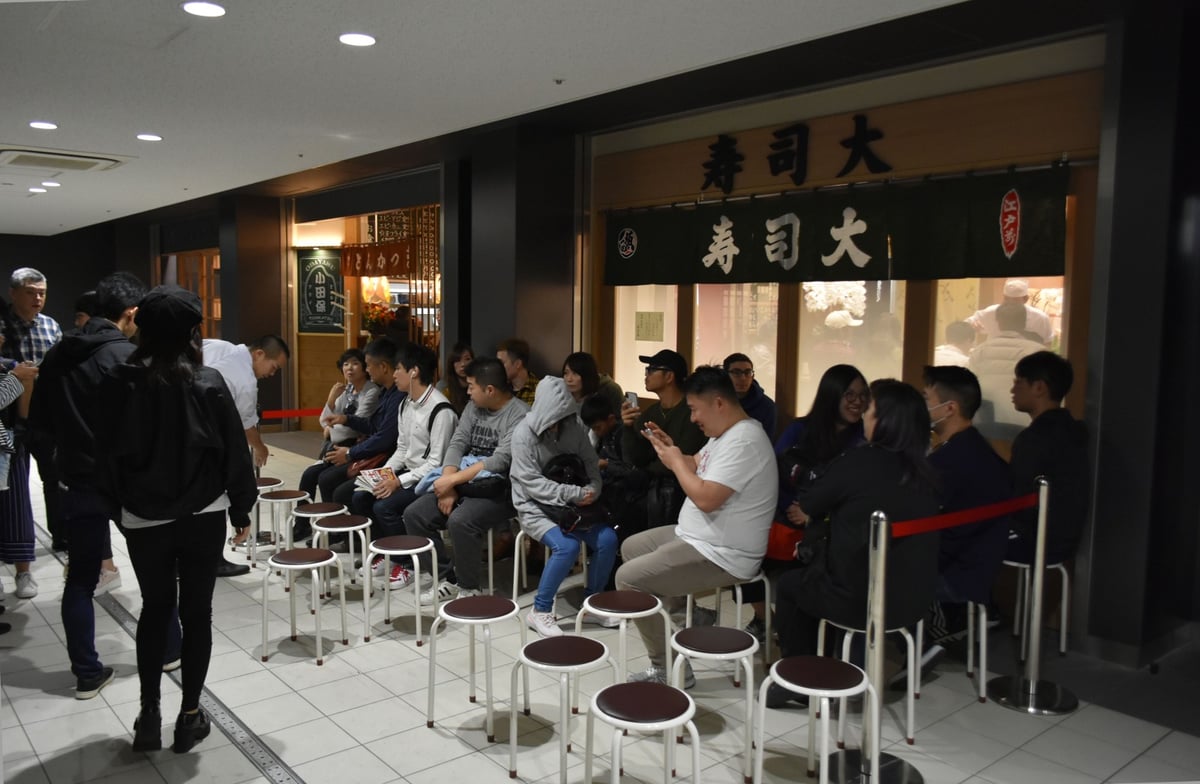
The queue outside Sushi Dai at Toyosu Market, photographed shortly after the market opened in 2018. The wait is now managed with timed slots. Photo: Edomura no Tokuzo, CC BY-SA 4.0
Tsukiji still has a role, by the way. The wholesale market left, but the outer market of food stalls and small restaurants stayed, and it remains a good place to graze on tamagoyaki, seafood bowls and a casual sushi set without a dawn alarm.
Twelve names cover most of any menu board. Cuts of tuna come first, because they are priced as a ladder.
Maguro: tuna, the lean red cut. The starting point.
Chutoro: medium fatty tuna, the middle of the ladder, rich but not overwhelming.
Otoro: the fattiest tuna belly, the top of the ladder and the price list.
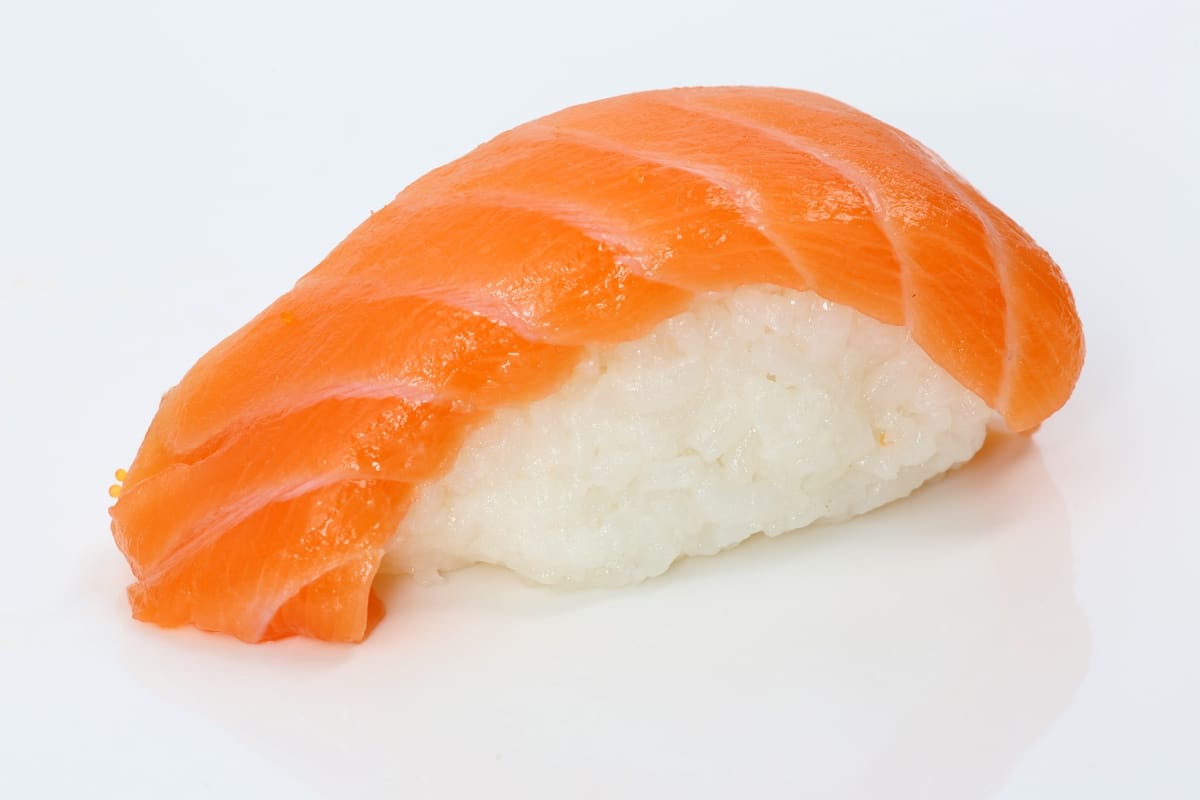
Salmon: salmon, called sāmon. Mild, fatty and the most popular plate at conveyor chains.
Hamachi: young yellowtail, pale and buttery.
Tai: sea bream, the classic white fish, firm and clean tasting.
Hotate: scallop, sweet and soft, often served with a squeeze of citrus and salt.
Ebi: prawn, usually served cooked and butterflied; amaebi is the raw sweet shrimp.
Aji: horse mackerel, a shiny silver fish, often with grated ginger and spring onion.
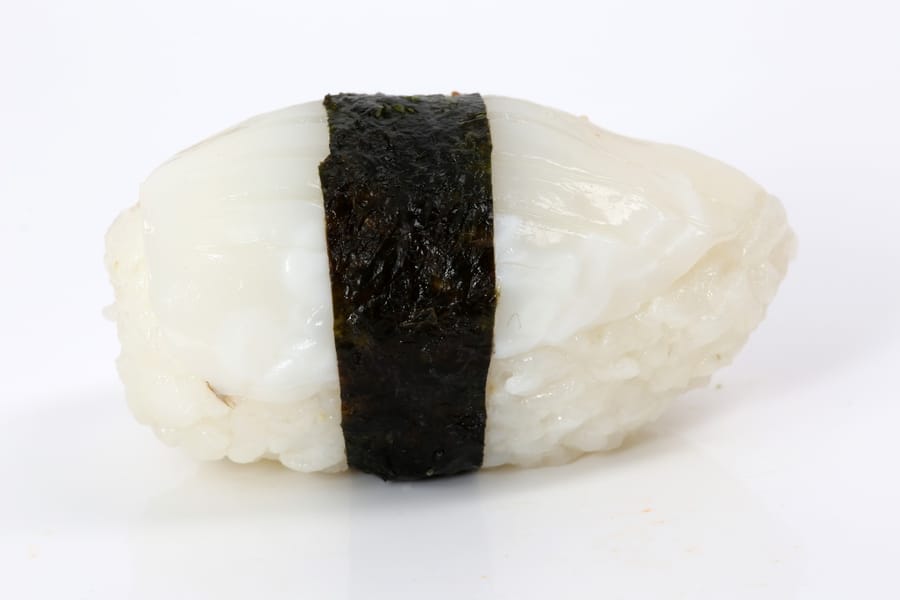
Saba: mackerel, cured in vinegar, stronger flavoured and much loved in Tokyo.
Ikura: salmon roe, bright orange pearls served as a gunkan, the little seaweed cup shape.
Uni: sea urchin, soft, golden and intensely savoury. The splurge piece.
Anago: saltwater eel, simmered and served warm with a sweet glaze. Softer than the freshwater unagi.
Tamago: the sweet omelette block, how many people finish a meal, and how chefs quietly judge each other.
Sushi etiquette has a reputation for strictness that the reality does not deserve. Restaurants in Japan feed first-timers every day. A handful of habits will see you through every format on this page.
Soy sauce goes on the fish, lightly. Turn the nigiri so the fish side dips into the soy, not the rice. Rice acts like a sponge, drinks up far too much, and then falls apart on the way to your mouth. A light touch is the whole technique.
Wasabi is probably already in it. At proper counters the chef puts a small amount of wasabi between the fish and the rice when shaping each piece. Adding a little more is fine. Stirring a lump of wasabi into your soy dish is the one habit that marks you out at a good counter; at a conveyor belt shop, nobody minds.
Ginger is a palate cleanser, not a topping. The pickled ginger, gari, is there to reset your mouth between different fish. Eat a slice on its own between pieces. Laying it on top of the sushi is a mix-up, not a crime, but now you know.
Fingers are allowed. Nigiri was street food, and eating it with your fingers is entirely correct, at counters often the norm. Pick the piece up, turn it fish side down, dip, and eat it in one bite if you can; the piece is built to be eaten whole. Chopsticks are fine too. Biting a piece in half and putting the rest back is the thing to avoid.
Eat it when it lands. At a counter the chef times each piece and watches for it to be eaten before shaping the next. Chat and enjoy yourself, but do not let pieces queue up in front of you.
Small courtesies at the top end. Skip strong perfume at a small counter, where it competes with the fish. Keep voices low. And ask before photographing the chef at work; at conveyor shops, photograph away.
One last idea for travellers who like to get involved: making sushi is as instructive as eating it. Our roundup of unique hands-on experiences in Japan (https://yonihon.com/travel-guide/unique-things-to-do-in-japan/) includes the workshops and classes worth building into a trip.