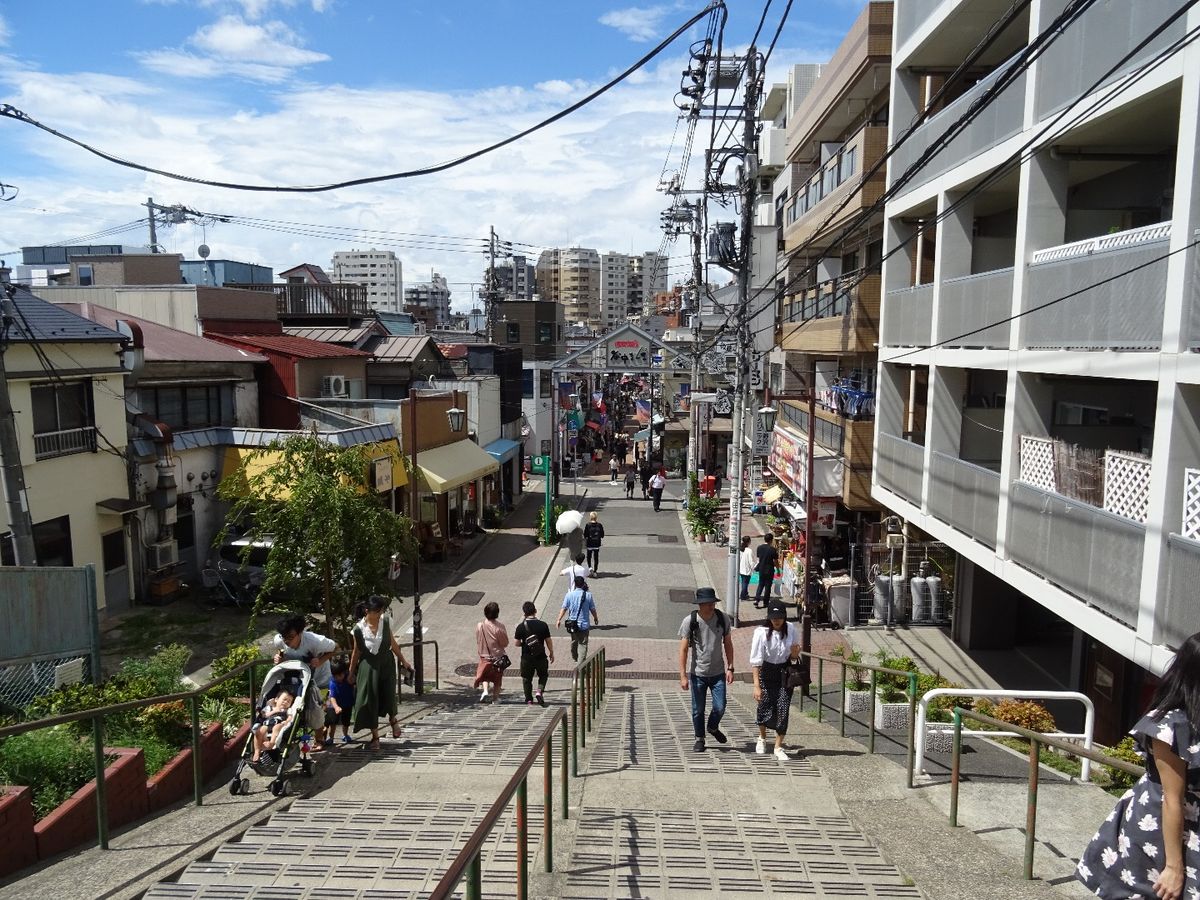
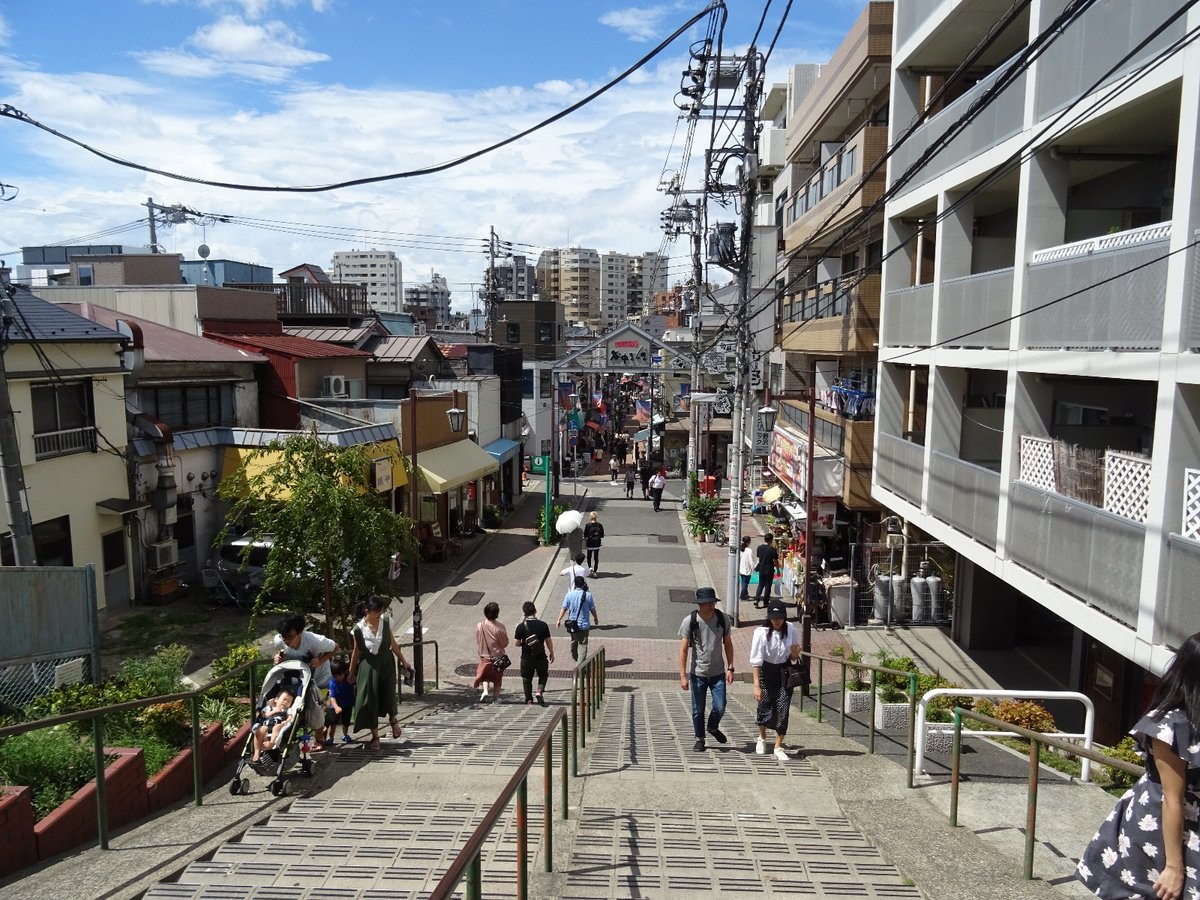
The view from the top of the Yuyake Dandan steps, down onto Yanaka Ginza. Come at the end of the afternoon and this is the light the steps are named for. Photo: Christophe95, CC BY-SA 4.0
Most of Tokyo was rebuilt twice in the last century, once after the earthquake of 1923 and once after the air raids of 1945. Yanaka, a low pocket of streets on the northern edge of Ueno, largely was not. It kept its wooden houses, its narrow lanes and its temples, and it still does the daily shopping for the people who live there.
That is what makes it worth half a day of any Tokyo trip. There is no single famous sight and no ticket to buy. Instead there is a walk: out of Nippori Station, through one of the city's oldest public cemeteries, past a temple with a bronze Buddha older than the neighbourhood around it, and down a flight of steps into a shopping street of about 60 small shops. Go slowly. Yanaka rewards that.
Yanaka sits on the edge of the Ueno plateau, raised ground above the flat lowlands to the east. When the Great Kanto Earthquake of 1923 set fires sweeping across the low city, and again when air raids burned much of Tokyo in 1945, the worst of the damage fell elsewhere. GO TOKYO, the city's official guide, puts it simply: the area has largely survived wars and earthquakes, and walking it feels like stepping back into the Showa era (1926 to 1989).
The shape of the place is older than that. Yanaka grew up as a temple town. During the Edo period (1603 to 1868), temples were gathered in districts like this one, away from the crowded centre, and dozens still stand within a few streets of each other. Temple land tends to stay temple land, and the lanes between the plots stayed narrow, which is one reason the big redevelopment that reshaped other districts never quite reached here. Houses stayed low, shops stayed small, and the skyline stayed human.
Together with its neighbours Nezu and Sendagi, Yanaka forms the area locals call Yanesen. If Asakusa is old Tokyo performed for an audience, Yanaka is old Tokyo still getting on with its day. For the grander, festival side of the old city, read our guide to the best things to do in Asakusa (https://yonihon.com/travel-guide/best-things-to-do-in-asakusa/). Yanaka is the quieter companion piece.
Leave Nippori by the west exit and follow the road that skirts the cemetery. Nippori is one of the best connected small stations in Tokyo: the JR Yamanote, Keihin-Tohoku and Joban lines stop here, along with the Keisei line and the Nippori-Toneri Liner. The Yamanote ride from Tokyo Station takes about 12 minutes, and the Keisei Skyliner from Narita Airport reaches Nippori in as little as 36 minutes, which makes Yanaka a gentle first stop on arrival day. Our airport guide compares every route into the city (https://yonihon.com/travel-guide/narita-or-haneda-to-tokyo/).
Yanaka Cemetery opens off the street a few minutes from the station. It was established in 1874, covers about 10 hectares, and holds roughly 7,000 graves. The Tokyo Metropolitan Park Association, which manages it, notes that much of the land once belonged to the temples of Tennoji and Kan'eiji. A broad central avenue runs through it, lined with cherry trees and known locally as Sakura-dori, Cherry Blossom Avenue. In early April it is one of the loveliest walks in the city. The rest of the year it is simply calm: stone lanterns, old trees, and cats asleep on warm gravestones.
The cemetery's best known resident is Tokugawa Yoshinobu, the fifteenth and last shogun, whose decision to return power to the Emperor in 1867 ended more than two and a half centuries of Tokugawa rule. His grave sits in the Kan'eiji section of the cemetery, about seven minutes on foot from Nippori Station. Taito City describes it as a round barrow covered with a layer of stones, a Shinto style resting place rather than a Buddhist one, and it is designated a Tokyo Metropolitan Historic Site. It is a modest, quiet plot, which suits a man who spent his long retirement keeping out of politics.
You will share the paths with plenty of other notable names. The graves here include Shibusawa Eiichi, the banker often called the father of Japanese capitalism, and the painter Yokoyama Taikan. Pick up the map at the cemetery office if you want to find specific graves, because the grounds are big enough to wander in for an hour without trying.
Halfway along the cherry avenue, a small fenced plot holds the foundation stones of a five-storied pagoda. It belonged to Tennoji, the temple next door, and it was famous long before it fell: the novelist Koda Rohan used it as the model for his novel The Five-Storied Pagoda. The stones are all that is left, and they make a good pause point before you leave the cemetery by its southern side.
Tennoji stands at the edge of the cemetery, and it is one of the oldest temples in this part of Tokyo. Taito City's historic sites guide traces its origins to the Muromachi period (1394 to 1427), which makes it one of the few temples in the city founded before the Edo period. In Edo times it was famous for a more worldly reason: official lotteries were held here, and Tennoji was counted among the city's three great lottery temples.
The treasure to look for is the seated Buddha in the grounds, a copper figure cast in 1690. It sits outdoors under a simple shelter, large, green with age and entirely unbothered by the centuries. The temple grounds are free, small and usually near silent.
From Tennoji, drift south and west through the lanes rather than taking the main road. This is the temple town at its best: a gate, a small hall, a notice board in Japanese, a gardener sweeping. Galleries and studios sit tucked among the houses in converted wooden buildings, many of them open only at weekends or for short exhibitions. There is no list to work through. If a door is open and a sign invites you in, go in. If it is closed, the lane itself was the point.
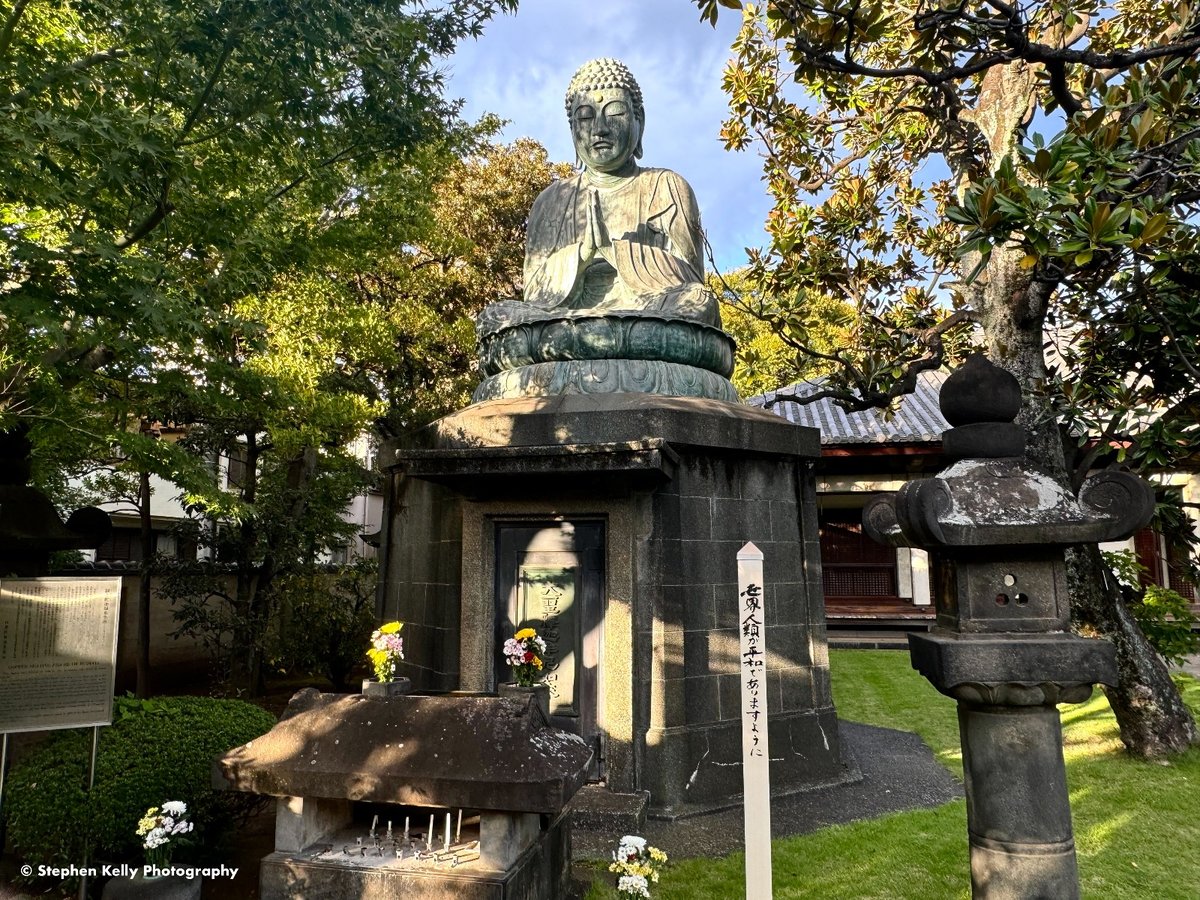
Tennoji's seated Buddha, cast in 1690 and green with age. The temple beside it is one of the few in Tokyo founded before the Edo period. Photo: Stephen Kelly, CC BY 2.0
At the bottom is Yanaka Ginza, the neighbourhood's shopping street: around 60 shops along about 170 metres, most of them small family businesses. There are greengrocers, a tea merchant, sweet shops, a sake shop, bamboo craft and everyday stores selling the things the streets around actually need. Look up as you walk. Seven lucky cat statues are placed around the street, on signs and ledges, a small treasure hunt that children take very seriously.
Our guide to Tokyo's yokocho alleys and shotengai streets (https://yonihon.com/travel-guide/tokyo-yokocho-and-shotengai-guide/) covers Yanaka Ginza alongside the city's great drinking alleys. Here, the street deserves its own slower pass, because the eating is the main event.
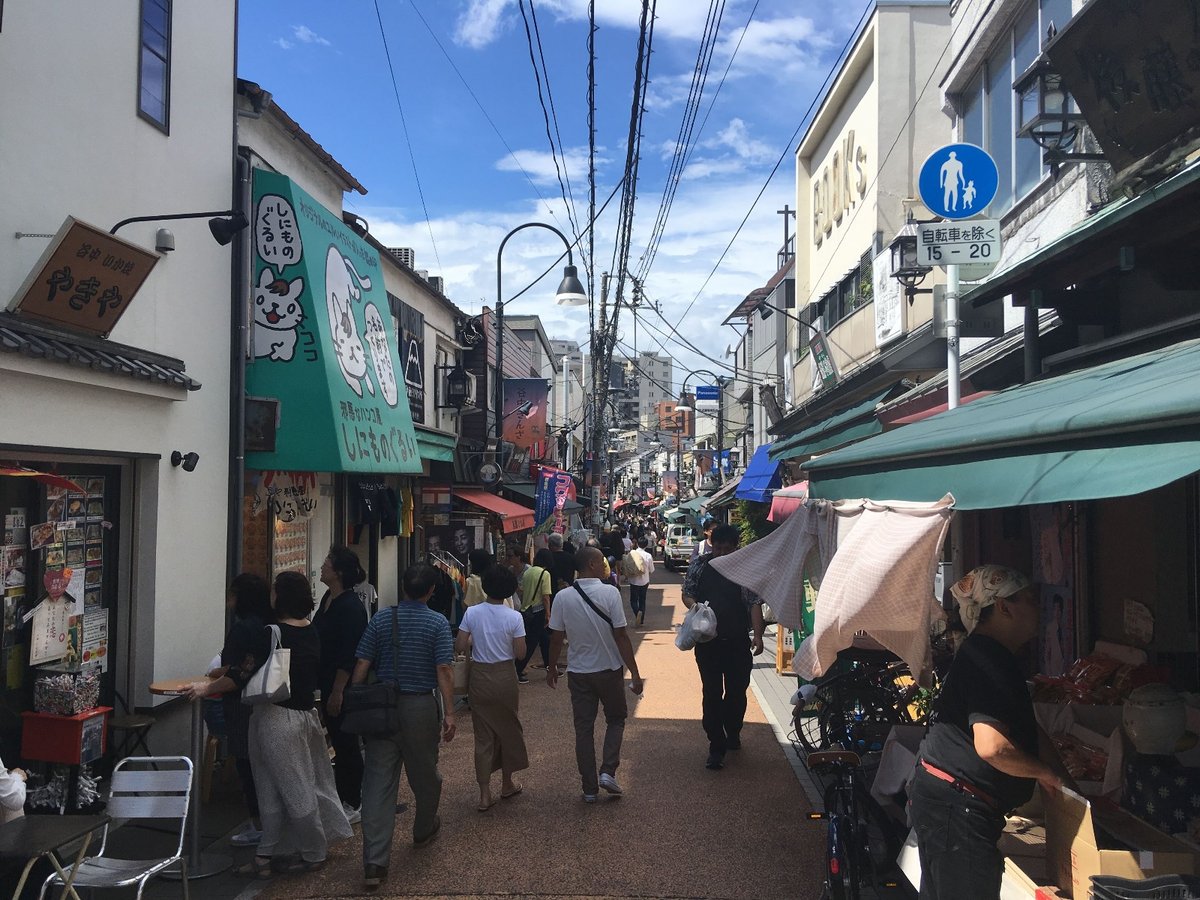
Yanaka Ginza on a busy afternoon. Around 60 shops, most of them family run, line about 170 metres of street. Photo: Christophe95, CC BY-SA 4.0
Graze, do not commit to a sit-down lunch. The street's food is built for eating in small amounts, often standing just outside the shop that made it.
Menchi katsu from the butchers.
The classic order. Menchi katsu is a deep-fried patty of seasoned minced meat and onion in a crisp crumb, sold hot from the counter for a couple of hundred yen. The street's butchers are known for them, and the correct procedure is to buy one, step to the side of the shopfront, and eat it while it is still too hot. Then, if you are honest with yourself, buy another at the next butcher and compare.
Rice crackers at Yanaka Senbei. GO TOKYO's walking guide for the area singles out Yanaka Senbei Shinsendo, an old rice cracker shop with glass counters and big round jars. The crackers come crunchy or chewy, sweet or salty, in flavours such as sesame and shrimp. They travel well, which makes them the souvenir to buy here rather than anything fragile.
Sweets, chestnuts and whatever is hot. The official guides list the street's grazing menu as piping hot sweet potatoes, sweet chestnuts, grilled squid and pork cutlets, alongside traditional wagashi sweets made in small batches. In summer, shaved ice shops draw queues. At the far end of the street there is a coffee roastery if you want to sit down for ten minutes and watch the street go by.
Carry cash in small notes and coins. Several shops are cash only, and the street has no patience for a ¥10,000 note at a cracker counter.
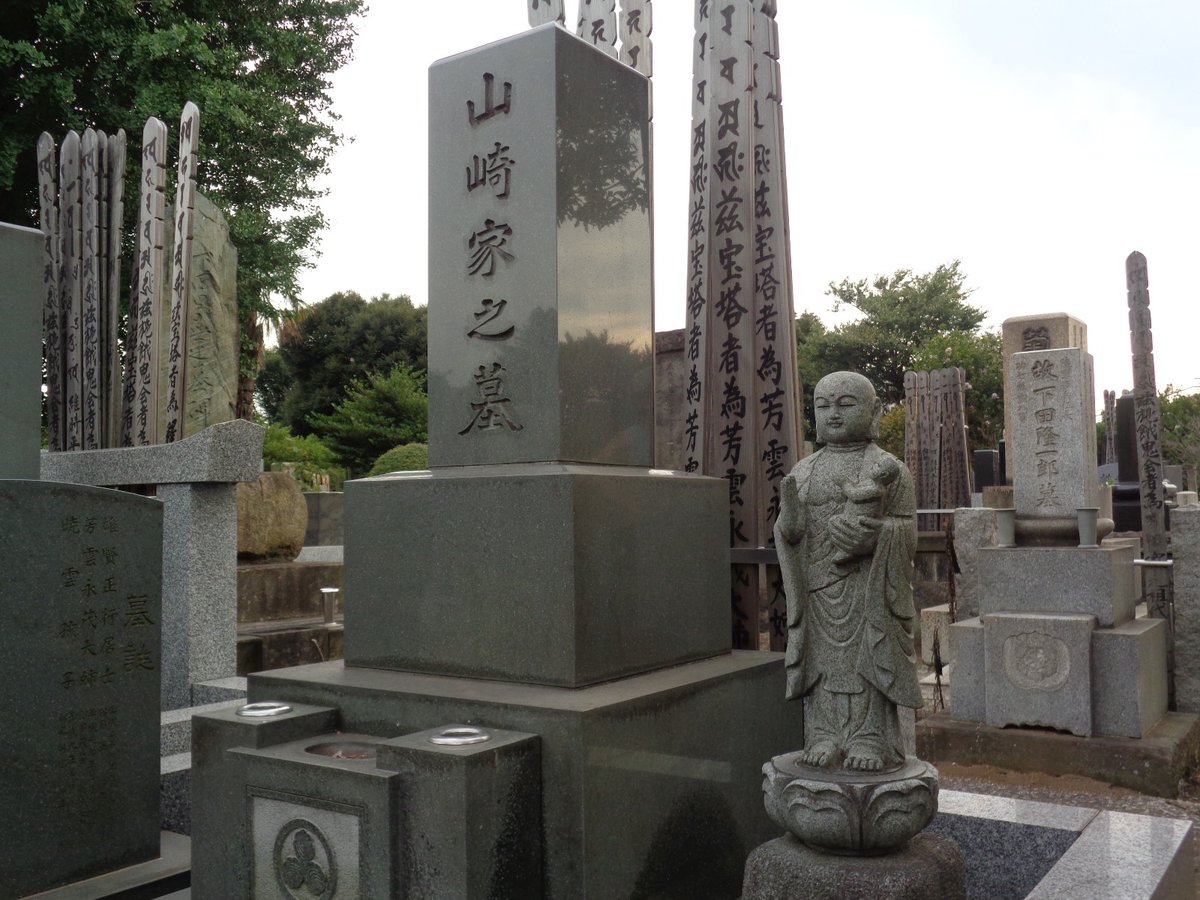
Yanaka Cemetery, opened in 1874 and still a working cemetery. Walk the paths quietly and stick to the map if you are looking for a particular grave. Photo: Gustave67, CC BY-SA 4.0
Nearest stations:
Nippori (JR Yamanote, Keihin-Tohoku and Joban lines, Keisei line, Nippori-Toneri Liner), about 5 minutes on foot to Yanaka Ginza and 6 to 7 minutes to the cemetery and Yoshinobu's grave. Sendagi (Tokyo Metro Chiyoda Line), about 3 minutes on foot from the Dokan exit to the far end of Yanaka Ginza, which makes it the natural finishing point of the walk.
How long: the route is about two and a half kilometres. Two hours covers it briskly; three to four hours is better, with the cemetery, one or two temples and a full grazing pass of the shopping street.
When the shops are open: each shop sets its own hours, most opening around 10:00 or 11:00 and closing by 18:00 or 19:00. Several food shops close on Mondays. The cemetery paths and temple grounds keep their own quiet hours and are best visited in daylight.
Cost: the whole walk is free. Budget ¥1,000 to ¥2,000 in cash for snacks and small souvenirs and you will eat very well.
Go on a weekday morning.
By late morning the shops are open, the light in the cemetery is good, and the shopping street belongs mostly to locals doing their rounds. Weekend afternoons are lively but crowded, and the steps at sunset can be packed shoulder to shoulder.
Remember that people live here. Yanaka is a residential neighbourhood first and a sight second. Keep voices down in the lanes, do not peer into gardens or photograph residents and their homes, and step aside on the narrow streets when someone is simply trying to get home.
Treat the cemetery as a cemetery. It is a beautiful place to walk, and it is also where families come to tend graves. Stay on the paths, keep noise low, do not eat or drink among the graves, and never climb on or move anything at a graveside. Photography of the avenues and trees is fine; close photographs of individual family graves are best avoided.
Eat standing still, to the side. Street food here is eaten outside the shop, out of the flow of shoppers, not while walking. Rubbish bins are rare, so carry a small bag and take your skewer sticks and wrappers away, or hand them back to the shop.
Finish at Sendagi, or double back for sunset. The route ends naturally at Sendagi Station on the Chiyoda Line. If your timing is flexible, the nicest version of the day runs the other way: start at Sendagi in the mid afternoon, graze up the street, and be at the top of Yuyake Dandan when the light turns.
9 min · November 24, 2026
11 min · November 21, 2026
9 min · November 24, 2026