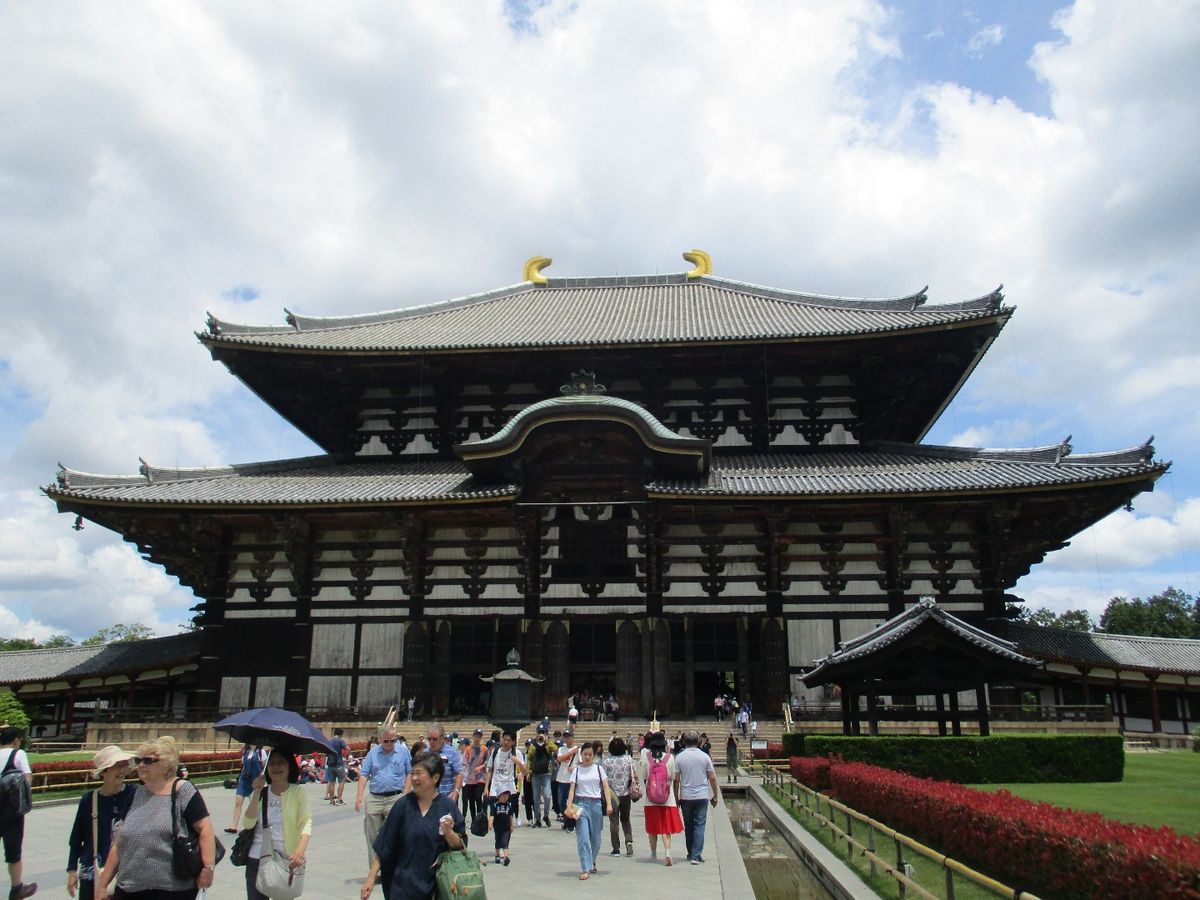
Nara was Japan's capital before Kyoto, and it holds the older city's trump cards: a Great Buddha cast in the 700s, a hall big enough to make modern stadiums feel modest, and around a thousand deer wandering a park the size of a small town. It is also, used properly, a half-day trip. The sights stand in one line inside and around Nara Park, and the whole visit takes about five hours door to door from Kyoto or Osaka.
Two things decide whether those five hours feel easy or wasted. The first is the train: Nara has two stations, and picking the wrong one costs you about 20 minutes of walking each way. The second is the clock: arrive by 9:00 and you will stand in front of the Great Buddha in relative quiet. Arrive at 11:00 and you will share him with every tour coach in Kansai.
Both Kyoto and Osaka are served by two railway companies into Nara, JR and Kintetsu, and they arrive at different stations.
Kintetsu-Nara Station is the one you want. It sits at the western edge of Nara Park, about five minutes on foot from Kofuku-ji Temple and ten from the deer meadows. Come out of the east exit, walk uphill, and you are in the park before your coffee cools.
JR Nara Station is about a kilometre further west. The walk to the park takes 15 to 20 minutes along Sanjo-dori, a perfectly pleasant shopping street, but it is 20 minutes each way spent walking away from the deer, and on a half-day trip that is the difference between seeing Kasuga Taisha and skipping it.
JR only wins if you hold a Japan Rail Pass (the JR trains below are covered, the Kintetsu ones are not) or if you are stopping at Fushimi Inari or Uji on the way, which sit on the JR Nara Line. Otherwise, take Kintetsu and spend the saved 40 minutes in the park.
Times assume a Kintetsu arrival. Everything is on foot; the whole route is a gentle loop of about four kilometres.
By 9:00, arrive at Kintetsu-Nara. Walk east up Noborioji street into the park. You will meet deer within two minutes. Do not buy crackers yet.
9:10, Kofuku-ji from the outside. The temple's five-storey pagoda is Nara's symbol, though it is partway through long-term repairs and partly sheeted, so admire it as you pass rather than building the morning around it. The temple grounds are free to cross.
9:20, crackers, briefly. Buy one pack of shika senbei from a licensed vendor near the Todai-ji approach (¥200 for a bundle of about ten) and feed two or three deer here, where the crowds are still thin. Read the deer section below first. Then put the rest away, out of sight, and keep walking. Deer follow visible crackers the way seagulls follow chips.
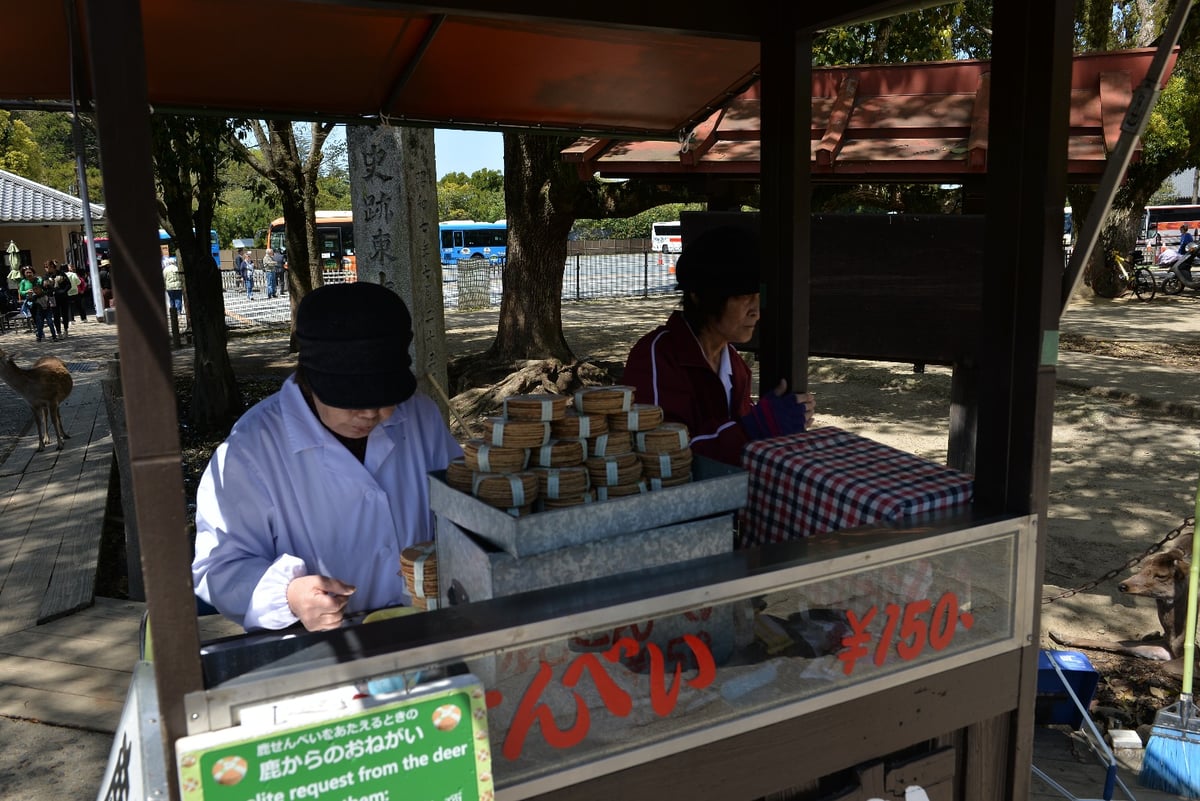
Shika senbei are the only food you may give the deer, and the stalls are run for the deer's welfare fund. Photo: shankar s., CC BY 2.0
9:30, Todai-ji and the Great Buddha. Pass through the Nandaimon gate, guarded by two fierce wooden Nio statues, and up the approach to the Daibutsuden, the Great Buddha Hall. Entry costs ¥800 for adults and teenagers, ¥400 for children aged 6 to 12, and the ticket window is cash only. A joint ticket with the Todai-ji Museum costs ¥1,200. The hall opens at 8:00 from November to March and 7:30 from April to October, and the first hour is the calm one. Tour coaches and school groups build from about 10:30.
Inside, the Buddha is 15 metres of bronze seated on a lotus pedestal, cast in the eighth century and recast in part since. Walk the circuit behind him: there is a pillar with a hole through its base the size of the Buddha's nostril, and tradition says squeezing through brings enlightenment. Children manage it. Most adults should enjoy watching children manage it.
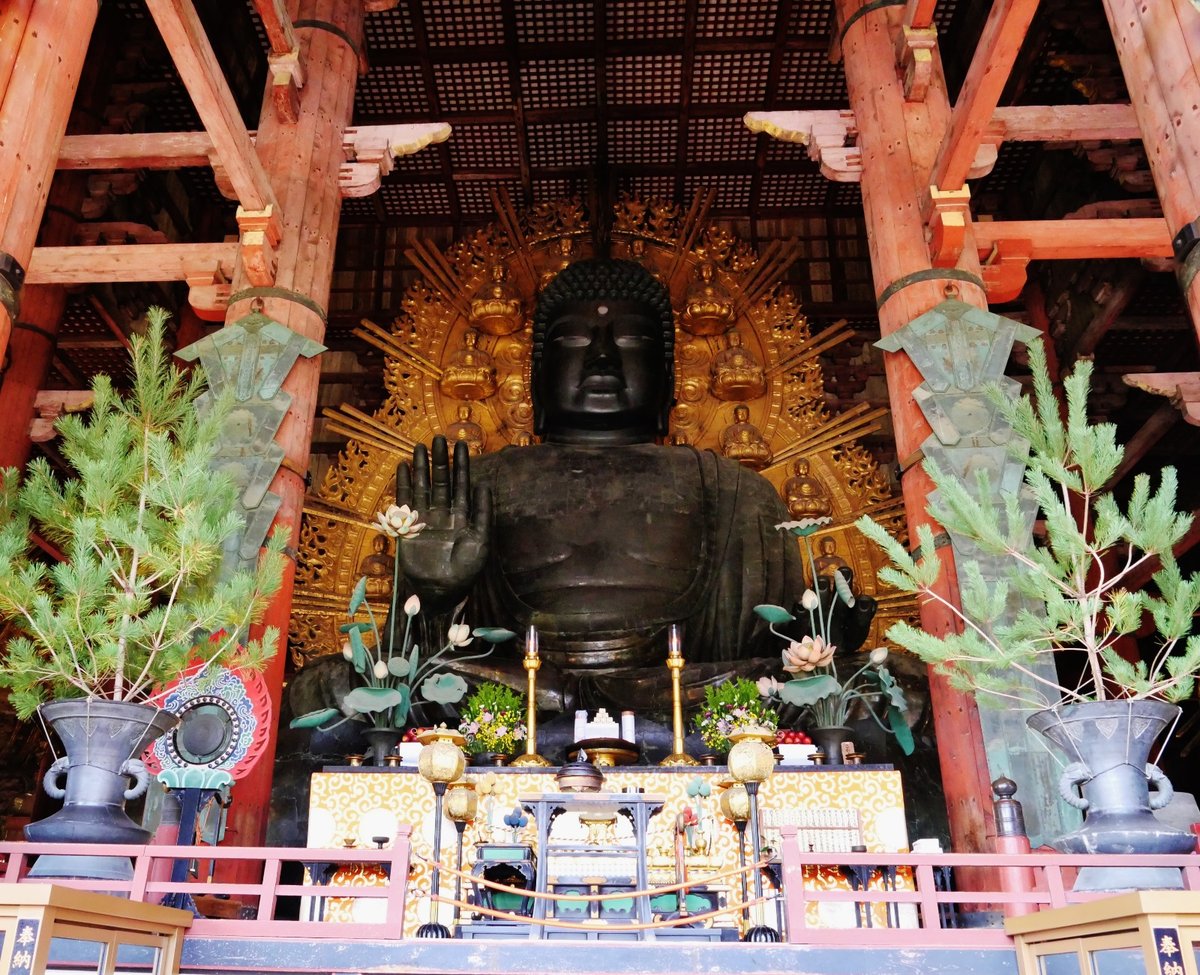
The Great Buddha of Todai-ji, 15 metres of bronze, cast in the Nara period. Photo: Zairon, CC BY 4.0
11:00, Nigatsudo, the quiet corner. Climb the stone steps behind and east of the Great Buddha Hall to Nigatsudo, the February Hall. Its wooden balcony looks out over the rooftops of Nara to the mountains, the lanterns are lit even in daytime gloom, and for reasons nobody can explain, the coaches rarely climb here. The lanes between the hall and the back of Todai-ji, lined with mud walls and small sub-temples, are the calmest walking in the park. If Nara has a secret, this is it.
11:45, Kasuga Taisha through the forest. From Nigatsudo, paths lead south through the Kasugayama woods to Kasuga Taisha, Nara's great Shinto shrine. The approach is lined with stone lanterns, around 2,000 of them, many green with moss, and deer drift between the trees. The shrine grounds are free. The special worship area inside, where you can stand before the main sanctuary and see the corridors of hanging bronze lanterns up close, costs ¥700 and is open 9:00 to 16:00. It is worth the ¥700: the Fujinami-no-ya hall, kept dark and lit only by its hundreds of donated lanterns, is the single most atmospheric room in Nara.
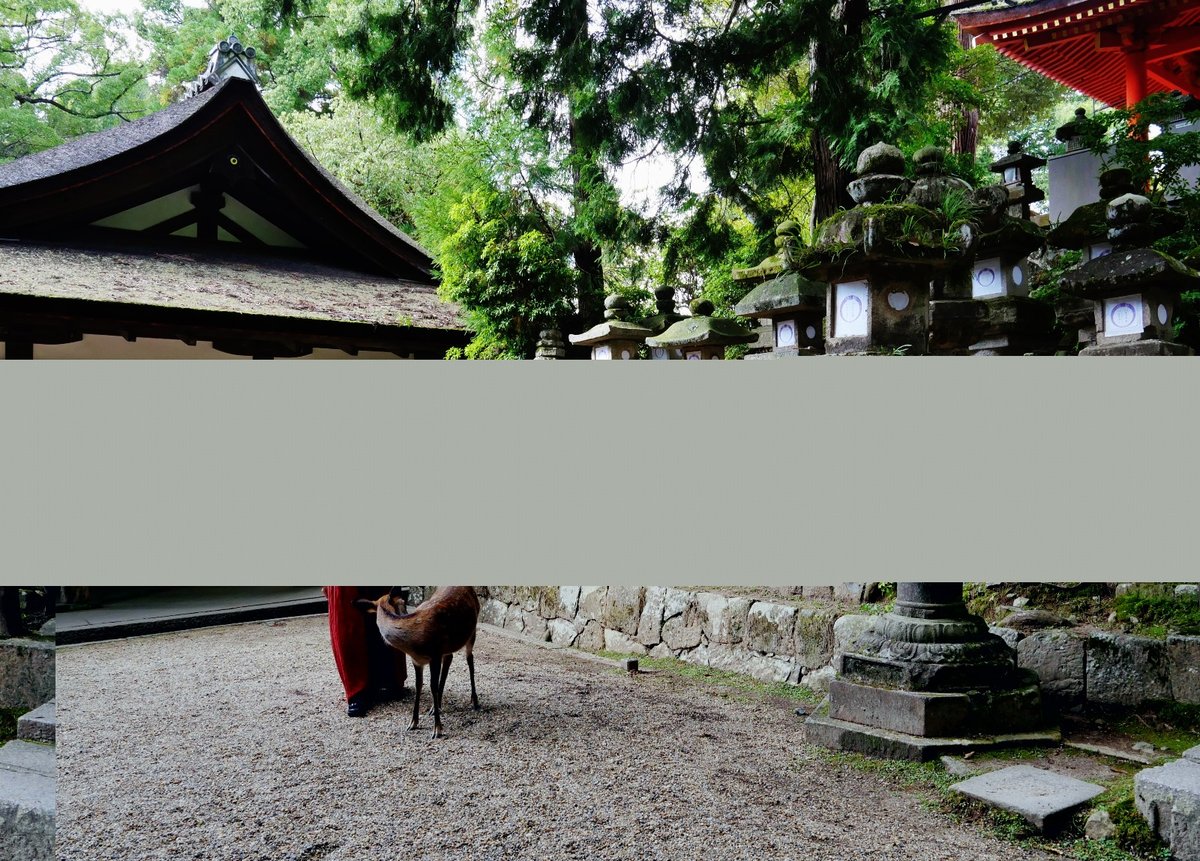
Lanterns and deer in the grounds of Kasuga Taisha. Photo: Zairon, CC BY 4.0
13:00, lunch and back. Walk back west along Sanjo-dori towards the stations, eating on the way. Nara's things to try are kakinoha-zushi (salmon or mackerel pressed sushi wrapped in persimmon leaf, built for train journeys), a bowl of chagayu tea porridge, or yomogi mochi from Nakatanidou near the Kintetsu station, where the pounding is done at a speed that draws its own audience. Be on a train by about 14:00 and you are back in Kyoto or Osaka for the afternoon.
The deer are the reason most people come, and they deserve a straight description. There are roughly 1,200 to 1,400 of them (the official census counts vary by year and have run higher recently), they are legally protected as natural monuments and regarded as messengers of the gods of Kasuga Taisha, and they are wild animals who have learned exactly how humans work.
Many of them bow. Bow to a deer holding a cracker and it will often dip its head in return, a habit learned over generations of being fed. It is genuinely charming. The same deer will also nudge you with its head, nibble your sleeve, tug at paper maps and bags (paper seems to read as food), and follow you in a small, patient crowd if it thinks you are hiding crackers. Males with antlers in the autumn rut, and mothers with fawns in early summer, can be properly aggressive. Every year visitors are injured, usually minor bites and knocks, almost always around food.
The working rules are simple:
Keep crackers hidden until you are ready. A pack in a pocket or closed bag does not exist. A pack in your hand is a public announcement.
Hand the cracker over quickly. Do not hold it up, wave it, or pull it back to take a photo. Teasing is what turns a bow into a bite.
Show empty hands when you are done. Holding both palms up and open is the local signal for "finished", and deer read it surprisingly well.
Watch small children. A deer is roughly toddler height at the head, and toddlers carry crackers at exactly deer mouth height. Feed hand to hand yourself and pass the cracker to the deer, not via your child.
Fares are adult, one way, verified against the railways' published fares. IC cards (ICOCA, Suica and the rest) work on all of these trains.
From Kyoto Station:
Kintetsu Limited Express to Kintetsu-Nara: about 35 minutes, ¥1,280 (¥760 fare plus the ¥520 limited express charge). All seats reserved, two trains an hour through the day. The fastest and most comfortable option, and the one to book for the 9:00 arrival.
Kintetsu Express to Kintetsu-Nara: about 45 to 50 minutes, ¥760. No reservation, sometimes a change at Yamato-Saidaiji. The best value to the right station.
JR Miyakoji Rapid to JR Nara: about 45 minutes, ¥720. Covered by the Japan Rail Pass. Right train, wrong station (see the trap above); budget the extra walk or take the loop bus from JR Nara to the park.
From Osaka:
Kintetsu Rapid Express from Osaka-Namba to Kintetsu-Nara: about 40 minutes, ¥680. The default choice from Osaka. A limited express covers it in about 30 minutes for ¥1,200 with the surcharge, if you want the guaranteed seat.
JR Yamatoji Rapid from Osaka Station to JR Nara: about 50 minutes, ¥840. Covered by the Japan Rail Pass, same station caveat. From JR Namba the same line takes about 45 minutes.
Coming back needs no planning: trains on all four routes run until late evening. But Nara is a morning city. The deer are fed and sleepy by mid-afternoon, the temple approaches fill up, and the light in the Kasuga forest is best before noon anyway.
Stay for Naramachi, the old merchant quarter south of Kofuku-ji: narrow lanes of wooden machiya townhouses, small museums in former merchants' homes, and cafes that close pleasingly early. Isuien Garden, between Todai-ji and Kofuku-ji, is a strolling garden in two parts (the back half frames the temple roofs as borrowed scenery) and is rarely busy. And if you are building a Kansai route, pair Nara with the days either side of it: our Osaka plan, Osaka for First-Timers (https://yonihon.com/travel-guide/osaka-for-first-timers/), and the hands-on Kyoto guide, Best Things to Do in Kyoto Beyond Temples (https://yonihon.com/travel-guide/kyoto-beyond-temples/), slot together with this one without repeating a single sight.
10 minutes · November 23, 2026
9 minutes · November 23, 2026
9 minutes · November 23, 2026
