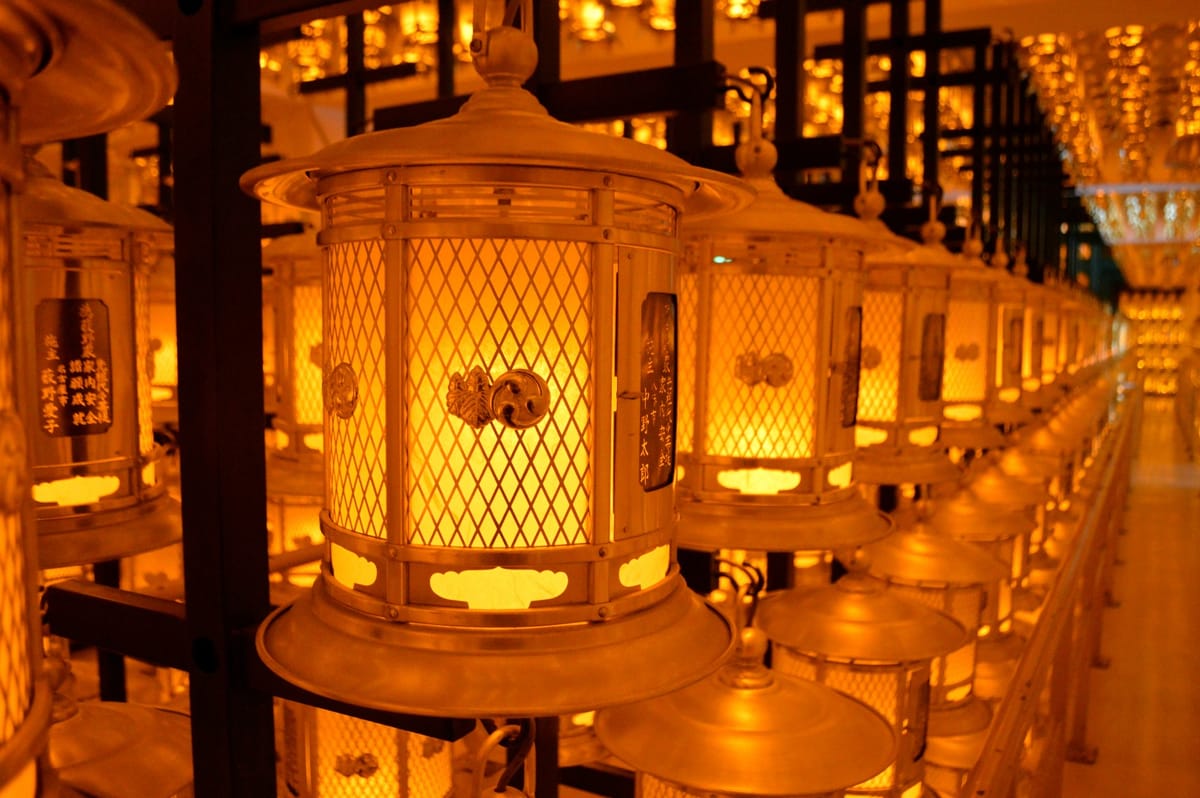
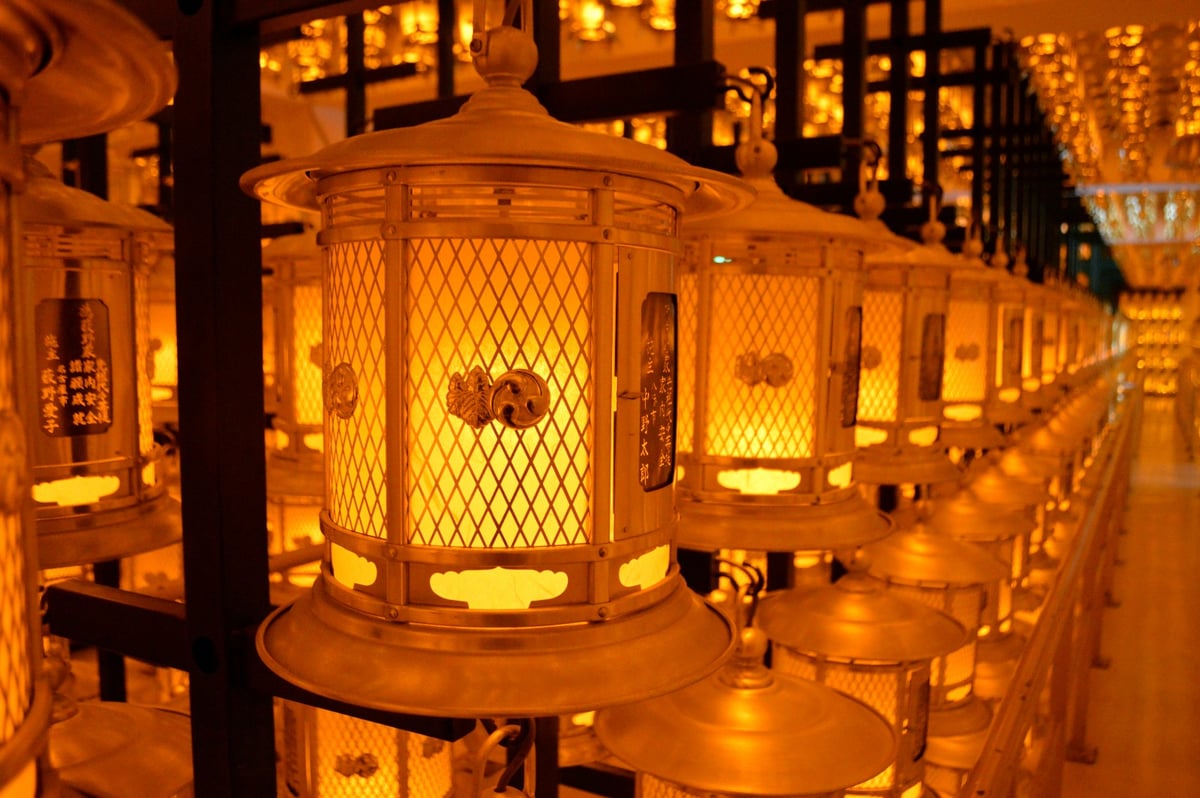
The Torodo, the hall of lanterns at Okunoin, where donated lanterns burn in their thousands. Staying overnight is what puts you here early, before the day buses arrive. Photo: DimiTalen, CC0
Most people visit Mount Koya, or Koyasan, on a day trip from Osaka, and a day trip quietly works against the place. The mountain is a working monastic town, and its best hours are the ones day visitors miss: the cemetery path at dusk, dinner at half past five, and a prayer hall full of chanting at seven the next morning.
A shukubo stay fixes the timing. Shukubo are temple lodgings, rooms inside working temples that have taken paying guests for centuries. Around fifty of Koyasan's temples run them, and a night in one means being fitted, politely, into the temple's own day.
This guide explains what that day actually looks like, what it costs, how the booking works, and how to get up the mountain, expanding on the shorter temple stay entry in our guide to hands-on experiences across Japan. (https://yonihon.com/travel-guide/unique-things-to-do-in-japan/)
Koyasan sits on a flat, forested plateau at roughly 800 metres in the mountains of Wakayama, south of Osaka. The monk Kukai, known after his death as Kobo Daishi, founded it as a training ground for Shingon Buddhism in 816, and it has been a religious town ever since. The head temple is Kongobuji, there are 117 temples on the plateau, and the area is UNESCO World Heritage listed.
Two practical consequences follow. It is noticeably cooler than Osaka, so bring a layer even in summer and a proper coat from late autumn. And everything runs on temple time: shops close early, and dinner is when the temple says it is.
Expect a Japanese style room: tatami mats, a low table, sliding screens, and a futon that is either already laid out or brought in while you are at dinner. Many rooms look onto a temple garden, and a yukata robe is provided.
What varies most between temples is the plumbing. At the classic end, both bath and toilet are shared. Pay more and you get a private toilet, and at the top end a private bathroom as well. The Shukubo Association prices its rooms in exactly those bands, which makes the band a useful first filter when choosing.
Both meals are included in almost every plan, and both are shojin ryori, the vegetarian cooking developed in Buddhist temples. There is no meat and no fish. A typical dinner is a lacquered tray of small dishes built around seasonal vegetables, mountain greens, simmered and fried tofu, pickles and soup, with rice. It sounds austere and eats far better than it sounds, because the cooking leans on dashi, sesame and careful seasoning.
Two Koyasan specialities are worth knowing by name. Goma-dofu is a firm, creamy sesame tofu, closer to a savoury custard than to ordinary tofu, and it appears at nearly every temple table. Koya-dofu, the freeze dried tofu named after the mountain, turns up in simmered dishes. Portions are generous. Alcohol surprises some guests: some temples serve beer or sake with dinner if you order it, others keep the table dry, so ask when you book.
Meal times are fixed and early. Dinner is commonly at 17:30, and if you arrive after that you may simply not get it. At Eko-in, arriving past 17:30 means no dinner and no refund. Plan your trains around dinner, not the other way round.
Guests are invited to the morning service, held in the main hall at around 6:00 to 7:00 depending on the temple and the season. You sit on a cushion at the edge of the hall while the monks chant sutras in front of the altar. Nobody checks your beliefs, and you are asked for nothing beyond sitting quietly and following the room's lead on standing and bowing.
Some temples add a second ritual straight afterwards. Eko-in follows its 7:00 service with a goma fire ritual at 7:30, in which wooden prayer sticks are burned in a consecrated fire. Guests can attend both without booking and without charge. Breakfast follows at about 8:00, and check out is usually by 10:00. Eko-in also runs ajikan meditation, the Shingon practice of meditating on the Sanskrit letter A, daily at 16:30 for about 40 minutes, free for guests, and leaves sutra copying materials in the room. If an activity decides your temple, confirm it runs on your date when you book.
The timetable at Eko-in runs like this:
A temple is not a hotel with stricter staff. It is a religious community that lets you sleep inside its routine, and the routine is the product.
Quiet comes first. Corridors and gardens go quiet after dinner, and the prayer halls and the inner part of Okunoin are places where silence is the default.
Gates and evenings. Some temples close their gates early in the evening, so check the time before you head out after dinner. Eko-in states that it has no curfew, which makes it a good base if the Okunoin night tour is part of your plan.
The bath is shared and set to temple hours. At most temples the bath is communal, separated by sex, and open in set windows. Eko-in's runs from 15:00 to 24:00 and again from 6:00 to 9:00. The usual onsen manners apply: wash before you get in, no swimwear, towel out of the water. Tattoo policies vary by temple, so ask when you book rather than at the bath door.
Shoes and floors. Shoes come off at the entrance, and you move around the building in slippers or socks. Tatami rooms are sock or bare feet only, never slippers.
Photography. Fine in gardens and most grounds, restricted where it matters most: no photography inside the Torodo lantern hall or beyond the Gobyobashi bridge at Okunoin, and none during services.
Temple lodging is priced per person, per night, with dinner and breakfast included. The association's published bands, checked on 24 November 2026, are:
Individual temples price inside those bands by room and season. On the association's own booking pages, the instantly bookable temples start from around ¥14,000 per adult. Weekends and the November leaf season push prices up, and a single guest usually pays a supplement. Two people sharing a mid range room with a private toilet, in a normal week, should expect something in the region of ¥20,000 to ¥30,000 each.
What the money buys is the location and the routine: you wake up inside the place everyone else is travelling to.
There are three sensible routes, and they suit different planners.
The Koyasan Shukubo Association runs the official booking site (koyasan-shukubo.net) and covers all 51 temple lodgings. It works in two ways. Six temples at the time of checking, including Eko-in, Hojo-in and Fugen-in, can be booked instantly online, confirmed the moment you finish. For every other temple you use the booking request service: you give your dates, budget and up to three preferred temples, or leave the choice to the association, and it replies by email with an offer. Nothing is confirmed until that email arrives and you accept it, so send the request early. The association asks for requests at least 14 business days before the stay.
The temple's own website is worth checking once you have a temple in mind. Several of the larger shukubo take direct reservations in English. Eko-in opens its own booking calendar up to 11 months ahead, and its plans spell out the day's timetable before you commit.
The big booking platforms list a selection of Koyasan temples too, with thinner detail on services and meal times than the association site.
Whichever route you use, book ahead for November weekends and for spring. The popular temples near Okunoin fill first.
Koyasan is a Nankai railway trip. Trains leave from Nankai Namba in Osaka, not JR Namba, and the Japan Rail Pass does not cover any of this journey.
Namba to Gokurakubashi by train. The Limited Express Koya is the comfortable option: all seats reserved, roughly 1 hour 20 minutes to 1 hour 30 minutes, with a limited express surcharge of ¥1,100 from Namba on top of the fare. Ordinary express and rapid express trains take about 1 hour 40 minutes and usually involve a change at Hashimoto. The ordinary one way fare from Namba to Koyasan Station is ¥1,430, and that fare already includes the cable car.
Gokurakubashi to Koyasan Station by cable car. The funicular climbs the last steep slope in about five minutes and is timed to meet the trains, so the change is a short walk across the station rather than a wait.
Koyasan Station into town by bus. Nankai Rinkan buses meet the cable cars: about 10 minutes to the town centre at Senjuinbashi, about 20 minutes to Okunoin-mae. Check which stop your temple names in its access information, because the wrong stop can mean a long walk with luggage.
Door to door, allow about two hours from Namba to your temple. Two warnings belong here. The cable car closes for maintenance on a few days most winters, with substitute transport arranged, and Nankai publishes those dates on its own site, so check nankai.co.jp in the week you travel rather than trusting any guide, including this one. And the last connections down the mountain leave in the early evening, one more argument for staying the night.
The ticket to know about is Nankai's Koyasan World Heritage Ticket. From Namba it costs ¥4,210 at a station window or ¥3,980 as a digital ticket, at the prices Nankai set from 1 April 2026. It covers the return train and cable car journey, a two day pass for the Rinkan buses, and discount coupons for the main sights, valid for two consecutive days. For an overnight trip using the buses both days, it usually beats paying as you go.
Okunoin, three times over. Okunoin is Japan's most atmospheric cemetery: a two kilometre approach from the Ichinohashi bridge, lined with ancient cedars and, by the usual count, more than 200,000 memorial stones, from shoguns and warlords to modern companies. At the far end stand the Torodo, the hall of some ten thousand donated lanterns, and the Gobyo, the mausoleum where Kobo Daishi is believed to rest in eternal meditation. Go once in daylight to take in the scale. Go again after dark on the guided night tour, run by a separate operator and booked apart from your temple stay. Then go a third time just after 6:00, when the Torodo opens and the morning food offering is carried across the bridge, and you may have the path almost to yourself. Starting from the Okunoin-mae bus stop cuts the walk roughly in half, the sensible option in the evening.
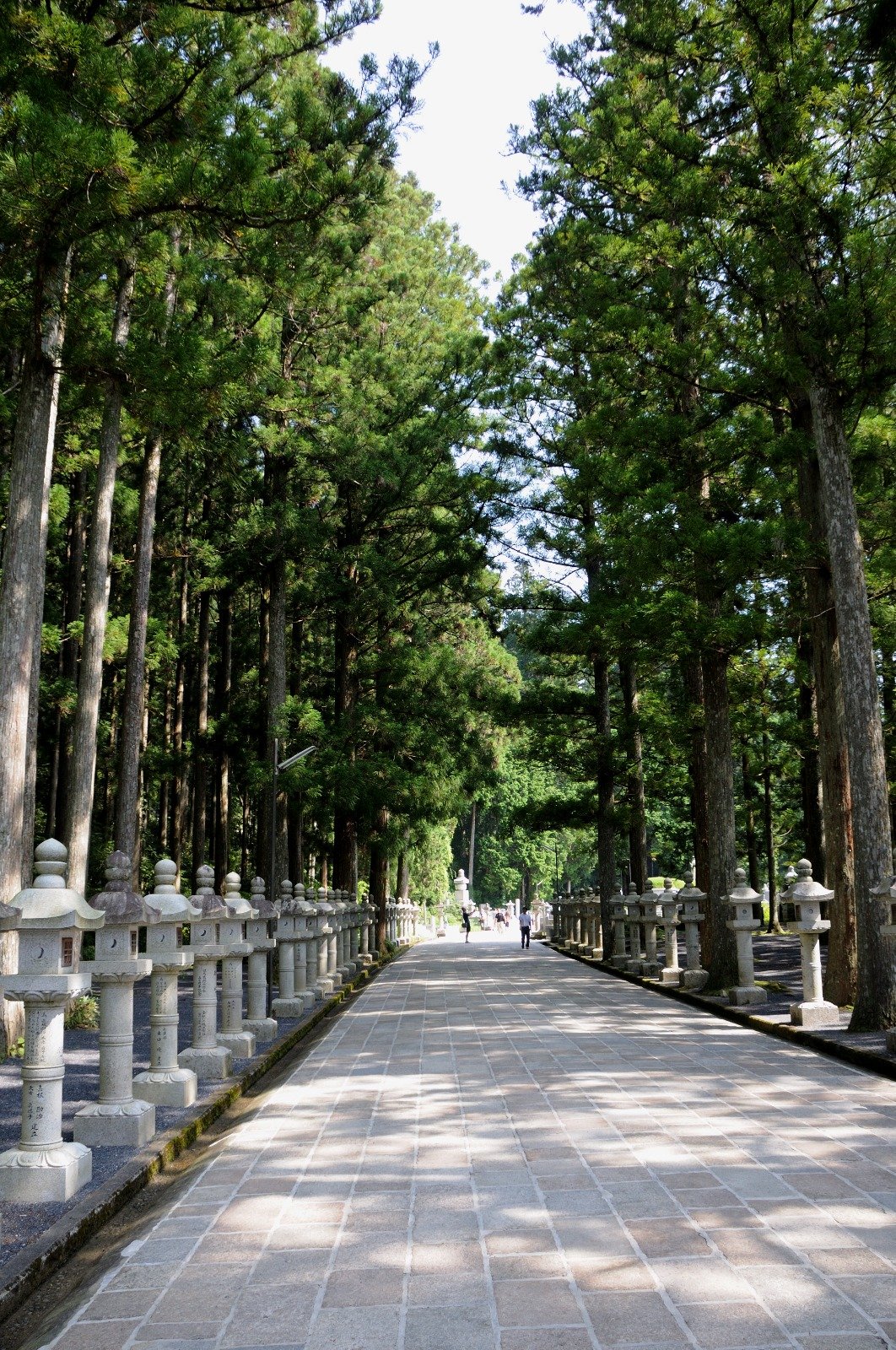
The Okunoin approach under the cedars. The full walk from Ichinohashi bridge takes the best part of an hour each way at a cemetery pace. Photo: Josep M. Gracia, CC BY-SA 4.0
Kongobuji. The head temple rewards an hour. Its tatami rooms are lined with painted screen doors, and behind the buildings sits the Banryutei, the largest rock garden in the country, two dragons suggested in raked gravel and granite. Admission is ¥1,000, and the temple opens 8:30 to 17:00 with last entry at 16:30.
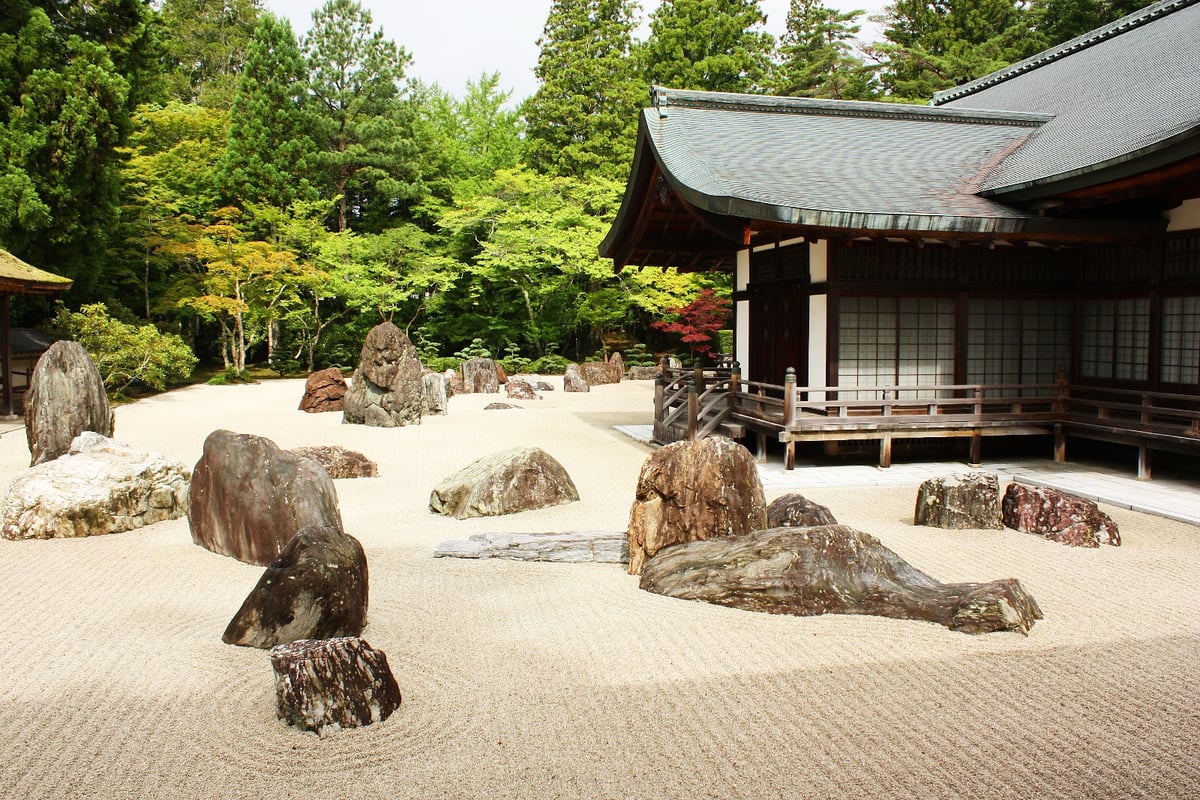
The Banryutei at Kongobuji, the largest rock garden in Japan, built in 1984 to mark 1,150 years since Kobo Daishi entered eternal meditation. Photo: Andrea Schaffer, CC BY 2.0
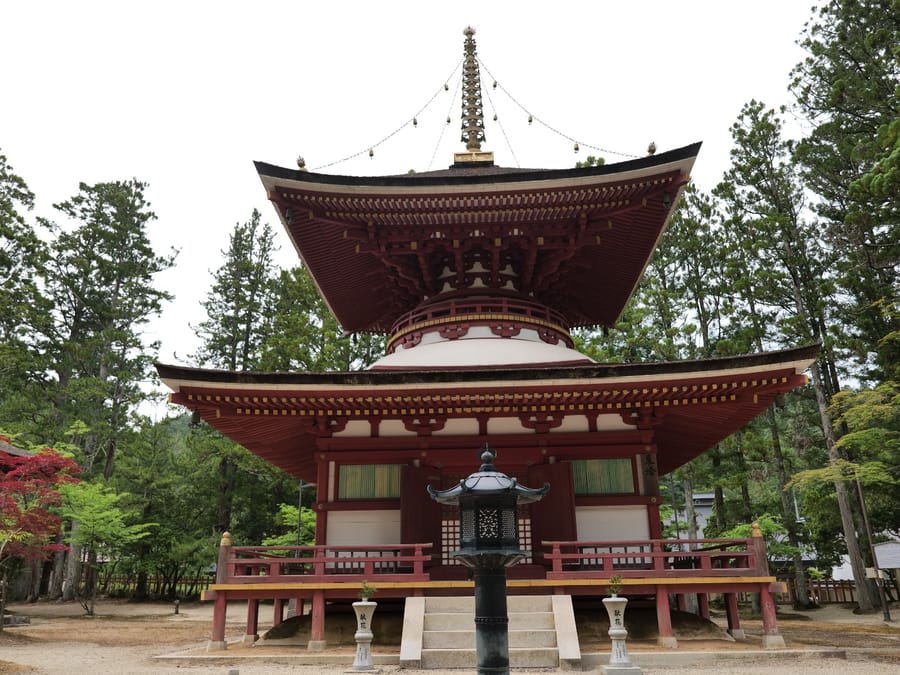
Danjo Garan. A few minutes west of Kongobuji, the Garan is the ground Kukai laid out first, and its grounds are free and always open. The building you will photograph is the Konpon Daito, a vermilion pagoda just under 49 metres tall whose interior is arranged as a three dimensional mandala. Going inside it, and into the neighbouring Kondo hall, costs ¥500 each. A combination ticket at ¥2,500 covers Kongobuji, both Garan buildings, the Tokugawa mausoleum and a jukai precept ceremony.
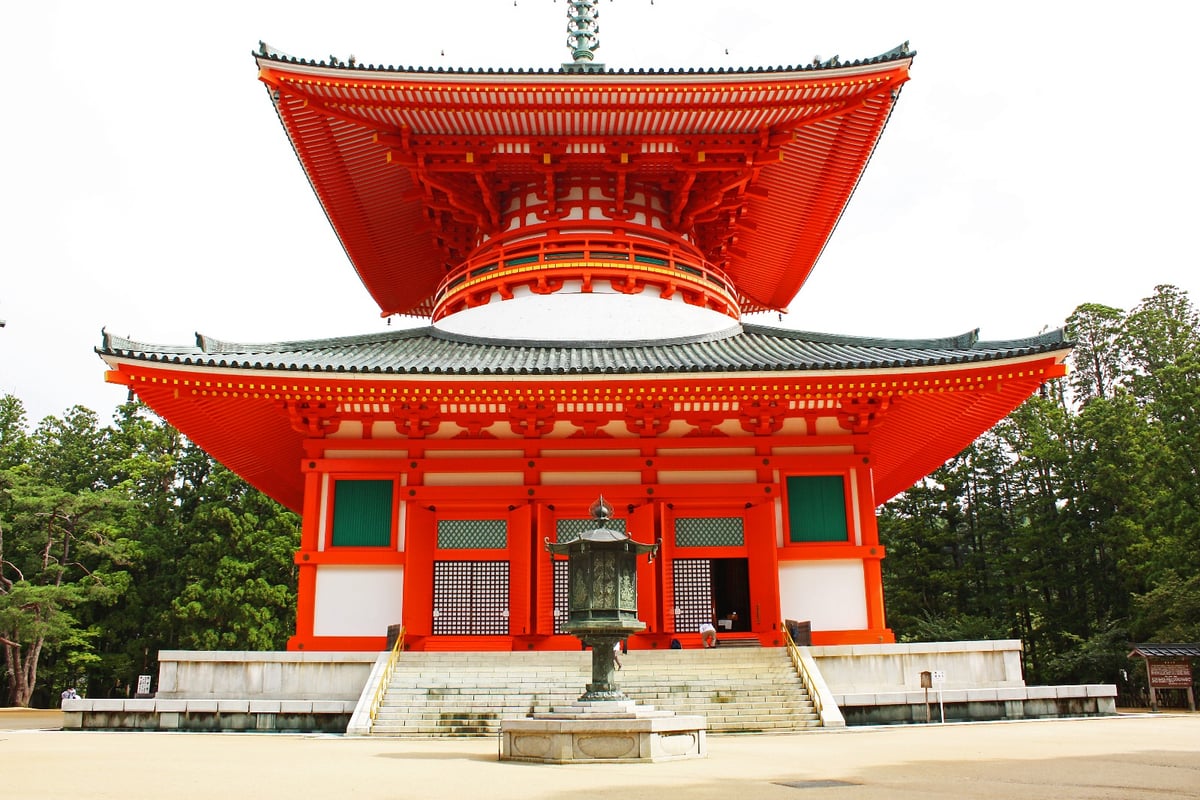
The Konpon Daito at Danjo Garan. The present pagoda is a 1937 rebuild of the one Kukai began in the ninth century. Photo: Andrea Schaffer, CC BY 2.0
A shukubo stay suits anyone whose interest in Japan runs deeper than the sights list: people who want one quiet, structured night, who like the idea of a dawn service whether or not they are Buddhist, and who eat happily without meat for two meals. It is a genuinely good choice in winter, when snow settles on the plateau and the cedars, and our Japan in winter guide https://yonihon.com/travel-guide/japan-in-winter-snow-monkeys-ski-guide/ covers how Koyasan fits a cold season itinerary. No faith, Japanese language or meditation experience is required. Curiosity and reasonable quiet are enough.
Think twice if your trip runs on late nights and lie ins, because the temple day starts early and ends not long after dinner. Think twice if you need an en suite bathroom and cannot book into the higher price band, if a futon on the floor is a problem for your back or knees, or if a shared bath is a hard no. Families manage it well with children old enough to keep the quiet hours; it is harder with toddlers. And if you only have a day, go anyway. Just know that the mountain after the last tour bus leaves is a different, better place, and it belongs to the people sleeping in the temples.
10 min · November 24, 2026