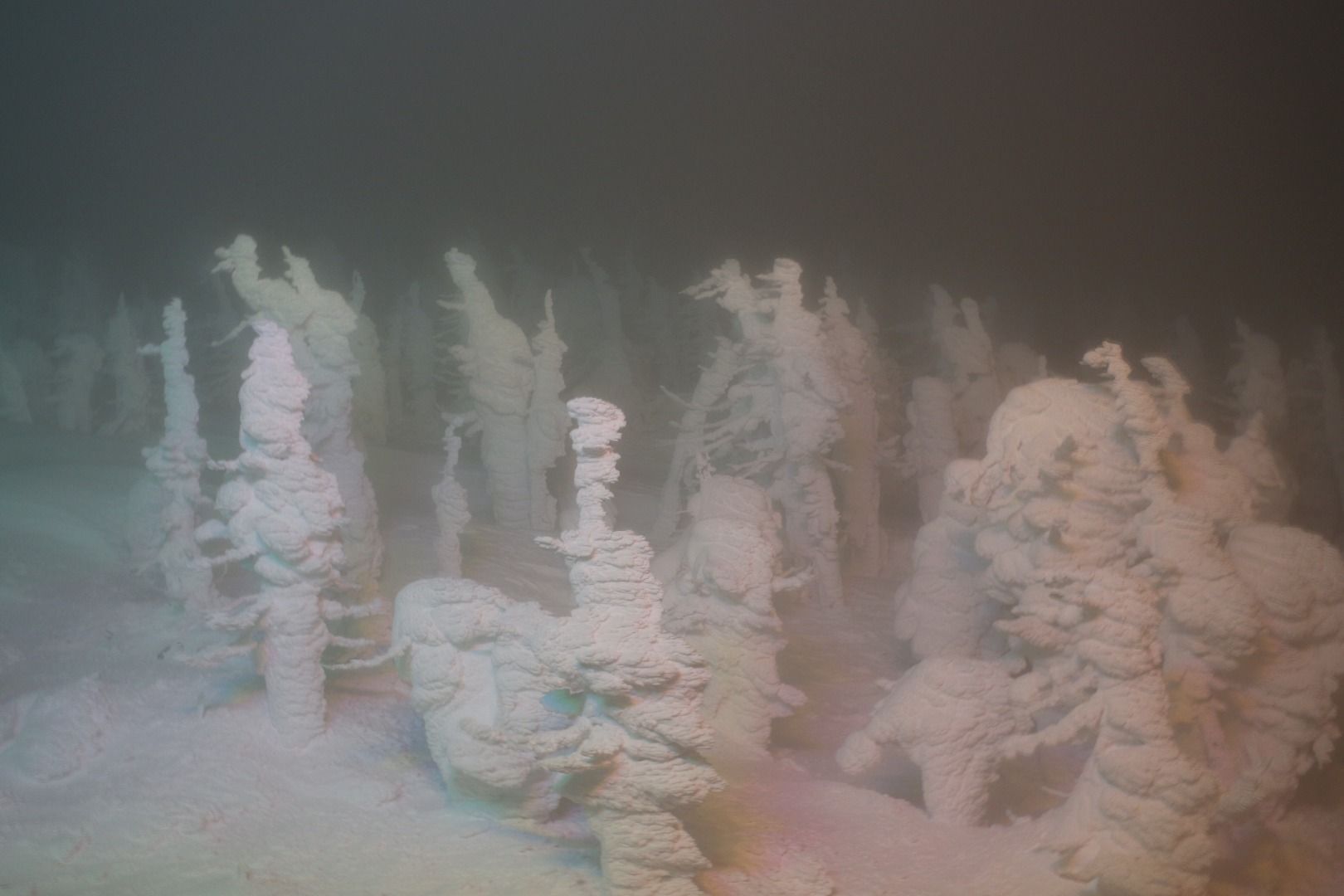
The snow monsters start as ordinary trees. The firs on the upper slopes of Mount Zao are Maries' fir, and through the winter the wind off Siberia drives supercooled water droplets into them, which freeze on contact, layer upon layer, until snow packs over the ice and each tree swells into a hunched white figure several metres tall. The Japanese name is juhyo, and Zao's are the most famous in the country, standing in their hundreds along the top section of the ropeway and around the summit station.
The way up is in two stages. From Zao Sanroku Station, on the edge of the hot-spring town of Zao Onsen, the first gondola climbs about seven minutes to Juhyo Kogen Station at 1,331 m. There you change to the upper line for a ten-minute ride to Jizo Sancho Station at 1,661 m, and it is along this second section, and in the fields around the top station, that the monsters stand thickest. In daylight, under a clear sky, they are brilliant white against deep blue. The light-up evenings are a different thing again: from 17:00 the trees near the top are picked out by coloured floodlights, and you ride up through the dark watching the shapes glow and shift colour as the gondola passes. Viewing at night is from the gondolas and from the area around the top station, where a viewing terrace looks over the lit forest and the statue of Jizo, the summit's guardian figure, stands half buried in snow nearby.
Timing matters twice over. First, the monsters grow through the season: in late December they are still forming and can look like well-frosted trees, while from late January through February they reach full size, and by March they begin to slump and collapse as the temperature rises. Second, the light-up does not run every night. It is held on 31 evenings only, mostly Fridays, Saturdays, Sundays and public holidays: 26, 27, 30 and 31 December; 1, 2, 3, 9, 10, 11, 16, 17, 22, 23, 24, 29, 30 and 31 January; and 5, 6, 7, 10, 11, 12, 13, 14, 19, 20, 21, 22 and 23 February. On those evenings the round trip costs ¥4,600 for adults and ¥2,300 for children aged 6 to 11, tickets are bought at the station on the day, and the last car up leaves Zao Sanroku at 19:45 sharp, so the evening is over by 21:00. For a closer look there is also the Night Cruiser, a heated snowcat that drives out among the lit trees from Juhyo Kogen Station on the same 31 evenings, at ¥8,000 for adults; it is booked online in advance and sells out on peak weekends.
Two warnings belong in any honest account. The summit is serious winter: the ropeway company warns that temperatures at Jizo Sancho drop below minus 10 degrees Celsius, and the wind can make it feel far colder. And the whole operation is weather dependent. Strong wind or heavy snow stops the ropeway, and the light-up is cancelled on bad nights, so check the operating status on the Zao Ropeway site on the day itself before travelling up.
What makes Zao work as a trip rather than just a sight is what waits at the bottom. Zao Onsen is one of Japan's oldest hot-spring towns, known for strongly acidic, milky sulfur water that leaves skin noticeably smoother, and the sensible shape of a light-up evening is to ride up at dusk, take the cold on the summit, and come back down to an outdoor bath while the snow falls on the far side of the steam. Staying in the town also removes the one logistical trap: buses back to Yamagata thin out in the evening, and nobody should be watching the 19:45 deadline with a last bus to catch as well.
Photos: Suicasmo (CC BY-SA 4.0), Ymblanter (CC BY-SA 3.0) and Mamusi Taka (CC BY-SA 3.0), via Wikimedia Commons.
Ride the ropeway after dark through a floodlit forest of snow monsters, on 31 selected evenings between 26 December and 23 February The monsters at full size from late January into February, standing in their hundreds around Jizo Sancho Station at 1,661 m Two-stage gondola ride from Zao Onsen, about 7 minutes to Juhyo Kogen (1,331 m) and 10 minutes more to the summit Optional Night Cruiser snowcat tour (¥8,000, book online) that drives out among the lit trees on light-up evenings By day, the same monsters in bright sun, with skiing and snowboarding on the slopes between them Zao Onsen at the base of the ropeway, a historic hot-spring town with strongly acidic sulfur baths for after the cold
•Check your date before anything else: the light-up runs on 31 evenings only, mostly weekends and holidays, listed in the description above and on the Zao Ropeway site
•Dress for below minus 10 degrees at the summit: full ski-level layers, hat, gloves, scarf and boots with grip; the top station area is exposed and windy
•The last ride up on light-up evenings is 19:45 from Zao Sanroku Station; aim to be at the station well before, as queues build on February weekends
•Check the ropeway's operating status on the day, because strong wind and heavy snow stop the cars and cancel the light-up without much notice
•Stay the night in Zao Onsen if you can; evening buses back to Yamagata are limited, and the town's baths are the best possible end to the evening
•Book Zao Onsen lodging early for late January and February weekends, which are the peak of both the monster season and the ski season
•If your dates miss a light-up evening, go in the daytime instead; the monsters in sunshine, with the range spread out below, are worth the fare on their own
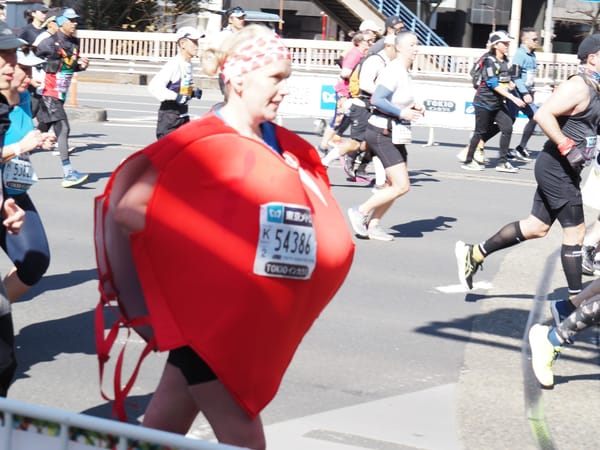
You cannot run the 2027 Tokyo Marathon, because the 40,000 places went in a ballot that closed in August 2026. But race day, Sunday 7 March 2027, is one of the great free shows in Tokyo: wheelchair racers at 9:05, the world's best marathon runners at 9:10, then hours of costume runners, all on closed streets from Shinjuku to Tokyo Station. Here is where to stand.
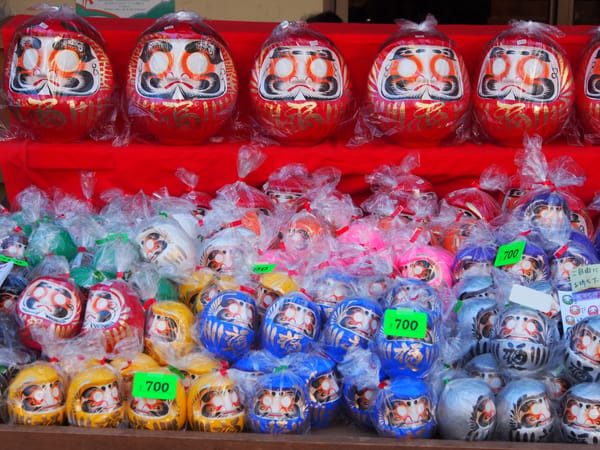
For two days every March, hundreds of stalls fill the grounds of Jindaiji Temple in Chofu with daruma dolls of every size and colour, and monks open each new doll's first eye with a Sanskrit character. It is one of Japan's three great daruma markets, an easy bus ride from Shinjuku.
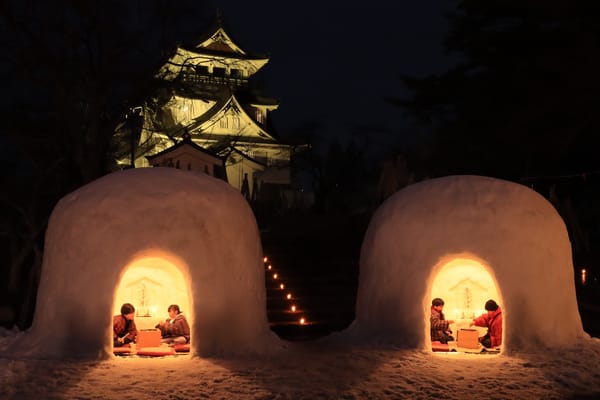
On 12 and 13 February 2027, and note that the dates have moved, the children of Yokote in Akita invite strangers into candle-lit snow huts and serve them grilled mochi and sweet amazake. The custom is about 450 years old, and it only happens on two evenings a year.
