First, the honest part: this listing will not get you a race number. Entry for the Tokyo Marathon 2027 opened and closed in the summer of 2026, the ballot has been drawn, and the field of 40,000 is set. What it gets you instead is a front-row place at one of the best free spectacles in the city. The 2027 race, on Sunday 7 March, marks 20 years since the first Tokyo Marathon in 2007, and it is a serious race as well as a street party: it is one of the Abbott World Marathon Majors, and it doubles as a selection race for the World Championships in Beijing in 2027 and the Los Angeles 2028 Olympics, so the elite field at the front is racing for more than prize money.
The morning starts with the fastest athletes of the day. The wheelchair marathon goes off at 9:05, five minutes before the runners, and the leading wheelchair racers cover the course in about an hour and a half, tucked low over their wheels at speeds the runners cannot match. If you only watch one start, watch theirs. The main field follows at 9:10 from beneath the twin towers of the Tokyo Metropolitan Government Building in Shinjuku, and because 40,000 people start in waves, the river of runners takes well over an hour to clear the start line.
The course is a tour of the city with the traffic removed. From Shinjuku it runs east through Suidobashi and Ueno Hirokoji, down through Kanda and Nihonbashi, then out to Asakusa, where the field streams past the Kaminarimon gate and its giant red lantern at roughly the 15-kilometre mark. The leaders reach Asakusa at about 9:55, less than 50 minutes after the start. From there the course turns south through Ryogoku, home of sumo, to the turnaround at Monzen-nakacho, then comes back through Nihonbashi and into Ginza at about 33 kilometres, where the leaders pass at roughly 10:50 and the race is usually decided. The finish is on Gyoko-dori, the broad avenue in front of Tokyo Station, and the winning man should cross a little after 11:10, with the leading women a few minutes behind.
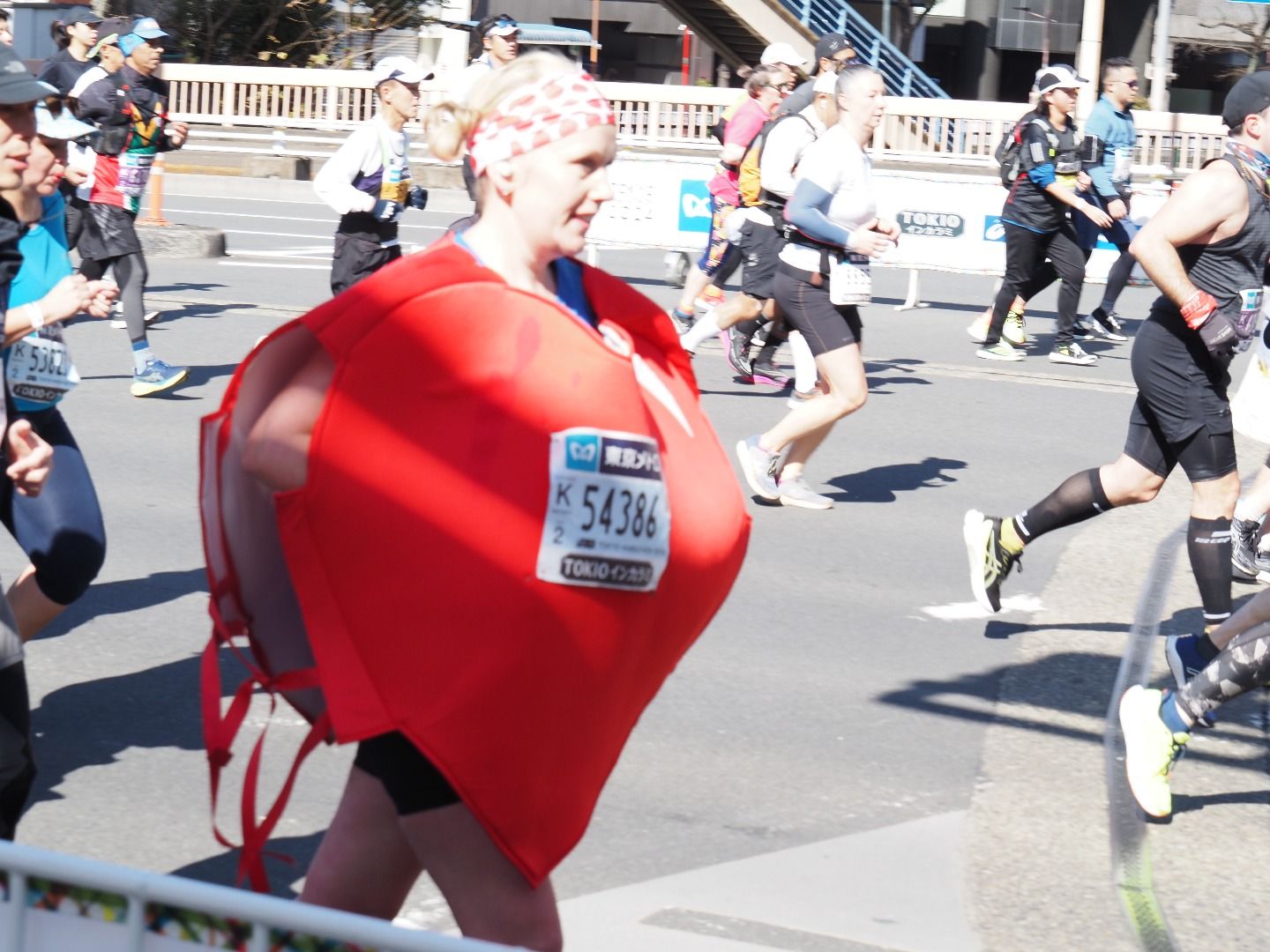
Then the day changes gear, and for spectators this is the best part. Behind the elites comes the mass field: club runners chasing personal bests, charity runners (5,000 of the 40,000 places are charity entries), and the costume runners Tokyo is famous for, superheroes, anime characters, a runner in a full heart costume, people carrying shrines, flags and occasionally furniture-grade props, all of them running 42 kilometres in it. Taiko drums, school bands and dance teams line the route, the crowds hand out everything from chocolate to cold spray, and the last finishers fight the clock to beat the 16:10 cut-off on Gyoko-dori, which is where the loudest cheering of the day happens.
Where should you stand? Asakusa is the classic early spot: arrive by 9:30, watch the wheelchair leaders flash past Kaminarimon at around 9:35, then the elite runners at about 9:55, with the temple as your backdrop. Ginza is the best late-morning spot, wide pavements, easy metro access, and the leaders arriving when the race is at full stretch; stay into the afternoon and it becomes prime costume-watching territory. Gyoko-dori is the emotional one: claim a barrier spot well before 11:00 for the winners, or come back at 15:30 for the final finishers. Monzen-nakacho, around the turnaround, has a neighbourhood feel the big junctions lack, with local stalls and the field passing at its most spread out. Pick two or three spots at most and connect them by subway: surface crossings over the course are closed while runners pass, and trying to cross central Tokyo by road on race morning is a mistake, because closures run from early morning across the whole route.
Race week has a free extra. The Tokyo Marathon EXPO fills the South Exhibition Halls at Tokyo Big Sight from Thursday 4 to Saturday 6 March (10:00 to 21:00 on Thursday and Friday, 10:00 to 18:00 on Saturday), and entry is free. Packet pick-up itself is runners only, in person with photo ID, but the EXPO floor of shoes, gear and race exhibits is open to everyone and is the easiest way to feel part of the week without a bib. And if all of this makes you want to run it yourself one day, entries for the next edition open in the summer, with the general ballot in August. Watching first is the right way round anyway: you will know exactly which kilometre you want your friends standing at.
Photos: nakashi (CC BY-SA 2.0) and Edomura no Tokuzo (CC BY-SA 3.0), via Wikimedia Commons.
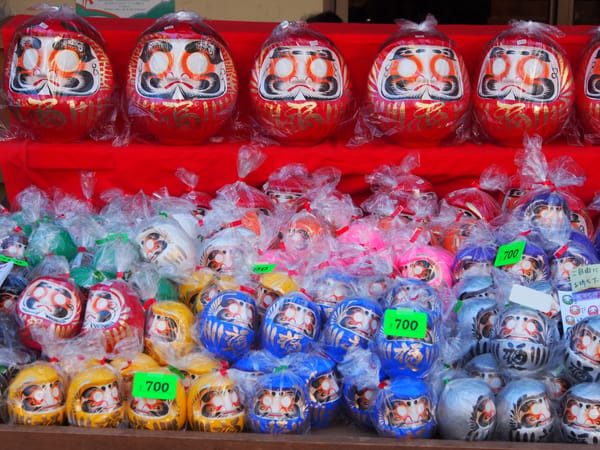
For two days every March, hundreds of stalls fill the grounds of Jindaiji Temple in Chofu with daruma dolls of every size and colour, and monks open each new doll's first eye with a Sanskrit character. It is one of Japan's three great daruma markets, an easy bus ride from Shinjuku.
Free to watch along the whole 42.195 km of closed central Tokyo streets, from the Shinjuku start to the Tokyo Station finish The wheelchair race starts at 9:05 and its leaders are the fastest athletes on the course, finishing in about an hour and a half Kaminarimon in Asakusa at about 15 km: elite runners under the giant lantern at roughly 9:55, the classic Tokyo Marathon photograph Ginza at about 33 km, where the elite race is decided late morning and the costume runners take over in the afternoon The final finishers racing the 16:10 cut-off on Gyoko-dori, in front of Tokyo Station, to the loudest crowd of the day The free Tokyo Marathon EXPO at Tokyo Big Sight, 4 to 6 March, open to non-runners
•You cannot enter the 2027 race: the general entry window closed on 28 August 2026 and the 40,000-runner field is set. Anyone selling a "guaranteed entry" now is not selling an official place
•Plan your spectating around the subway, not the roads: closures cover the course from early morning, buses are diverted, and you can only cross the route at stations and underpasses
•For the finish on Gyoko-dori, take your barrier spot well before the leaders arrive a little after 11:10; the pavements there fill early and the best views go first
•Supporting one specific runner? Agree the exact spot in advance, street name, side of the road and a landmark, and expect phone networks near the course to be busy; the field is dense and runners pass a given point faster than you think
•Asakusa doubles up well: Senso-ji and Nakamise are a two-minute walk from the Kaminarimon viewing point, so you can sightsee before and after the leaders pass
•Dress for standing still in early March: race day in Tokyo is often bright but cold, and the wind between the Ginza buildings is sharper than it looks
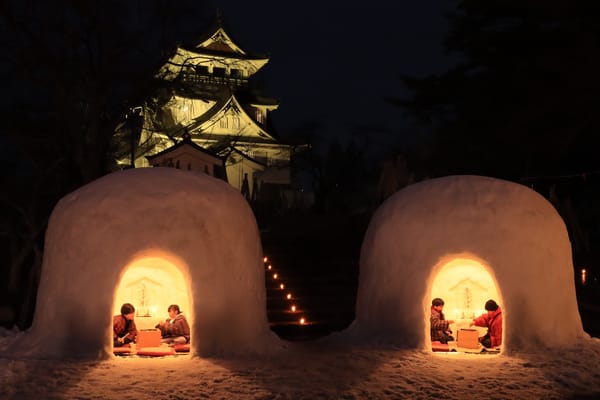
On 12 and 13 February 2027, and note that the dates have moved, the children of Yokote in Akita invite strangers into candle-lit snow huts and serve them grilled mochi and sweet amazake. The custom is about 450 years old, and it only happens on two evenings a year.
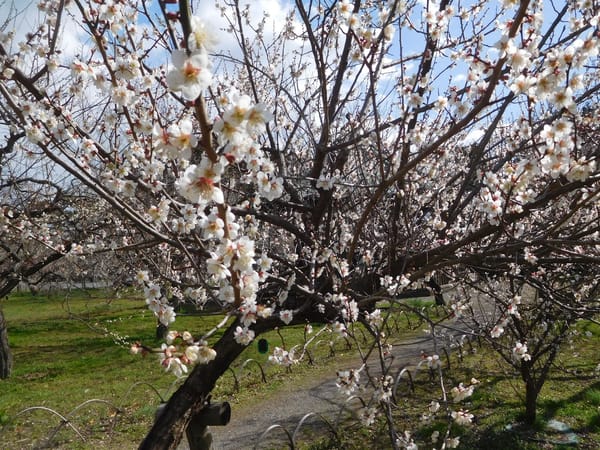
Cherry blossom gets the fame, but plum blossom comes first. For 40 days each year Mito's Kairakuen, one of Japan's Three Great Gardens, fills with around 3,000 plum trees in white, pink and deep red, and the 131st festival in 2027 runs from 11 February to 22 March, an easy day trip from Tokyo.