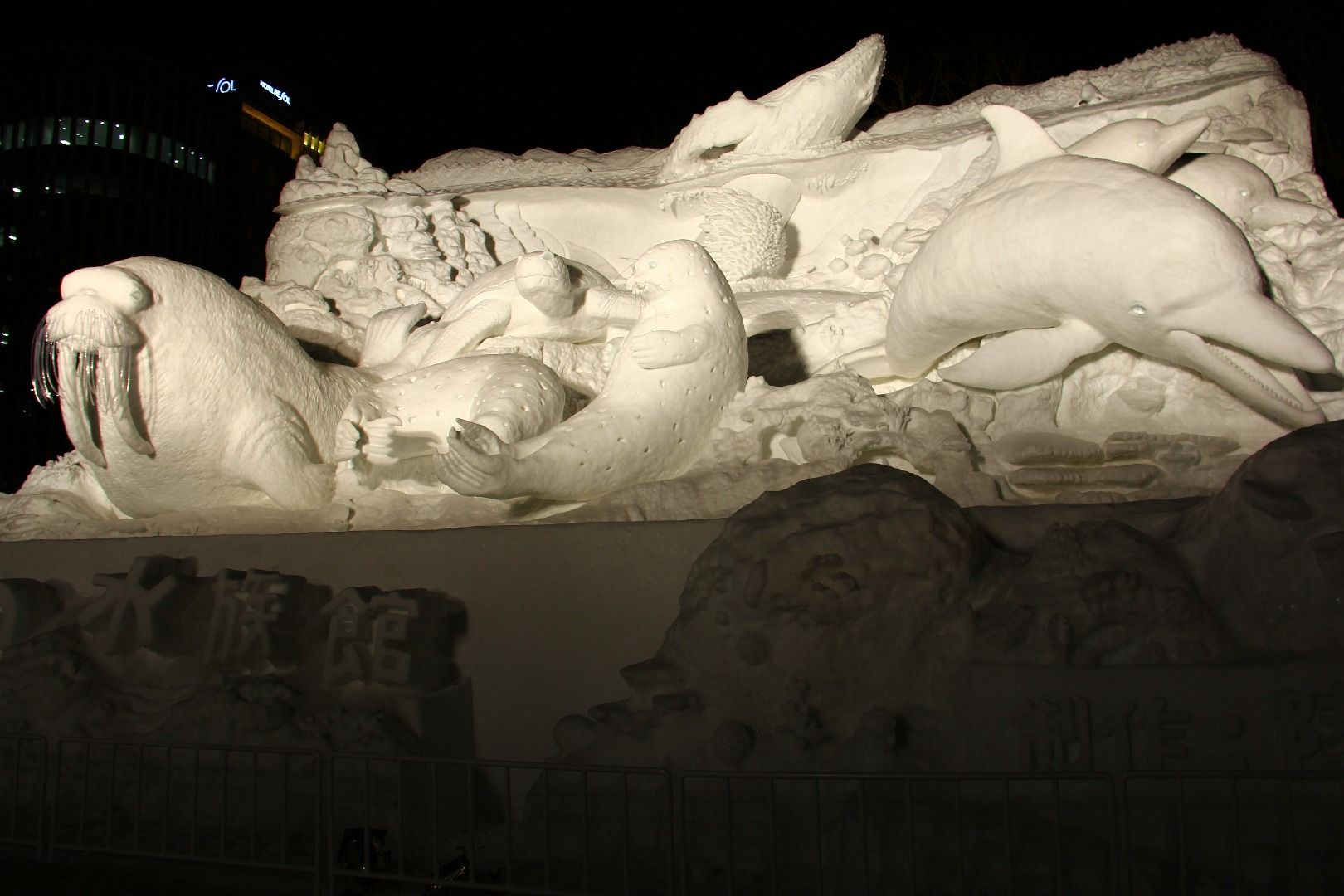
There are winter festivals, and then there is what Sapporo does to itself every February. For eight days the city centre becomes an open-air gallery of snow and ice: full-size buildings, famous landmarks and film characters rebuilt in packed snow along a park in the middle of town, ice carvings glowing in the entertainment district, and a dome full of slides at the edge of the city. The Sapporo Snow Festival is one of the largest winter events in the world, drawing more than two million visitors in a typical year, and the 77th edition runs from Thursday 4 to Thursday 11 February 2027. Entry to all three sites is free.
It began modestly. In February 1950, students from three high schools and two junior high schools in the city built six snow statues at Nishi 7-chome in Odori Park, on ground that was then used for dumping the snow cleared from Sapporo's streets. About 50,000 people came to look. Three years later a student team raised a statue 15 metres high, called Shoten, or Ascension, and the race for scale was on. From 1955 the Ground Self-Defense Force joined in, treating the construction as winter engineering training, and its teams still build the largest sculptures today, trucking in clean snow from outside the city when the local fall is not enough.
The main site is Odori Park, the broad green strip that cuts across central Sapporo. During the festival it fills block by block for eleven blocks, roughly a kilometre and a half of sculptures. The layout listed for the coming edition puts large snow sculptures in the 4, 5, 7, 8 and 10-chome blocks, small and medium works in the 3, 6 and 9-chome blocks, and the Sapporo International Art Festival at 2-chome, with the citizen sculptures built by Sapporo schools and local groups filling their own plots along the park. At the western end, 11-chome hosts the International Snow Sculpture Competition, where teams from overseas carve against each other over the festival days. In 2026 the big Odori sculptures carried projection mapping shows after dark, and the standard advice holds for any year: walk Odori twice, once in daylight to read the detail in the carving, and once after dark when the floodlights and projections change the sculptures completely. The Sapporo TV Tower stands at the park's eastern end at 1-chome, and its observation deck gives the one view that takes in the whole line of sculptures at once.
The second site, Susukino, works in ice rather than snow. Susukino is Sapporo's nightlife quarter, all neon and ramen shops, and during the festival its main street, Ekimae-dori between Minami 4-jo and Minami 6-jo, fills with ice carvings: dragons, sea creatures, furniture you can sit on, all of it lit from within after dark. It is the natural evening site, small enough to walk in under an hour and surrounded by places to eat afterwards.
The third site, Tsudome, is the one aimed at children and anyone who wants to play in the snow rather than look at it. Tsudome is the Sapporo Community Dome in Higashi Ward, and its grounds hold giant tube slides, snow rafting and play areas built from snow. It runs in the daytime and is reached by shuttle bus from Sakaemachi Station on the Toho subway line. Families based in central Sapporo usually give it a morning, then head back to Odori for the sculptures in the afternoon light.
Two things shape a trip here. The first is cold: Sapporo in early February sits below freezing day and night, the pavements between sculptures are polished ice, and the wind off the Sea of Japan finds every gap in a coat. Proper winter boots with grip matter more than any other single item. The second is demand. Festival week is the busiest of Sapporo's year, and hotels near Odori book out months ahead. The same week also holds the Otaru Snow Light Path (6 to 13 February) and the Asahikawa Winter Festival (6 to 11 February), both easy trips from Sapporo, so one Hokkaido journey in this window can take in three festivals without rushing.
Photos: Cesar I. Martins (CC BY 2.0), Ominae (CC BY-SA 4.0) and Kinju Nazuna (CC BY-SA 4.0), via Wikimedia Commons.

You cannot run the 2027 Tokyo Marathon, because the 40,000 places went in a ballot that closed in August 2026. But race day, Sunday 7 March 2027, is one of the great free shows in Tokyo: wheelchair racers at 9:05, the world's best marathon runners at 9:10, then hours of costume runners, all on closed streets from Shinjuku to Tokyo Station. Here is where to stand.
Large snow sculptures in five Odori Park blocks, some as tall as buildings, built by Ground Self-Defense Force teams as they have been since 1955 The International Snow Sculpture Competition at 11-chome, with overseas teams carving through the festival Dozens of citizen sculptures by Sapporo schools and local groups, the festival's original spirit from 1950 Susukino's ice carvings along Ekimae-dori, lit from within after dark in the middle of the nightlife district Tsudome's giant tube slides and snow play areas, the family site, reached by shuttle bus from Sakaemachi Station The whole festival is free, and the Sapporo TV Tower deck overlooks the full line of Odori sculptures
•Book Sapporo hotels months ahead for festival week, and expect the Odori and Susukino areas to sell out first
•Walk the Odori site twice, in daylight for the carving detail and after dark for the lighting and projection shows
•Weekday mornings are the quietest time at Odori; the final weekend, ending on the 11 February holiday, is the busiest
•Wear winter boots with real grip and dress for standing still in sub-zero air; the ground between sculptures is packed ice
•Use the subway between sites (Odori and Susukino stations are minutes apart) and the festival shuttle bus for Tsudome
•Check snowfes.com from mid December 2026 for the 2027 site maps and sculpture list before you travel
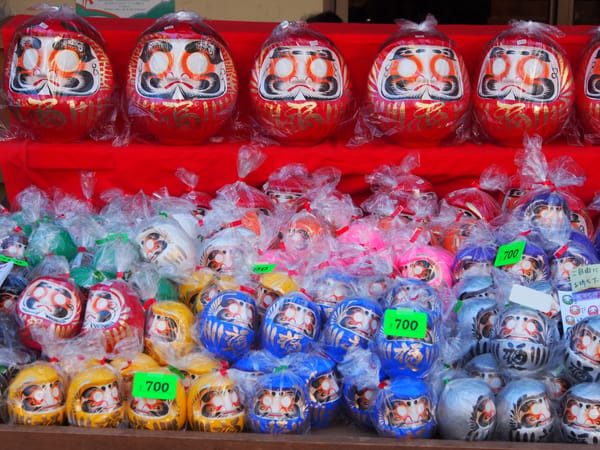
For two days every March, hundreds of stalls fill the grounds of Jindaiji Temple in Chofu with daruma dolls of every size and colour, and monks open each new doll's first eye with a Sanskrit character. It is one of Japan's three great daruma markets, an easy bus ride from Shinjuku.
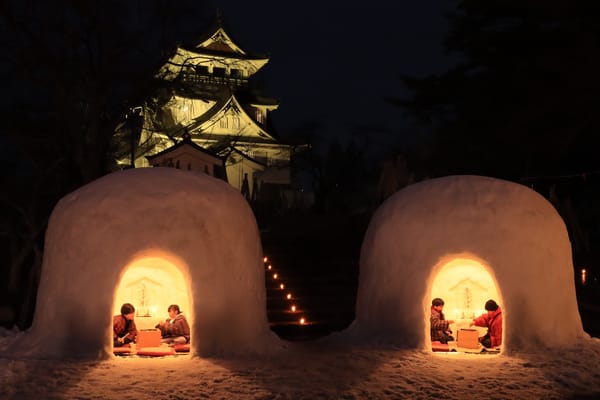
On 12 and 13 February 2027, and note that the dates have moved, the children of Yokote in Akita invite strangers into candle-lit snow huts and serve them grilled mochi and sweet amazake. The custom is about 450 years old, and it only happens on two evenings a year.