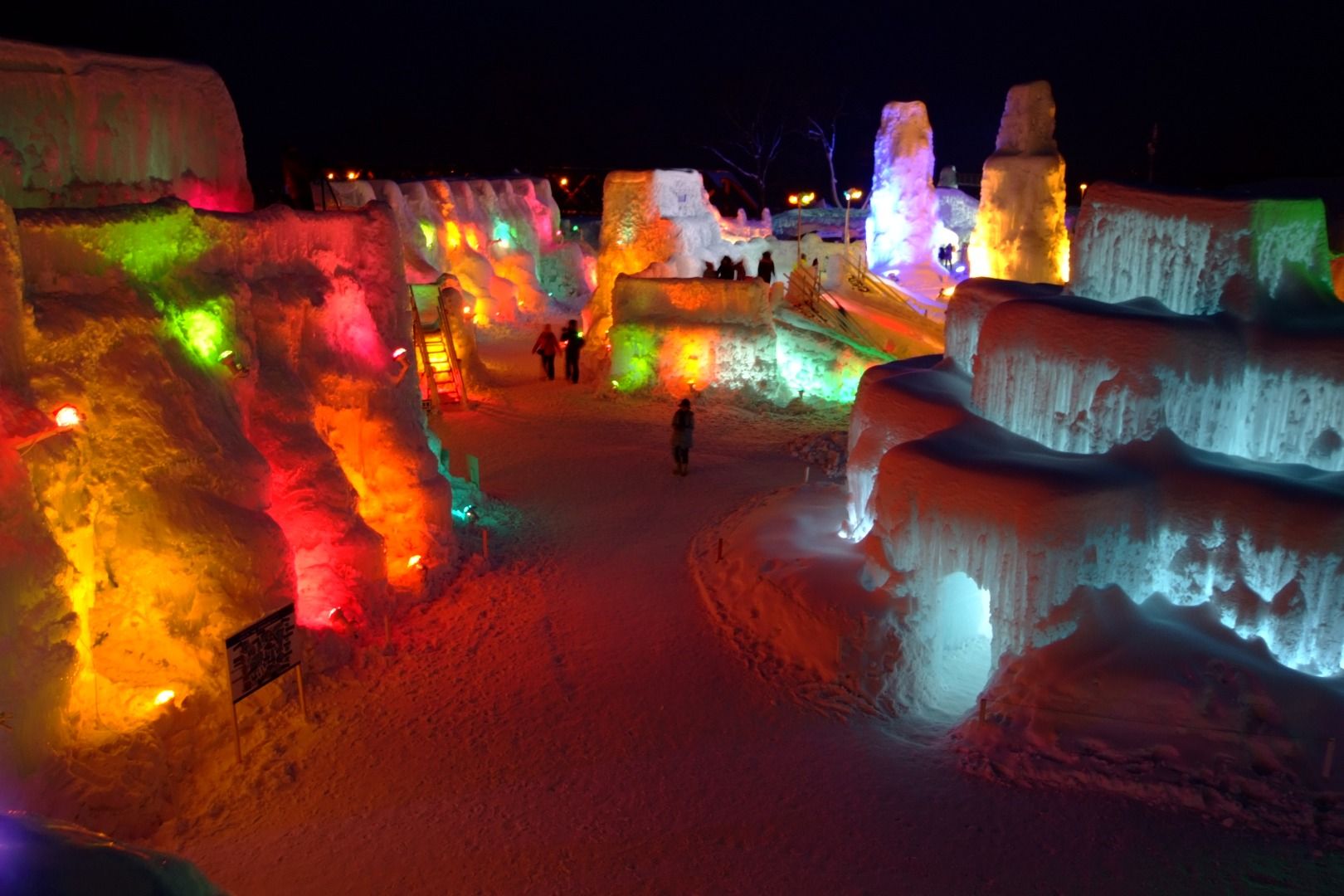
The ice at Lake Shikotsu is not carved from blocks. It is grown. Through the coldest weeks of the year, water from the lake is sprayed over frames and left to freeze in layers, building up towers, walls, tunnels and caves that stand on the shore at Shikotsuko Onsen until the thaw takes them. Lake Shikotsu, in Shikotsu-Toya National Park, is known across Japan for the clarity of its water, and that clarity is the festival's signature: in daylight the ice takes on a pale natural blue that the organisers call Shikotsu blue, strongest on bright mornings and in the hour before the lights come on.
From 16:30 the same structures are lit in colour, green, red, gold and blue, and the site turns into the open-air ice museum the organisers describe. There are ice slides for children, walk-through caves, and walls thick with icicles to wander between. It is a smaller, quieter event than the Sapporo Snow Festival, set in forest by a lake rather than in a city centre, and that is its appeal. LIVE JAPAN puts the 2026 edition at around 127,000 visitors over 24 days, so expect company, but not Sapporo's crush.
The festival runs from Saturday 30 January to Tuesday 23 February 2027, 10:00 to 20:00 every day, and the long run is strategically useful. It starts before the Sapporo Snow Festival (4 to 11 February) and ends nearly two weeks after it, and the venue sits close to New Chitose Airport rather than to Sapporo. That makes it the Hokkaido winter festival that fits an arrival or departure day, or a half day built around a flight, provided you leave a wide margin before check-in.
Getting there is the part to plan properly, because there is no train to the lake. The festival's own shuttle, the Hyoto Blue Liner, runs from New Chitose Airport (domestic terminal) via JR Chitose Station to Shikotsuko Onsen, and it is reservation only. Bookings close at 20:30 the day before travel, there are no same-day bookings, and cancellations are charged in full, so the bus has to be fixed before the rest of the day is. The fare is ¥2,000 one way, seats are guaranteed, and the ride takes about 45 minutes from JR Chitose Station and about an hour from the airport. The first bus leaves the airport at 09:00; the last bus back leaves the lake at 20:30 and ends at JR Chitose Station, while the last return that reaches the airport leaves the lake at 19:30. A taxi from the airport takes about 40 minutes. Driving is possible, with free winter parking for ordinary cars at the Shikotsuko car park, but the roads are snow-covered and the shuttle exists precisely so visitors do not have to.
One price change matters for 2027. Entry for junior high school age and older is still ¥1,000 on weekdays, but the organiser raised weekends and public holidays to ¥3,000 from this edition, citing crowding and costs, in a notice dated 2 July 2026. Note that Thursday 11 February and the final day, Tuesday 23 February, are both public holidays, so they carry the ¥3,000 price too. A weekday visit is a third of the price and noticeably calmer. If you are staying at the lake, guests of Shikotsuko Onsen hotels can also buy a Premium Time ticket on certain weekdays (¥1,500 including admission) for entry from 20:15 to 21:15, after the general crowds have gone, plus the following morning; it is booked through the hotels, not at the gate.
Practical notes to finish. The venue is outdoors on snow and ice, in a place where winter lows average around minus 8 degrees, and the paths between the ice structures are slippery; boots with grip are not optional. The organiser bans drones and individual live streaming at the venue. And like every Hokkaido winter event, the festival can be cancelled if the weather turns dangerous, so check the official site on the day. Warm up afterwards in Shikotsuko Onsen, where several facilities offer day bathing.
Photos: t-konno, CC BY-SA 3.0, via Wikimedia Commons. Festival photos are from earlier editions.
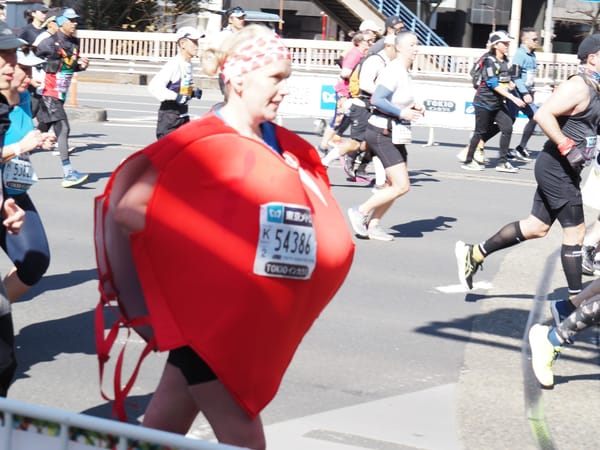
You cannot run the 2027 Tokyo Marathon, because the 40,000 places went in a ballot that closed in August 2026. But race day, Sunday 7 March 2027, is one of the great free shows in Tokyo: wheelchair racers at 9:05, the world's best marathon runners at 9:10, then hours of costume runners, all on closed streets from Shinjuku to Tokyo Station. Here is where to stand.
Ice towers, tunnels and caves grown by spraying Lake Shikotsu water onto frames, not carved from blocks The natural Shikotsu blue of the ice by day, then a full colour light-up from 16:30 to 20:00 The longest-running window of Hokkaido's big winter festivals, 30 January to 23 February 2027, overlapping the Sapporo Snow Festival (4 to 11 February) Close to New Chitose Airport, so it fits an arrival or departure day better than any other major winter festival Premium Time entry for Shikotsuko Onsen hotel guests on certain weekdays, 20:15 to 21:15 after general closing, ¥1,500 including admission A lakeside hot spring town at the gate: finish the evening with day bathing at Shikotsuko Onsen
•Book the Hyoto Blue Liner bus before anything else: it is reservation only, bookings close at 20:30 the day before, there are no same-day bookings and cancellations cost the full fare
•Go on a weekday if you can: entry is ¥1,000 instead of ¥3,000, and the site is calmer. Remember 11 and 23 February are public holidays and priced as weekends
•Arrive in the middle of the afternoon to see both versions of the festival, the blue ice in daylight and the colours after 16:30
•Fix your return bus before you go in. The last bus that reaches New Chitose Airport leaves the lake at 19:30, and afternoon buses can run late
•Wear boots with real grip and dress for well below zero; the ground is ice and packed snow and you will be outdoors for one to two hours
•Do not plan to fly drones or live stream: both are banned by the organiser. Check the official site on the day, as severe weather can cancel the festival
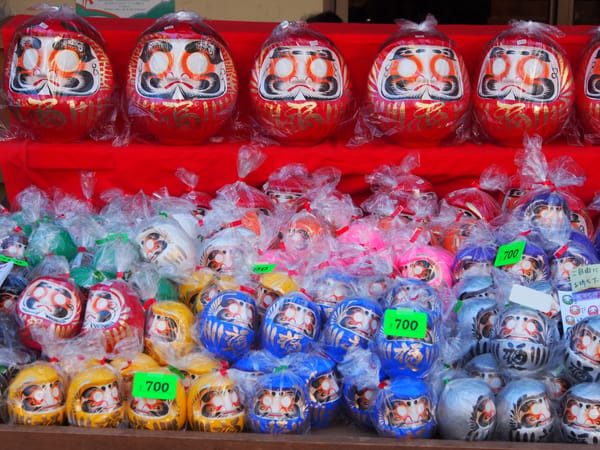
For two days every March, hundreds of stalls fill the grounds of Jindaiji Temple in Chofu with daruma dolls of every size and colour, and monks open each new doll's first eye with a Sanskrit character. It is one of Japan's three great daruma markets, an easy bus ride from Shinjuku.
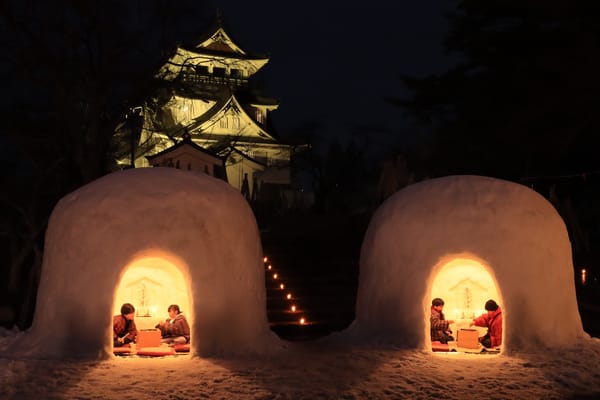
On 12 and 13 February 2027, and note that the dates have moved, the children of Yokote in Akita invite strangers into candle-lit snow huts and serve them grilled mochi and sweet amazake. The custom is about 450 years old, and it only happens on two evenings a year.