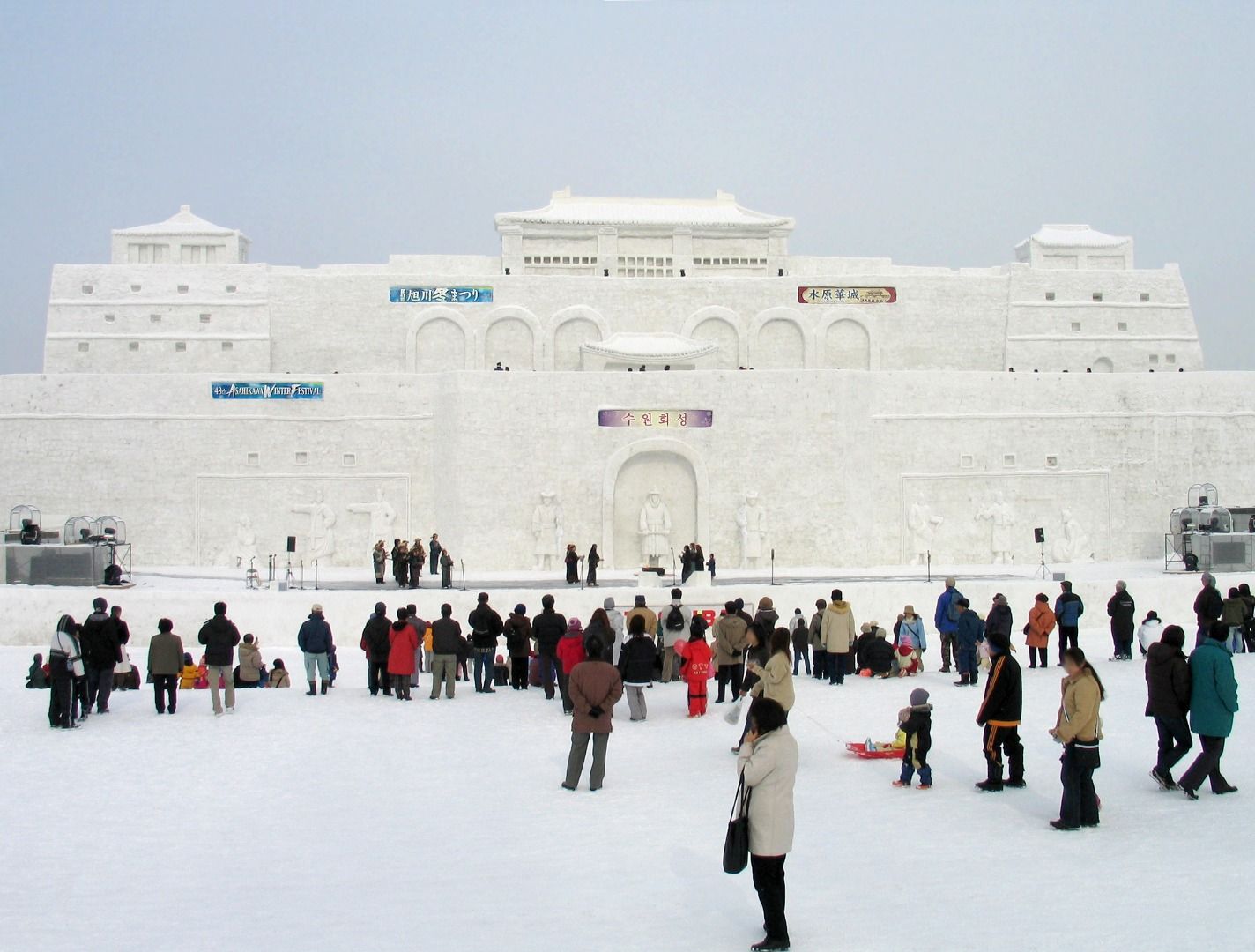
Every February, in the same week as the Sapporo Snow Festival, Hokkaido's second city holds a winter festival of its own, and it plays a different game. Sapporo spreads a hundred sculptures along a park. Asahikawa puts most of its effort into one enormous structure on the bank of the Ishikari River and builds the festival around it. The 68th Asahikawa Winter Festival runs from Saturday 6 to Thursday 11 February 2027, across two sites in the city, and entry is free.
The setting does half the work. Asahikawa sits inland, ringed by mountains, and it is one of the coldest cities in Japan: in January 1902 it recorded minus 41 degrees, still the lowest temperature in the country's official records. Snow that falls here stays crisp, sculptures keep their edges all week, and the air on a clear festival night has a bite that Sapporo, down on the coast, rarely matches.
The main sculpture stands at the Asahibashi Riverside Site, on the frozen riverbank below the Asahibashi bridge, next to Tokiwa Park. By the organisers' figures it runs about 140 metres wide and 20 metres high, which puts it among the largest snow sculptures built anywhere in the world. Asahikawa has form at this scale: its giant sculptures have twice been certified by Guinness World Records, including a full-size Suwon Hwaseong Fortress in 1994. The sculpture is built with help from the Ground Self-Defense Force's 2nd Division, based in the city, and it is not only for looking at. The festival stage sits in front of it, so concerts and ceremonies play out against a wall of carved snow, and in recent editions a snow slide of about 100 metres has run down the structure, with smaller citizen and school sculptures, a snow maze and food stalls spread across the riverside ground. After dark the sculpture is lit, and in recent years fireworks have been launched over the frozen river on some evenings.
For 2027 the headline is the subject. The Hokkaido Shimbun has reported that the main sculpture will feature Godzilla, which feels right for a city that builds at monster scale: a creature famous for towering over cities, carved 20 metres high out of snow, in one of the coldest places in Japan. The detailed programme is still to come, so treat the Godzilla plan as a reported headline rather than a published schedule, and expect the design to be revealed closer to February.
The second site could hardly be more convenient. Heiwa-dori Kaimono Koen, the pedestrian shopping street that runs from JR Asahikawa Station, hosts the festival's ice carving: the World Ice Sculpture Competition lines the street with works by carvers from overseas, lit after dark, among the shops and cafes. It takes about a minute to walk from the station doors to the first sculptures, which makes Heiwa-dori the easy evening half of the festival after a day at the riverside.
Most visitors pair the festival with the city's other winter draw. Asahiyama Zoo, about 40 minutes by bus from the station area, runs its famous penguin walks through the snow season, when the king penguins file out for a stroll along a snow course in front of the crowds. The zoo enters its 60th anniversary year in 2027. A festival day that starts with the penguins, moves to the riverside sculpture for the afternoon and ends among the lit ice carvings on Heiwa-dori is about as complete a Hokkaido winter day as exists.
Getting there is simple. Asahikawa is about 1 hour 25 minutes from Sapporo by the Lilac and Kamui limited expresses, and the festival overlaps the Sapporo Snow Festival (4 to 11 February) and the Otaru Snow Light Path (6 to 13 February), so it works as a long day trip from Sapporo or, better, as an overnight that lets you see the sculpture lit without watching the clock for the last train.
Photos: Keihin Nike (CC BY-SA 3.0 and CC BY 3.0), Nagono (CC BY-SA 3.0) and Nayoro (CC BY-SA 4.0), via Wikimedia Commons.

You cannot run the 2027 Tokyo Marathon, because the 40,000 places went in a ballot that closed in August 2026. But race day, Sunday 7 March 2027, is one of the great free shows in Tokyo: wheelchair racers at 9:05, the world's best marathon runners at 9:10, then hours of costume runners, all on closed streets from Shinjuku to Tokyo Station. Here is where to stand.
The main snow sculpture at the Asahibashi Riverside Site, about 140 metres wide and 20 metres high, among the largest snow sculptures in the world, with the festival stage built in front of it In 2027 the main sculpture will feature Godzilla, as reported by the Hokkaido Shimbun A snow slide of about 100 metres running down the big sculpture in recent editions, plus citizen sculptures, a snow maze and food stalls on the riverside ground The World Ice Sculpture Competition along Heiwa-dori, the pedestrian street by the station, its carvings lit after dark Winter fireworks over the frozen Ishikari River on some evenings in recent editions Asahiyama Zoo's penguin walks run through the snow season in the same city, an easy pairing with the festival
•Use the festival shuttle bus between the station area and the Asahibashi Riverside Site; Hokkaido Tourism puts the ride at about 30 minutes, and Heiwa-dori starts about 1 minute from the station
•Dress warmer than you would for Sapporo: Asahikawa is inland and colder, and the riverside site is exposed, so thermal layers, a hat, gloves and boots with grip are essential
•See the main sculpture twice if you can, in daylight for its scale and after dark when it is lit
•Keep one evening flexible: fireworks nights and stage times are set by the 2027 programme, which had not been published at the time of writing
•Reserve limited express seats and Asahikawa hotels early, because the week overlaps the Sapporo Snow Festival and the whole region fills up
•Check the official site, asahikawa-winterfes.jp, for the 2027 programme, site hours and shuttle details before you travel
For two days every March, hundreds of stalls fill the grounds of Jindaiji Temple in Chofu with daruma dolls of every size and colour, and monks open each new doll's first eye with a Sanskrit character. It is one of Japan's three great daruma markets, an easy bus ride from Shinjuku.
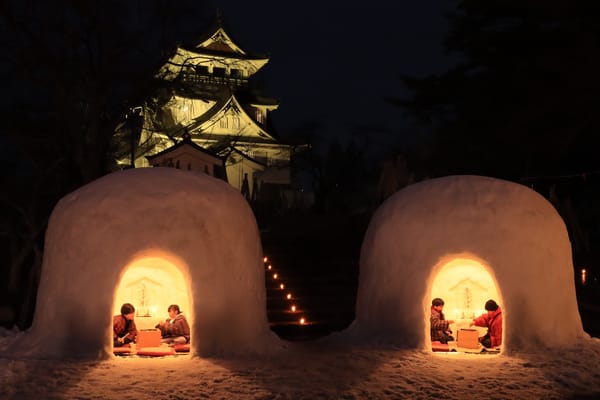
On 12 and 13 February 2027, and note that the dates have moved, the children of Yokote in Akita invite strangers into candle-lit snow huts and serve them grilled mochi and sweet amazake. The custom is about 450 years old, and it only happens on two evenings a year.