Practical Japan travel tips that can save you time, money and unnecessary stress
Planning your first trip to Japan can feel overwhelming, especially when payment methods, transport systems and local customs work differently from those at home.
These 15 things to know before visiting Japan cover the practical details that can help you avoid common mistakes and enjoy a smoother journey.
Updated for 2026, this guide includes current advice about cash, IC cards, the Japan Rail Pass, internet access, onsen etiquette, luggage forwarding and seasonal weather.
1. Carry some cash, even though Japan is becoming more cashless
Cards and mobile payments are now accepted at many hotels, department stores, restaurants and convenience stores. However, cash remains useful at small restaurants, temples, local markets, rural businesses and some ticket machines.
Foreign-issued cards are commonly accepted at Seven Bank ATMs, often found inside 7-Eleven stores, and at many Japan Post Bank ATMs. Card compatibility and operating hours can vary, so bring more than one payment method.
Withdraw or exchange a modest amount of yen after arriving. Keeping a mixture of notes and coins is helpful for small purchases, lockers and machines that do not accept cards.
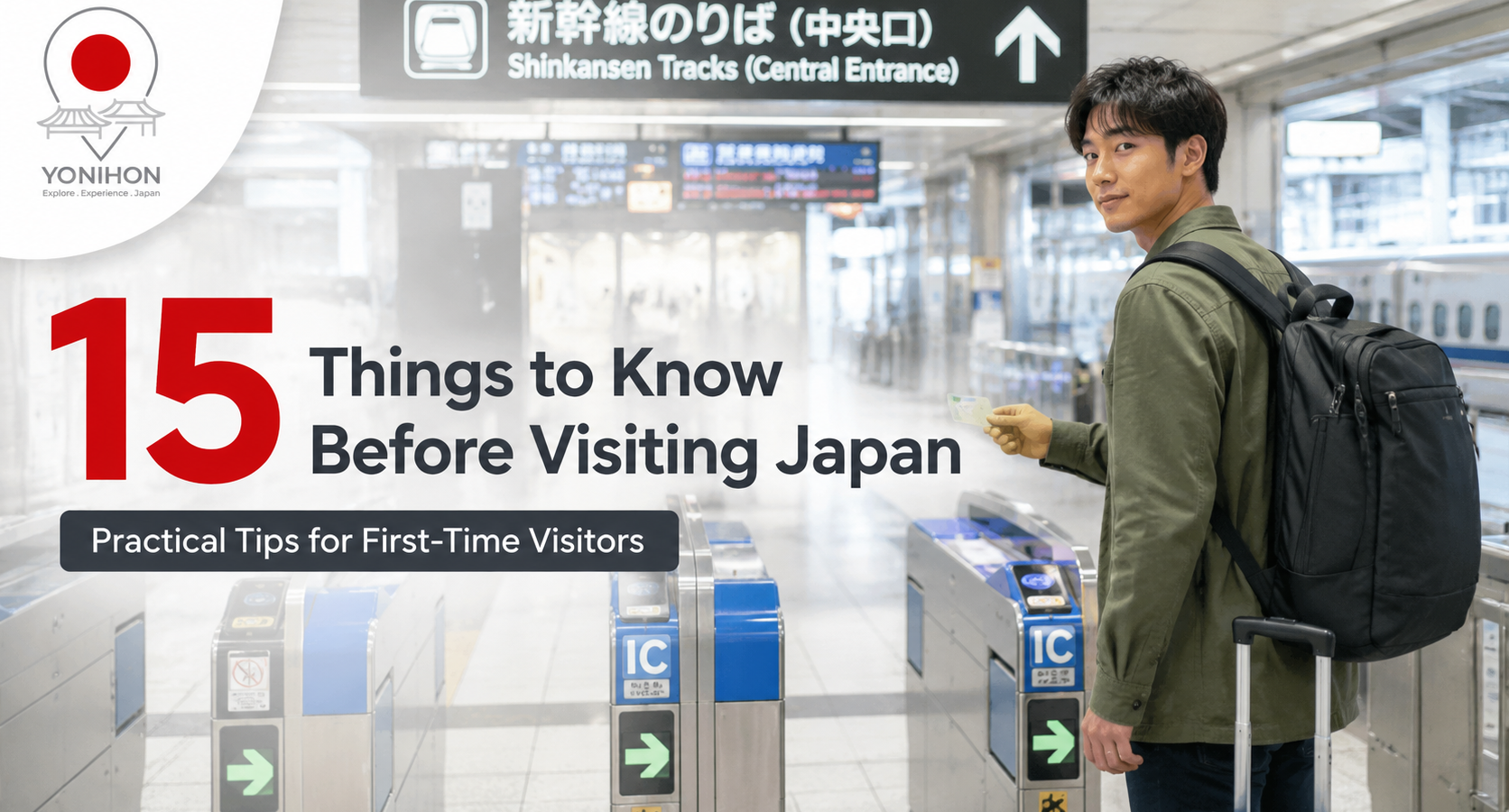
2. Use an IC card for easier transport
A rechargeable IC card can make travelling around Japan much simpler.
Cards such as Suica and PASMO can be used on many participating trains, subways and buses. They can also be used for small purchases at convenience stores, vending machines and other participating businesses.
Instead of calculating the fare for every journey, you normally tap the card when entering and leaving the station.
Tourist IC card options and purchase locations can change. Check the current conditions for cards such as TOURIST PASMO and Welcome Suica before travelling. Compatible iPhone users may also have access to a mobile option.
Remember that an IC card is a stored-value payment method, not an unlimited transport pass. It is also not accepted on every transport network in Japan.
3. Calculate whether the JR Pass is worth it
The nationwide Japan Rail Pass can be useful for travellers making several long-distance JR journeys within a limited period. It is not automatically the cheapest choice for every visitor.
Individual tickets may cost less when your itinerary includes only one or two intercity journeys. A regional rail pass may offer better value if your trip concentrates on one part of Japan.
Before buying a pass:
- List your planned long-distance journeys.
- Check the individual ticket prices.
- Compare the total with nationwide and regional pass prices.
- Confirm which trains and routes are included.
- Check whether reservations or additional tickets are required.
Choose a rail pass based on your actual itinerary rather than its popularity.
4. Arrange internet access before arrival
Mobile internet is useful for maps, train information, translation, restaurant research and emergency updates.
An eSIM may be suitable when you have an unlocked, compatible phone and want to avoid carrying another device. Pocket Wi-Fi can be practical when several people or devices need to share one connection.
Before choosing, check:
- Device compatibility
- High-speed data limits
- Coverage in the regions you will visit
- Hotspot or tethering restrictions
- Collection and return requirements
- What happens when the high-speed allowance is used
Download your hotel addresses, booking confirmations and essential maps for offline use as a backup.
5. Learn basic onsen etiquette
Visiting an onsen, or hot-spring bath, can be a memorable part of travelling in Japan. Communal baths have several important rules.
Wash your body thoroughly at the shower area before entering the bath. Swimwear is normally not permitted unless the facility clearly says otherwise. Keep your small towel, hair and belongings out of the water.
Tattoo policies differ between facilities. Some onsen accept tattoos, some permit smaller tattoos when covered, and others offer private baths as an alternative.
Always check the individual facility’s rules before making a special journey or booking accommodation.
6. Know when to remove your shoes
Shoes are removed in Japanese homes, traditional inns and certain restaurants, temples, clinics and fitting rooms.
The entrance area where shoes are removed is called a genkan. Leave your outdoor shoes on the lower entrance floor and avoid stepping there in your socks or bare feet.
Indoor slippers may be provided, but they should normally be removed before walking on tatami mats. Toilets may have separate slippers that must remain inside the bathroom.
Comfortable shoes that are easy to remove, along with clean socks, can make these situations much easier.
7. Tipping is generally unnecessary
Tipping is not a standard part of everyday service in Japan.
Restaurant staff, hotel employees and taxi drivers do not normally expect an additional percentage. Leaving cash on a restaurant table may cause confusion because staff may assume that you forgot it.
A polite “arigatou gozaimasu” is usually the most natural way to express appreciation.
Some private guides or businesses accustomed to international visitors may have different practices, but tipping is not normally required unless the business clearly states otherwise.
8. Be considerate on public transport
Trains and buses in Japan can become crowded, but passengers generally try to minimise disruption to others.
Keep your phone on silent, avoid phone calls in ordinary carriages and use headphones at a considerate volume. Let passengers leave before boarding and follow the queue markings on the platform.
Avoid allowing backpacks or luggage to block doors and aisles. On crowded services, carry your backpack in front of you or place it on an overhead rack when possible.
Priority seats are intended for elderly passengers, pregnant passengers, people with disabilities and passengers travelling with small children.
Escalator customs differ between regions. Follow signs rather than relying on one nationwide rule.
9. Convenience stores can solve many travel problems
Japanese convenience stores, commonly called konbini, are helpful when travelling early, arriving late or staying somewhere with few nearby shops.
Many branches offer:
- Ready-to-eat meals, snacks and drinks
- Toiletries and everyday essentials
- Basic first-aid and hygiene products
- ATMs
- Printing and photocopying
- Ticket services
- Parcel services at participating branches
- Toilets at some locations
Most major convenience-store chains operate for long hours, and many branches are open 24 hours. However, opening hours and available services vary by location.
10. Be prepared to carry your rubbish
Public rubbish bins can be difficult to find in Japan.
Carry a small reusable bag for tissues, wrappers and other personal waste. Bottle and can collection bins are sometimes available beside vending machines.
Some stations and convenience stores also provide separated bins, although they are intended for appropriate waste and may not be available at every location.
Do not leave rubbish beside a full bin or in public spaces. Keep it with you until you find a suitable disposal point.
Pay attention to the labels because bottles, cans, plastics and other waste may need to be separated.
11. Smoke only where it is clearly permitted
Smoking is prohibited in many indoor public places and businesses, except in designated smoking areas that meet the relevant requirements.
Some municipalities also restrict smoking on streets or while walking. Local rules and possible fines differ between cities and districts.
Use only clearly marked smoking areas and follow the signs at your current location. Do not assume that smoking outdoors is permitted simply because you are outside.
12. Learn a few useful Japanese phrases
Visitors can travel through major Japanese cities without speaking fluent Japanese. Even so, a few phrases can make everyday interactions easier.
Useful expressions include:
- Sumimasen: Excuse me or sorry
- Arigatou gozaimasu: Thank you very much
- Onegaishimasu: Please
- Eigo wa hanasemasu ka?: Do you speak English?
- Kore wa ikura desu ka?: How much is this?
- Toire wa doko desu ka?: Where is the toilet?
Translation apps can help, but short and simple sentences usually produce better results. Showing a written hotel name, address or destination is often easier than attempting an unfamiliar pronunciation.
13. Understand a few dining customs
Eating out in Japan is generally relaxed, but several customs are useful to know.
Do not place chopsticks vertically in a bowl of rice, and do not pass food directly from one pair of chopsticks to another. Both actions resemble practices associated with Japanese funerals.
Slurping ramen, soba or udon is accepted, but visitors are not required to do it.
At some casual restaurants, you purchase a meal ticket from a machine before sitting down. At others, you order at the table and pay at the register when leaving.
When unsure, look for instructions, observe how the restaurant operates or politely ask a member of staff.
14. Use luggage forwarding and station storage
Large suitcases can be difficult to manage on crowded trains, station stairs and narrow streets.
Luggage-forwarding services, commonly called takuhaibin or takkyubin, allow travellers to send bags between many hotels, airports and supported destinations.
Some convenience stores also accept luggage, although availability and size limits vary.
Delivery times depend on the route, provider and collection time. Confirm when your bag will arrive and keep medication, documents, valuables, chargers and at least one change of clothes with you.
Stations commonly provide coin lockers, but larger lockers may fill quickly in popular areas. Staffed storage counters and reservable luggage-storage services are useful alternatives.
Travelling between cities with a smaller overnight bag can make the journey noticeably easier.
15. Pack for the season and the region
Japan’s climate varies significantly by location.
Tokyo, Kyoto, Hokkaido and Okinawa can experience very different conditions during the same month. Check the forecast for each destination instead of relying on one general forecast for the whole country.
Many regions experience a rainy season around early summer, although the timing varies. July and August can be extremely hot and humid.
Typhoon activity generally increases during late summer and early autumn, while northern areas can be cold and snowy in winter.
Pack comfortable walking shoes, suitable layers and rain protection. Follow official weather and transport updates during severe conditions and keep some flexibility in your itinerary.
Quick Japan travel checklist
Before leaving for Japan:
- Arrange an eSIM, SIM card or pocket Wi-Fi.
- Carry at least two payment methods.
- Prepare a small amount of Japanese yen.
- Check current tourist IC card options.
- Compare rail passes with individual ticket prices.
- Save important documents and addresses offline.
- Pack easy-to-remove shoes and clean socks.
- Carry a small bag for personal rubbish.
- Check tattoo policies before visiting an onsen.
- Research the weather for every destination.
- Consider forwarding large luggage between cities.
- Purchase travel insurance suited to your plans.
Final thoughts
A little preparation can make a first trip to Japan much more comfortable. You do not need to memorise every custom, and an honest effort to follow local instructions is usually enough.
Understanding these things to know before visiting Japan can help you prepare your payment methods, use public transport more confidently and avoid common cultural misunderstandings.
With the practical details organised, you can spend less time worrying about logistics and more time enjoying Japan’s food, culture, neighbourhoods and local experiences.
Explore YoNihon’s locally selected workshops, cultural activities and seasonal experiences when planning your trip.